

#Your Website Is Not a Tamagotchi
Let's get this out of the way first. You're trying to figure out the average website maintenance cost because you got an invoice that made your eyes water, or you're trying to budget for a site that doesn't feel like a digital money pit. For most small businesses we've worked with here in Texas since 2004, you’re looking at a monthly cost between $400 and $800 to keep your site secure, fast, and, you know, actually working.
- A website needs ongoing care. It's not a "set it and forget it" project.
- The real cost isn't just the monthly fee; it's the lost business from a slow, broken, or hacked site.
- Bruce & Eddy handles everything from quick Wix launches to full-blown custom web apps. We’ve been at this since 2004.
- Our maintenance plans are built for real businesses in places like Houston, Austin, and San Antonio.
- SEO isn't an afterthought. It's how we turn your maintenance cost into a growth investment.
So, What's the Real Price of Keeping Your Website Alive?
My dad, Butch, loves to say, “A website isn’t a brochure; it’s a machine.” And like any machine, it needs regular tune-ups. Skipping maintenance is like deciding oil changes are optional for your truck. It'll run fine for a bit, right up until the engine seizes on I-10 somewhere between Katy and the Hill Country. Suddenly, you've got a much bigger, more expensive mess.
The truth is, website maintenance isn't some vague task. It's a whole checklist of critical jobs happening behind the scenes. Industry-wide, small and mid-sized businesses typically spend $400–$800 per month on maintenance. That's not counting major redesigns. For larger, more complex websites with heavy traffic, that figure can easily climb to $2,000–$5,000 monthly.
What's in That Monthly Number Anyway?
Think of it as peace of mind in a can. It covers the non-negotiable tasks that keep your digital doors open.
- Security Monitoring: Our 24/7 bouncer, actively stopping hackers and bots.
- Software & Plugin Updates: Keeps your site's features from breaking every time WordPress pushes an update.
- Regular Backups: The "undo" button for when things inevitably go wrong.
- Performance Checks: Makes sure your site loads fast so visitors don't leave.
This table breaks down what you can generally expect to pay per month.
Typical Monthly Website Maintenance Costs at a Glance
| Business / Site Type | Average Monthly Cost Range | What It Usually Covers |
|---|---|---|
| Small Business / Brochure Site | $150 – $600 | Basic security, backups, software updates, and minor text/image changes. |
| Nonprofit / Small eCommerce | $400 – $1,200 | Everything in the small business tier, plus advanced security, performance monitoring, and more frequent content updates. |
| Mid-Sized Business / Lead Gen | $800 – $2,500+ | All of the above, plus uptime monitoring, dedicated support hours, SEO checks, and strategic consulting. |
As you can see, the investment grows with your business.
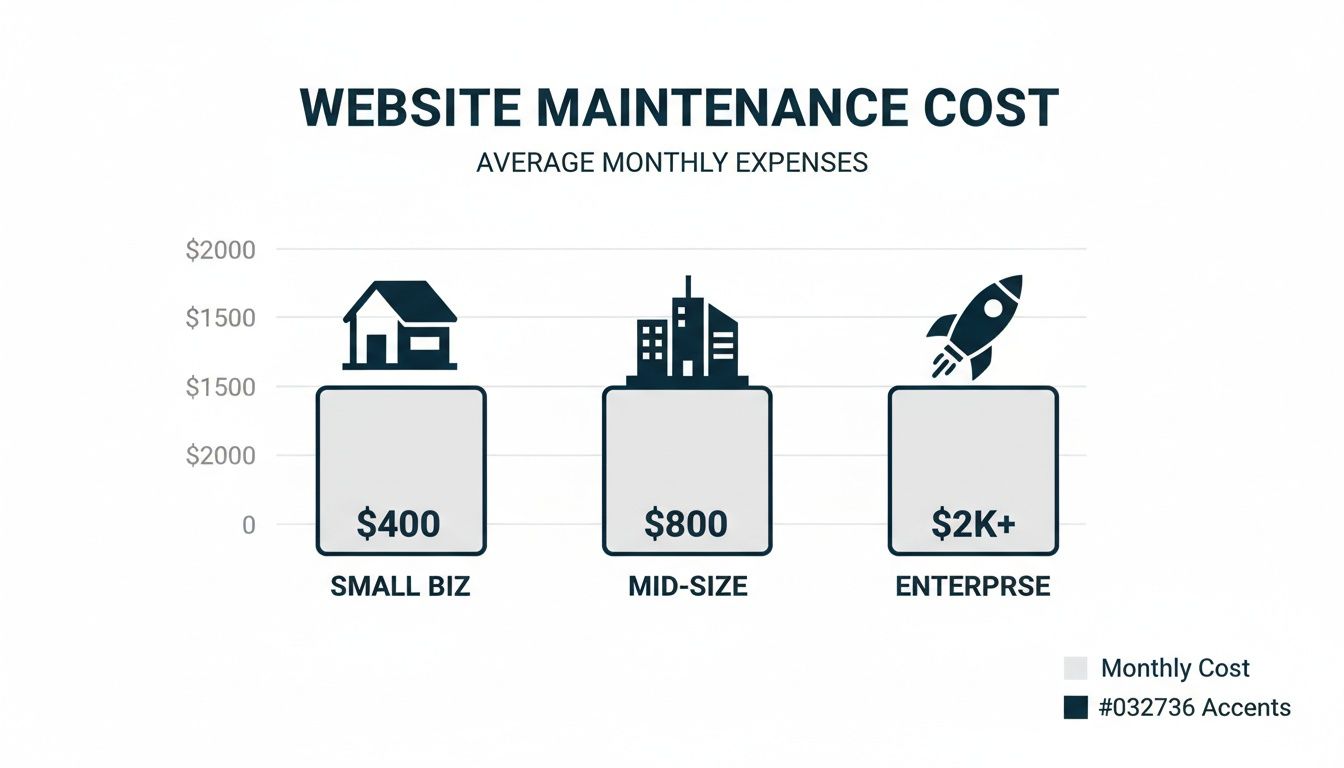
The chart makes it pretty clear: as your business scales, so do the technical demands. For a more detailed look, this is a great breakdown of IT support and maintenance services.
Our own website maintenance and support services are designed to handle these exact needs, proactively.
Breaking Down What You're Actually Paying For
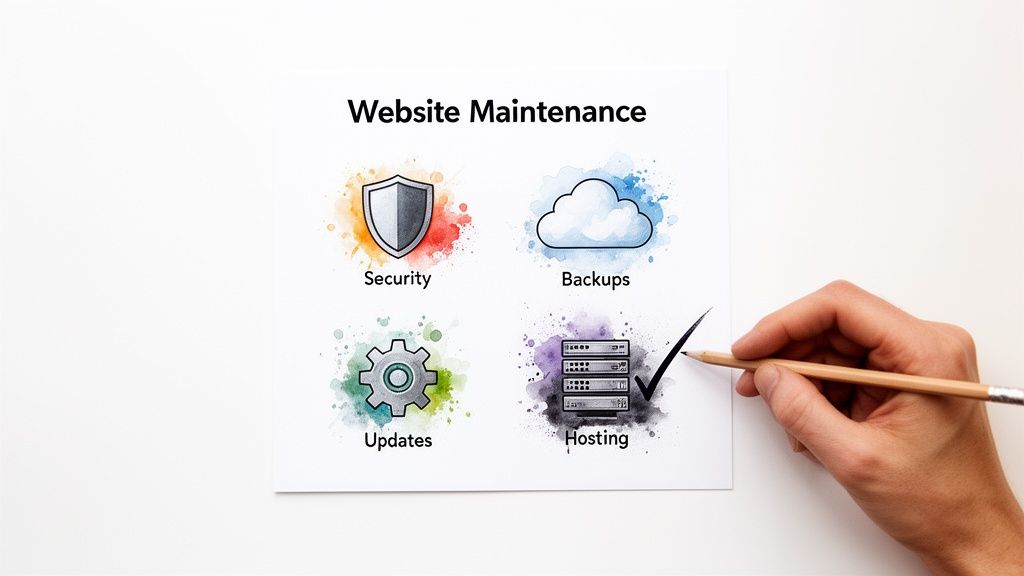
So, what exactly are you paying for? It’s not some vague charge for us to poke your website with a stick. It’s an active, ongoing process that keeps your corner of the internet secure and humming along smoothly.
A good maintenance plan is your oil change, tire rotation, and engine diagnostic all rolled into one predictable cost. Without it, you’re just waiting for a breakdown.
The Core Technical Checklist
These are the non-negotiables. If your current provider isn't handling these, we need to talk.
-
Hosting and Domain Management: This is the digital real estate where your website lives. We make sure the rent is paid and your address doesn't get sold by mistake. If you’re fuzzy on the details, we put together a guide explaining what website hosting really is.
-
Security Monitoring & Malware Scanning: We're the digital bouncers, actively watching for and blocking suspicious activity 24/7. This isn't a once-a-month task; it's constant.
-
Regular Backups: Your "get out of jail free" card. If something goes catastrophically wrong, we can restore a clean version of your site in a snap.
Software Updates and Performance Tuning
Now we get into the more technical side. Most WordPress sites are a complex stack of software, themes, and plugins. They all need to play nicely together.
When a client from Dallas calls us saying their site "just broke for no reason," 99% of the time, the culprit is an out-of-date plugin clashing with a recent WordPress update. It’s a totally preventable headache.
Our team, especially our code perfectionist Anjo, doesn't just hit "update all" and pray. That's a recipe for disaster. We test every update on a staging server first to make sure nothing breaks, which prevents downtime on your live site. This process also includes performance tuning, because a slow website is a useless website.
The Hidden Costs of DIY Website Maintenance

I get it. When you’re just starting out, the temptation to handle website maintenance yourself is huge. It feels like a simple way to save a few hundred bucks a month.
But here’s a hard truth we’ve learned since 2004: DIY maintenance often costs you more in lost opportunity than you save in actual dollars.
It’s the classic "penny wise, pound foolish" situation. The real cost isn't the subscription for a security plugin. It's the three hours you torched on a Tuesday morning trying to figure out why your contact form stopped working. Three hours you should have spent talking to a new client.
The True Price of Going It Alone
When you’re the chief cook and bottle-washer for your website, you’re on the hook for everything. The hidden costs pile up fast.
- Your Time: Every hour you spend troubleshooting is an hour you’re not making money.
- Lost Customers: When your site goes down and you’re scrambling to figure out why, you are actively losing customers.
- Security Disasters: A security breach can be catastrophic. We're talking data loss, a trashed reputation, and even getting blacklisted by Google. Cleaning up that kind of mess costs thousands.
My dad, Butch, compares it to doing your own plumbing. Sure, you might fix a leaky faucet. You could also flood the entire kitchen and end up calling a professional anyway. Only now the job is ten times more expensive.
When DIY Becomes a Liability
We once got a frantic call from a business owner near Fredericksburg whose site had been hacked. He’d been managing it himself to save money. The hackers had been in his system for months, quietly redirecting his traffic to spammy sites. It took days to scrub everything clean, and he lost weeks of valuable leads.
His "savings" ended up costing him a small fortune. A solid plan, like the ones we've built into our website maintenance checklist, is designed to prevent these exact disasters.
Finding the Right Maintenance Plan for Your Business
We're not a one-size-fits-all shop. A nonprofit in San Antonio has wildly different needs than a tech startup in Austin, and our approach reflects that.
Ever since we started back in 2004, Butch has insisted on finding the right tool for the job. It’s why our services aren’t a single-item menu. It's also why I created our BEGO program. It’s for small businesses that need a professional website with predictable costs and unlimited updates. No surprise invoices, no technical headaches. Just a rock-solid site that gets the job done, looked after by Amy, our client happiness guru.
When You Need More Horsepower
But what happens when your business is too complex for a template? That’s where Butch and our lead developer, Anjo, step in with custom web development. They build sophisticated web apps and complex sites from the ground up. It’s the perfect answer for companies with unique needs, from Fort Worth to our home base here in Richmond.
We believe the platform should serve the business, not the other way around. If you’re fighting your website’s limitations more than growing your company, something is wrong.
This isn't a niche problem. A huge chunk of the global website maintenance market is right here in North America. Businesses rely on their sites to generate real revenue. For a deeper dive, check out how the global maintenance services market is growing on dataintelo.com.
Embracing the Builders and Beyond
We're also big fans of the builders. Blake, our go-to for rapid deployments, can get a fantastic Wix website launched in no time. For more design-forward brands in places like Marfa or Wimberley, Landon works his magic on Squarespace websites.
The point is, we support them all. This approach is part of a larger tech strategy, much like the support that managed IT services for small businesses provide for a company's entire infrastructure.
Our goal is simple: make sure every client gets the exact support they need. It’s about being smart, strategic, and useful. You can learn more in our guide to small business website management.
Moving Beyond Maintenance to Actual Growth

Keeping your website secure and online is just table stakes. It’s the digital equivalent of making sure your shop’s front door locks. But nobody gets rich just by keeping the lights on. The real magic starts when your website becomes a tool that actually grows your business.
This is where the conversation pivots from upkeep to a genuine growth partnership. For us at Bruce & Eddy, that next step is almost always Search Engine Optimization (SEO). Why? Because a technically perfect website that nobody can find is just an expensive digital paperweight.
Turning Your Website Into a Lead Magnet
SEO isn’t an add-on; it’s the engine that transforms your site from a passive brochure into an active, lead-generating machine. It’s how potential customers in Houston, Dallas, or even out in Glen Rose find you the moment they’re searching for exactly what you do.
We weave SEO into our long-term client relationships:
- Initial SEO Audits: We start by looking under the hood to see what’s working, what isn’t, and where the biggest opportunities are hiding.
- Ongoing Strategy: This isn't a one-and-done deal. We map out a continuous plan of content and technical fixes to build your authority over time.
- Content That Works: We help you create blog posts and service pages that answer the specific questions your customers are typing into Google.
A great website answers a customer's questions before they even have to ask. A great SEO strategy makes sure your site is the first one they find.
This is how we shift the discussion beyond the average website maintenance cost and start talking about return on investment. When your website starts pulling in new leads from places like Sugar Land and San Antonio, that maintenance fee doesn't just feel worth it. It feels like a bargain.
Common Questions About Website Maintenance Costs

Alright, let's tackle the questions probably bouncing around in your head. After doing this since 2004 (well, for Butch and the crew, I joined later), we’ve heard it all.
Here are the straight-up, no-fluff answers.
What Is a Reasonable Hourly Rate for Web Support?
For a legitimate, professional web developer in the U.S., you should expect to pay between $75 to $200 per hour. The rate depends on what you’re asking for.
Simple content updates? That’ll be on the lower end. Need emergency surgery to fix a crashed e-commerce site or custom code from a specialist like Anjo? That’s going to be on the higher end. You’re paying for expertise.
If someone from Butch’s hometown of Midlothian quotes you $20 an hour for "expert development," you should run. Fast. You’re not getting a bargain; you’re buying a future headache.
Are There Hidden Costs I Should Watch Out For?
Absolutely. The biggest red flags are the things left out of your agreement.
Be on the lookout for surprise charges like:
- Premium Plugin Licenses: They install a fancy plugin but "forget" to mention you're on the hook for the $300 annual renewal fee.
- Backup Restoration Fees: Your plan includes backups, but they ding you with a fee to actually use one.
- Scope Creep Charges: You ask for one small change and suddenly get an invoice for hours you never approved.
A good maintenance plan is crystal clear. Before you sign anything, always ask, “What happens if I need something not covered by this plan?” Their answer tells you everything.
How Often Should My Website Software Be Updated?
For core software like WordPress and critical security plugins, the answer is immediately. As soon as a security patch is released, it needs to be applied.
For less critical plugins and themes, updating weekly or bi-weekly is usually fine. But a solid maintenance plan isn't about checking in once a month. It involves constant, active monitoring.
Can I Switch Maintenance Providers Easily?
You should be able to. As long as you have full admin access to your website and your hosting account, switching providers should be straightforward.
Here’s the deal: if your current provider makes it difficult to leave or holds your logins hostage, it’s not just a red flag. It’s a five-alarm fire. Your website is your asset. You should always have the keys.
If your website feels like it’s held together with duct tape and hope, maybe it’s time for a real conversation. My family’s been helping businesses from Arlington to Bruceville-Eddy (yes, it’s a real place) since I was in high school. The team at Bruce & Eddy is here to figure out what you really need.
