

Alright, let's talk about finding an SEO agency. The whole process feels like trying to find a good mechanic. You know you need one, you've heard horror stories from friends, and you're pretty sure you're about to get taken for a ride.
I’m Cody Ewing, and I run business development here at Bruce & Eddy. My dad, Butch, started this company back in 2004, and since then, we’ve seen it all. From agencies in Dallas promising page-one rankings overnight to consultants in Austin speaking a language only a robot could love, it's a jungle out there. Most business owners just want to know how clicks turn into customers, but the industry often rewards complexity over clarity.
You don't need another confusing report. You need a partner. So, here’s a no-nonsense guide to help you find one.
The TL;DR for Busy People
- Know Your Goal: Before you talk to anyone, decide what success looks like. Is it more phone calls, online sales, or quote requests? Your answer changes everything.
- Spot the Fakers: If an agency guarantees a #1 ranking or talks about their "secret sauce," run for the hills. Real SEO is hard work, not magic.
- Look for a Partner, Not a Vendor: You need a team that acts like an extension of your own. They should learn your business, speak your language, and be genuinely invested in your growth.
- SEO Takes Time: Anyone promising instant results is selling you a fantasy. Real, sustainable growth takes 6-12 months. Patience isn't just a virtue; it's a strategy.
- Don't Chase the Lowest Price: Cheap SEO is expensive in the long run. It almost always involves cutting corners and using sketchy tactics that can get your site penalized.
First, Figure Out What You Actually Need
Before you even think about interviewing an SEO agency, you need to have an honest chat with yourself. What does “success” actually look like for your business? I’ve seen folks from Fort Worth to Fredericksburg get tangled up in vanity metrics like “more traffic” without ever asking what that traffic is supposed to do.
My dad, Butch, has a simple framework he uses. He asks clients to forget about keywords for a second and just finish this sentence: “I’ll know our SEO is working when we get more _______.”
Is it more phone calls to your shop in Richmond? More quote requests for your B2B service in Frisco? Or is it more online sales for your store that ships nationwide? Your answer to that question dictates the entire strategy.
This helpful infographic hits on the common points of confusion business owners face when shopping for SEO, from jargon to empty promises.
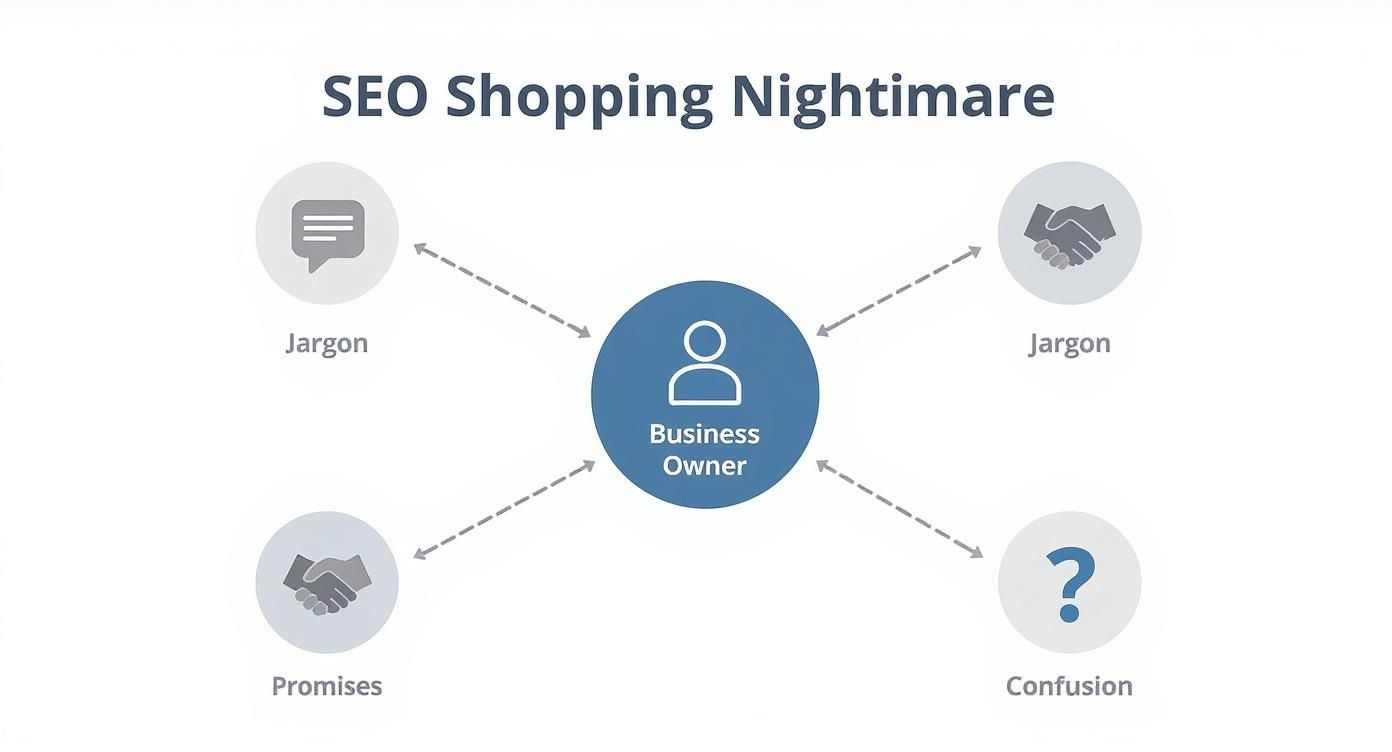
As you can see, a lack of clear goals at the start leads directly to frustration and wasted investment later on.
Tying Goals to Real-World Outcomes
Once you have your primary goal, everything else just clicks into place. You can start separating the nice-to-haves from the need-to-haves. A local bakery in Glen Rose needs local SEO. A software company in Austin needs a national content strategy. They are completely different animals.
Here’s a quick breakdown of how your goals line up with specific SEO services:
- More Foot Traffic: Your focus should be squarely on local SEO. This means optimizing your Google Business Profile, getting a steady stream of positive reviews, and showing up in those crucial "near me" searches.
- More Leads/Forms: This is a job for a smart mix of on-page SEO and content marketing. You’ll need informative blog posts and sharp service pages that answer customer questions and funnel them right to your contact form.
- More Online Sales: E-commerce SEO is its own beast. It involves deep optimization of product pages, managing technical details like site structure, and making sure the checkout process is silky smooth.
To make this crystal clear, here’s a quick guide connecting common business objectives with the specific SEO services that actually move the needle.
Matching Your Business Goal to an SEO Service
| Your Business Goal | The SEO Service You Need | What It Looks Like in Action |
|---|---|---|
| Get more customers in the door. | Local SEO | Claiming & optimizing your Google Business Profile, building local citations, and a review generation strategy. |
| Increase quote requests online. | Content Marketing & On-Page SEO | Creating in-depth service pages, writing blog posts that solve customer problems, and optimizing forms. |
| Sell more products from your website. | E-commerce & Technical SEO | Optimizing product descriptions and images, improving site navigation, and speeding up page load times. |
| Become the go-to expert in your field. | Content Strategy & Link Building | Publishing authoritative articles, case studies, and white papers, then earning backlinks from respected sites. |
This goal-setting exercise isn't just busywork. It transforms you from a passive buyer into an informed partner, ready to have a truly productive conversation. Knowing your "why" is the most important step in finding the right "who." If you want a refresher on the basics, you can check out our guide on what search engine optimization is.
Before committing to an SEO agency, it's also helpful to clearly define your overarching marketing goals. This involves looking at the bigger picture of how a partner can contribute, and for a deep dive, consider this guide on understanding the broader context of marketing consulting.
The global SEO market is projected to hit USD 127.3 billion by 2030, and a massive chunk of that—42.3%—is focused on on-page SEO. That tells you something important: foundational work like great content and a solid site structure is where the real value lies. An agency’s ability to nail these basics is absolutely non-negotiable.
Spotting Experts from Snake Oil Salesmen
The SEO industry has its share of characters. You’ve got the genuine experts who live and breathe this stuff, and then you’ve got the folks who sound like they memorized a marketing textbook from 1998. The trick is telling them apart before you sign a contract.
I’ve sat in on calls where agencies promised things that made my dad, Butch, nearly fall out of his chair. It’s wild out there. A good partner will educate you, but a salesperson will try to confuse you.

The Biggest Red Flags to Watch For
If you hear any of the following phrases, it’s time to politely end the Zoom call. These are the classic signs of someone selling you a bottle of snake oil.
- “We guarantee a #1 ranking on Google.” This is the biggest lie in the SEO world. Nobody can guarantee a specific ranking because nobody controls Google’s algorithm. It’s impossible, full stop.
- “We have a secret, proprietary method.” Real SEO isn’t a secret recipe; it’s a combination of proven strategies, hard work, and technical skill. "Secret" usually just means they don’t want to explain what they’re actually doing.
- “Trust us, the technical stuff is too complicated to explain.” A great partner, like our lead developer Anjo, can break down complex ideas into plain English. If an agency uses jargon to make you feel dumb, they aren't trying to be your partner.
The goal of a first meeting shouldn't be to impress you with buzzwords. It should be to understand your business. If they talk more about their "process" than your customers, that's a huge red flag.
Questions That Separate the Pros from the Pretenders
To arm you for your next conversation, here are a few questions that cut right through the fluff. A solid agency will have great answers; a shaky one will start tap-dancing.
- Can you show me a case study from a client similar to my business? Their experience should be relevant to your goals. Getting results for a restaurant in Katy is different from helping a B2B service in Dallas.
- How do you measure and report on success? Look for answers tied to business outcomes—leads, calls, sales—not just traffic and keyword rankings. Our client happiness lead, Amy, makes sure our reports are clear and connected to what our clients actually care about.
- What does the first 90 days of working together look like? They should have a clear onboarding process that includes a technical audit, goal alignment, and strategic planning. A vague answer means they don't have a plan.
Finding the right team means finding people who are transparent, educational, and focused on your real-world outcomes. It’s about building long-term value, not just chasing short-term tricks that can get you penalized by Google. For a deeper dive, our guide to hiring a technical SEO specialist breaks down even more of the nitty-gritty details.
Decoding the Modern SEO Proposal
Alright, you’ve made it through the first round of calls. Now for the fun part: your inbox is suddenly flooded with PDFs, each one promising you the moon. This is the moment you separate the real pros from the copy-and-paste crowd. A good proposal isn't just a price sheet; it's a strategic blueprint built just for you.
When we send a proposal to a business, whether they're in Katy or Arlington, it’s never a template. It's the direct result of us listening to what you actually need. A generic proposal is a massive red flag—it means they didn’t hear a thing you said and are just trying to cram you into their standard package.
What to Look for in a Winning Proposal
A proposal should leave you feeling understood and confident, not scratching your head. It should read like a clear map showing you how to get from where you are now to where you want to be. If it's loaded with jargon and vague promises, it's not a roadmap; it’s a treasure map with no 'X' to mark the spot.
Here’s what every solid proposal needs to have:
- A Clear Audit of Your Current Situation: They need to show they've done their homework. This means at least a quick analysis of your website’s current SEO health, who your main competitors are, and where your biggest opportunities lie.
- A Detailed Outline of the Strategy: This is the heart of the document. It must cover the three main pillars of SEO: on-page, off-page, and technical. What content will they create? What’s their plan for building your site's authority? A great proposal will even explain the importance of off-page SEO services and how that work contributes to your overall visibility.
- Specific, Tangible Deliverables: What are you actually getting for your money? The proposal should list clear action items, like "four optimized blog posts per month" or "a complete technical site audit in the first 30 days."
- Transparent Pricing Structure: No hidden fees, no confusing tiers. It should be totally clear what you’re paying for and why.
Understanding the Different Pricing Models
You'll probably run into a few different ways agencies structure their fees. None of them are inherently bad, but you absolutely need to understand what you’re signing up for.
A great proposal should feel less like a sales pitch and more like the first chapter of a long-term partnership. It should be customized, clear, and focused on your business goals.
The average monthly SEO budget for small to midsize businesses lands somewhere between $1,500 and $5,000, so proposals in this ballpark are pretty standard. It's also interesting to see that budgets often lean heavily toward content creation and link-building, which makes perfect sense—that’s where the long-term value really gets built. You can find more details in this breakdown of SEO market statistics.
Here’s a quick rundown of the most common models you’ll see:
- Monthly Retainer: This is the go-to model for ongoing SEO. You pay a fixed fee each month for a clearly defined set of services. It works great for building a long-term strategy and a strong, collaborative partnership.
- Project-Based Fee: This is for one-off jobs, like a website migration or a massive technical audit. You pay a single flat fee for a specific, time-bound project with a clear end date.
- Hourly Rates: Some consultants work by the hour. This can be useful for very specific tasks or quick consultations, but it can get expensive and unpredictable fast if you're trying to run a full-scale SEO campaign.
In the end, the proposal you choose should feel like a handshake, not a handcuff. It should be a clear, honest document that sets the stage for a partnership that gets you real results.
The Money Talk and Justifying the Investment
Alright, let's talk about the elephant in the room: the price tag. SEO isn't just another line item expense like office coffee; it's a serious investment in a core business asset that can pay dividends for years to come.
A lot of folks get sticker shock, but you have to think of it like this: good SEO is like building a custom home. You want a solid foundation laid by experts, not a cheap shortcut that’ll crumble in the first big storm.
Chasing the lowest price is almost always a huge mistake. Low-cost agencies have to cut corners somewhere, and it's usually with sketchy tactics that can get your site penalized by Google. Fixing that mess will cost you far more than just doing it right the first time. It’s the digital equivalent of hiring the cheapest contractor only to find out they used glue instead of nails.
Framing the SEO Investment
Any agency worth its salt will tell you straight up: this isn't an overnight fix. If someone promises you instant, top-of-page-one results, they're selling you a fantasy. Real, sustainable growth takes patience and a solid strategy.
We’re always upfront with our clients and tell them to expect a 6 to 12 month runway before they see a significant return. Those first few months are all about laying the groundwork—technical fixes, deep research, and strategic content. The real magic starts to happen after that foundation is firmly in place.
So, how do you sell this to your team or the higher-ups? You frame it as exactly what it is: a long-term growth strategy. You’re not just "buying keywords." You're building genuine brand authority, generating a steady stream of qualified leads, and creating a sales channel that works for you 24/7. To get this right, you really need to understand how to measure content marketing ROI.
The Numbers Don't Lie
There's a reason the internet marketing consultant market in the US is a massive industry, projected to be worth $119.4 billion. It's because when it's done right, it works.
Consider this:
- Organic leads from SEO have an average conversion rate of 14.6%.
- That blows traditional marketing's 1.7% conversion rate out of the water.
- This is why 70% of marketers say SEO drives more sales than even pay-per-click ads.
You can dig into more of these SEO market insights yourself. When you partner with the right team, SEO becomes a powerful, incredibly efficient engine for business growth.
Finding a True Partner, Not Just a Vendor
When all is said and done, picking an SEO agency isn't just about buying a service; you're kicking off a relationship. The proposals are in, the numbers seem fine, but that final decision often boils down to a gut check.
You're looking for an extension of your own team. From my experience, the best SEO results always come from true partnerships—the kind where the agency is just as invested in your success as you are. It’s way more about genuine collaboration than just getting a monthly report.

The People Behind the Proposal
So, what does a real partnership actually feel like? For starters, it means finding people you genuinely enjoy talking to.
Think about these simple questions as you make your choice:
- Do they communicate clearly? Or do you hang up every call feeling more confused than when you started?
- Do they get your brand’s voice? Can they represent your business in a way that feels authentic to you and, more importantly, to your customers?
- Are they proactive? A great partner brings new ideas to the table. They don’t just sit back and wait for you to ask what’s next.
At Bruce & Eddy, our client happiness expert, Amy, makes sure communication is always open and friendly. We don't see ourselves as just another vendor. We're long-term partners for businesses all over Texas, from our home base near Midlothian to clients in Sugar Land, Arlington, and beyond.
The big question you have to ask yourself is this: ‘Do I trust these people with my business?’ If the answer isn’t a resounding ‘yes,’ you should probably keep looking. No amount of technical skill can make up for a lack of trust.
We’re in it for the long haul, handling everything from hosting and maintenance to ongoing strategy. It’s just how we’ve done things since 2004. Your business deserves a team that’s ready to grow right alongside you.
Answering Your Lingering SEO Questions
Even after the proposals are in and you've shaken a few hands, some questions always seem to stick around. We get it. Here are the big ones we hear from business owners in Katy, Sugar Land, and Arlington who are trying to figure this all out.
How Long Does It Really Take to See SEO Results?
Honestly, anyone who gives you a hard date is either guessing or pulling your leg. It just doesn't work that way.
In most cases, you can expect to see some initial movement—positive signals that things are heading in the right direction—within 3 to 6 months. Think of this as the foundation settling. The real, business-impacting results, the kind that make you want to high-five your team, often take 6 to 12 months to really kick in.
SEO is a long game. It builds momentum over time, and how fast you see results depends on how competitive your industry is, your website's current health, and the consistency of the effort.
What's the Difference Between Local and National SEO?
This is a fantastic question because it gets right to the core of your business goals. The strategy changes completely depending on the answer.
- Local SEO is all about getting found by customers in a specific geographic area. Think "best tacos in Bastrop" or "plumber near me" when you're in Richmond. This approach leans heavily on your Google Business Profile, local reviews, and showing up on the map.
- National SEO targets a much broader audience without any geographic limits. This is for businesses selling products or services across the country. The focus shifts to more general, high-competition keywords that aren't tied to a location.
For many Texas businesses, the right approach is actually a blend of both. It really just depends on where your customers are.
You absolutely can do SEO yourself! The real question isn't about ability; it's about time, expertise, and opportunity cost. SEO is a full-time job that requires constant learning just to keep up with algorithm changes.
Hiring an agency brings specialized tools, years of hands-on experience, and a dedicated team to the table. This frees you up to focus on what you do best: running your business. It's a trade-off. We can help you figure out which path makes sense and teach you how to track SEO performance so you always know what’s working, no matter who’s doing it.
If your website feels like it’s held together with duct tape and hope, maybe it’s time to talk. Bruce and Eddy has been building serious results (while keeping things human) since 2004. Let's see what we can build together.
