

99.58% of featured snippets come from pages already ranking in Google's top 10 results. That makes snippet optimization an improvement to strong SEO, not a shortcut around it. The practical formula is simple: earn relevance first, then format the answer so Google can extract it cleanly.
A featured snippet is the answer box Google places above or alongside traditional organic results for some queries. Google introduced the feature in January 2014 as a way to answer questions directly on the results page, and later explained that snippets are selected from pages it considers most helpful for the query. The history matters because a snippet isn't a decorative badge you can force onto a weak page. It's a quality signal layered onto existing visibility.
Why Rankings Come Before Snippets
The first question in how to optimize for featured snippets isn't “Which heading should I use?” It's “Does this page already deserve to be on page one?”
A large-scale study cited by Shno's featured snippet statistics found that 99.58% of featured snippets came from pages ranking in organic positions 1 through 10. That leaves very little room for the popular fantasy that a buried page can leap from page eleven to the answer box because someone added a neat paragraph and a few bold phrases.
Google's own explanation is consistent with that pattern. It selects snippets from pages that provide the most helpful answer for a query, which means relevance, clarity, and overall page quality come before extraction-friendly formatting.
Practical rule: Treat snippet work as a second pass on a page that already has search potential.
The ranking gate
If your page ranks outside the top 10, fix the larger SEO problem first. That might mean improving topical coverage, resolving search intent mismatches, strengthening internal links, updating stale information, or addressing technical issues that make the page difficult to crawl and use.
If the page already ranks on page one, the work becomes more focused. You can identify the exact question it nearly answers, compare the current result format, and rewrite the relevant section so both readers and search engines can understand the answer immediately.
This is why getting named and ranking isn't the same. A page can appear in search results without earning the strongest available visibility for the query. A featured snippet may improve prominence, but it doesn't replace the fundamentals that got the page into consideration.
What formatting can and can't do
Formatting helps Google locate and interpret an answer. It can clarify relationships between a question and its response, separate steps in a process, or make comparison data legible. It can't compensate for an answer that's inaccurate, incomplete, aimed at the wrong intent, or attached to a page that has no meaningful organic traction.
That gives you a sensible order of operations:
- Validate the query: Confirm that the search has a clear informational intent and fits your business.
- Improve the page: Make the content more useful than the current result, not merely more decorated.
- Reach page one: Build the relevance and authority needed to enter the snippet candidate pool.
- Format the answer: Match the response to the paragraph, list, or table format Google appears to prefer.
- Measure the result: Check whether visibility brings the right visitors, not just more impressions.
The ranking step is the gate. The formatting step is the invitation.
Finding the Right Query Opportunities
You don't need to optimize every question your audience could ask. Start with queries that connect a real search need to a real business outcome.
Look for question-based searches involving what, why, how, when, where, and which. Then narrow the list to pages that already rank between positions 4 and 10. Those pages have demonstrated enough relevance to deserve attention, while still having room to move.

Use a prioritization pass
Start with Google Search Console. Filter the Performance report by queries that contain question words, then review the pages receiving impressions for those searches. Export the candidates and add a few practical fields:
- Business fit: Does the query relate to a service, product, audience, or problem you support?
- Current position: Is the page already on page one, or does it need broader SEO work first?
- Intent match: Does the page answer the question directly, or does it wander into a neighboring topic?
- SERP format: Does Google show a paragraph, list, table, or no featured snippet for the query?
- Conversion path: After getting the answer, would the reader reasonably need your service, tool, explanation, or next step?
Prioritize pages where the answer is valuable and the business connection is natural. A random definition may earn visibility but attract visitors who have no reason to continue. That's not a victory. It's just a very well-organized detour.
Push relevance before extraction
A study summarized by Ranktracker's featured snippet data found that pages outside page one win snippets only about 0.4% of the time, while positions 1 through 3 capture over 90% of snippets and position 1 alone captures roughly 30% to 35%. The exact percentages aren't a planning guarantee, but the strategic direction is clear: move the page upward before spending hours polishing the answer box.
For an existing article, compare the current top results against your page. Note the questions they answer, the formats they use, the depth they provide, and the assumptions they make. A focused content gap analysis can reveal whether your problem is missing information or poor presentation.
When a query serves contractors or other specialized operators, broader guidance on AI engine optimization for contractors can also help you think beyond one result type and organize content around the questions buyers ask across search systems.
Structuring Content for Answer Extraction
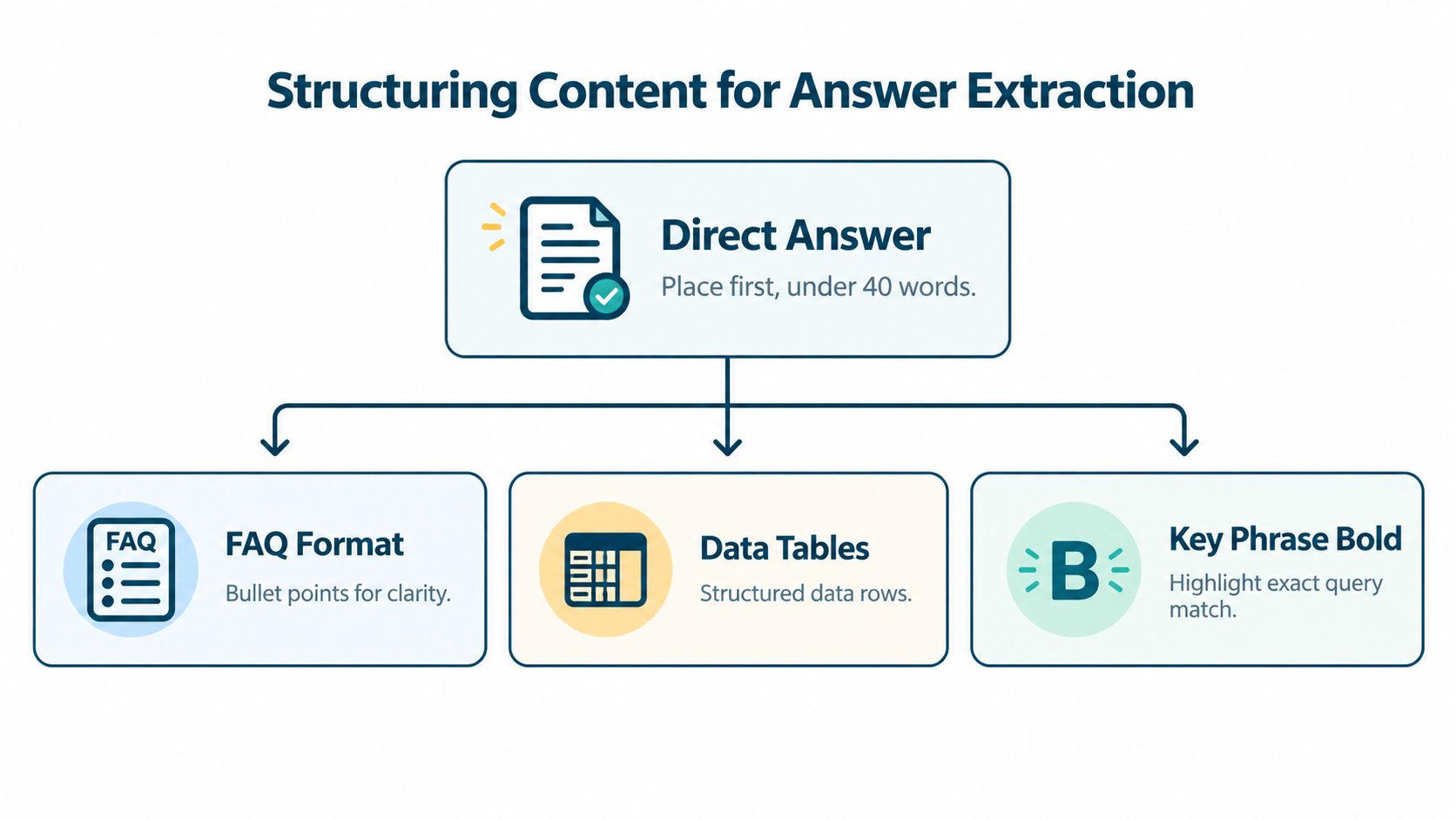
Once a page has a credible chance to compete, make the answer easy to find. Put a question-style heading close to the response, then answer that question immediately instead of burying the useful sentence under a warm-up paragraph.
For paragraph snippets, a practical target is 40 to 60 words, with the first sentence delivering the answer. This range appears repeatedly in industry guidance, including Webtonic's featured snippet recommendations. It isn't a character limit or a promise from Google. It's a useful editing constraint.
Put the answer before the explanation
A clean pattern looks like this:
What is a featured snippet?
A featured snippet is an extracted answer that Google displays prominently in search results to respond to a query. Google selects the text from a page it considers helpful and relevant, so concise formatting improves extractability but doesn't replace the need for accurate, useful content.
The paragraph gives the direct answer. The following text can explain how the feature works, what the reader should do, and where the limitations sit. This structure serves impatient readers without reducing the rest of the page to a one-sentence vending machine.
Use simple HTML elements: headings, paragraphs, ordered lists, unordered lists, and genuine tables. Avoid hiding the answer inside a visual component that search engines or assistive technologies may struggle to interpret. Structured data can clarify certain page elements, but it isn't a special featured-snippet switch. The surrounding visible content still has to do the work. See this practical guide to structured data for SEO before adding markup just because it sounds technical.
Keep the page useful after the extraction point
A snippet-friendly answer should stand on its own, but it shouldn't be the entire editorial strategy. Follow the short response with qualifications, examples, implementation details, and related questions that matter to the visitor.
Avoid these common failures:
- Verbose openings: Don't make readers excavate the answer from three paragraphs of scene-setting.
- Fragmented responses: Don't scatter one definition across several unrelated sections.
- Forced keywords: Don't make the sentence sound like it was assembled by a committee of search terms.
- Decorative formatting: Don't add a table or list when prose is clearer.
- Thin pages: Don't create a short answer that leaves the reader with no useful next step.
For a visual explanation of answer extraction and search presentation, this embedded video provides another format for reviewing the mechanics.
The best answer block is short because the question is narrow, not because the page has been starved of substance.
Matching Format to Intent
A paragraph isn't automatically the right answer just because it's easy to write. Google commonly displays paragraph, list, and table snippets, and each format suits a different kind of intent.
Paragraphs work well for definitions, explanations, and direct responses. Lists fit processes, grouped items, and ranked or ordered information. Tables help when the searcher needs to compare attributes across multiple options.
One large analysis found paragraphs made up about 70% of snippets, lists about 19%, and tables about 6.3%. The same analysis reported paragraph snippets averaging roughly 42 words, list snippets averaging about 6 items, and table snippets averaging roughly 5 rows and 2 columns. Those findings are summarized by Search Engine Journal's data-backed snippet analysis.
Choose the response shape first
| Snippet Format | Best For | Ideal Length |
|---|---|---|
| Paragraph | Definitions and direct explanations | Roughly 40 to 60 words |
| Ordered list | Processes, instructions, and sequences | About 6 items |
| Unordered list | Grouped recommendations or features | About 6 items |
| Table | Comparisons, specifications, and prices | About 5 rows and 2 columns |
For a process query such as “how do I secure a WordPress website,” use an ordered list with clear steps. For “best website features for a nonprofit,” an unordered list may be more natural. For “which hosting option fits a small business,” a table can expose the differences without forcing the reader through a paragraph maze.
The markup matters. Use real HTML lists rather than lines that only look like bullets because they contain symbols. Use table rows and headers for comparison data. A human should be able to scan the structure without guessing how the pieces relate.
Don't confuse eligibility with usefulness
List snippets are often truncated. One source states that Google typically shows five to eight items before adding a “More items” link, while another recommendation favors lists of around eight to ten items because truncation can still preserve visibility. The practical lesson is not to pad a list. It's to put the strongest and most representative items first. These mechanics are detailed in SEO Handbook's guide to featured snippet lists.
The larger challenge is that a snippet can answer the query so completely that the visitor has no reason to click. That trade-off becomes more important as Google gives AI-generated summaries more room in the results page. Optimize the format, but protect the reason to visit.
Navigating the AI Overview Era
Featured snippets still matter, but they no longer operate in a quiet search page where one answer box gets all the attention. Recent industry coverage from Search Engine Land's featured snippet guide describes featured snippets as still present while their visibility declines as AI Overviews occupy more SERP space.
That changes the target. You're no longer optimizing only for extraction. You're optimizing for extraction plus continued usefulness.
Build a two-layer answer
The first layer should answer the narrow question clearly. The second should explain something the summary can't easily replace, such as implementation choices, edge cases, risks, examples, or a decision framework.
A page about website migrations, for example, shouldn't stop at a definition of a redirect. It should help the reader decide which pages to map, how to verify the change, what to monitor, and when a technical review is sensible. The short answer earns eligibility. The practical detail earns attention.
A useful workflow looks like this:
- Record the current SERP: Save the query, result type, competitors, and whether an AI Overview appears.
- Review the answer block: Identify the exact sentence or list Google could extract from your page.
- Add click-worthy depth: Include specific context, limitations, examples, or actions that aren't redundant with the short answer.
- Check the conversion path: Make sure the next step fits the query. A reader asking for a definition may need education before a sales invitation.
- Recheck the experience: Review the result on desktop and mobile. A page can be technically eligible and still feel unhelpful.
For teams planning content beyond traditional results, this guide to generative search optimization for growth offers useful context. The same principle applies here: write content that can be summarized accurately without making the full page disposable.
You can also apply the broader framework in how to optimize content for AI search engines. Keep claims specific, make important entities and relationships clear, and give readers a reason to continue after the first answer.
Google also gives publishers ways to limit or block snippet use through max-snippet, nosnippet, and data-nosnippet, as described in its featured snippet documentation. That matters when an extracted answer could satisfy the query while hiding a valuable qualification or weakening a conversion path. Visibility is useful, but not every impression deserves to become a complete answer.
Testing and Measuring Results
Publishing the rewrite is the start of the experiment, not the end. Use Google Search Console to establish what changed for the target query and landing page, then evaluate the result in the context of your business.
Start with the Performance report. Filter by the page and query group, then record impressions, clicks, click-through rate, and average position before the update. Don't judge the work from one metric. A page may gain visibility while attracting fewer clicks because the search result answers more of the question before the visitor reaches your site.
Use a repeatable review cycle
A practical maintenance process has four parts:
- Check query movement: Look for changes in the target question and closely related searches.
- Inspect the live result: Search the query and note whether Google uses a paragraph, list, table, or another result feature.
- Review visitor quality: Check analytics for engagement, useful page paths, form activity, or other actions that fit the page's purpose.
- Update the source content: Refresh the answer when the underlying product, process, recommendation, or regulation changes.
Avoid declaring success because a page appeared once. Search results change, competitors revise their pages, and Google can select a different passage from the same URL. A durable process compares visibility with meaningful engagement over time.
Know when to change course
If the page ranks well but doesn't win the snippet, inspect the competing format first. You may be answering with a paragraph where users need steps, or using a list where the query calls for a comparison. If the page earns a snippet but attracts poor-fit visitors, revisit the query and consider whether limiting the extracted text would protect the page's purpose.
The strongest workflow connects ranking improvement, answer design, format selection, and business measurement. None of those parts works reliably in isolation. A beautifully formatted answer on a weak page won't get considered, and a high-ranking page with a buried answer may lose the extraction opportunity to a clearer competitor.
Start with one page already close to page one, one question with clear business relevance, and one format that matches the intent. Make the answer direct, preserve the depth behind it, then watch both search visibility and visitor behavior before expanding the process.
Bruce & Eddy can help evaluate the pages, technical structure, analytics, and search opportunities that support featured snippet work through practical website development and SEO services. Visit Bruce and Eddy to discuss a focused improvement plan for your site.
