

Ranking in AI Overviews comes down to strong organic rankings, technically clean pages, and distinctive first-party evidence that AI systems can cite without guessing. An Ahrefs analysis found that 76.1% of cited pages ranked in Google's top 10, but 14.4% ranked outside the visible top 100, so position matters without guaranteeing inclusion.
The popular advice says to add more FAQs, sprinkle in structured data, and chase position one. That's incomplete. A citation can increase visibility while reducing clicks, and a page can rank well yet offer nothing distinctive enough for Google to cite. The practical question isn't just how to rank in AI Overviews. It's whether appearing there helps a real business, nonprofit, church, or startup earn trust, qualified inquiries, and useful attention.
Why AI Overview Citations Are Not the Same as Traffic Wins
An AI Overview citation looks like a search win because Google has selected your page to support an answer. But visibility and traffic are separate outcomes. When a summary answers the user's question on the results page, the user may have less reason to visit the cited page.
A Pew Research Center analysis examined browsing activity from more than 900 U.S. adults in March 2025. It covered 68,879 Google searches, including 12,593 searches that produced an AI-generated summary. Users clicked a standard result or a link in the summary on 8% of searches with an AI summary, compared with 15% when no summary appeared. Direct clicks on links inside the summary occurred on only 1% of visits to pages containing one.
Practical rule: Treat a citation as an exposure signal first, and a traffic signal only after your own conversion data supports that interpretation.
That changes the investment decision. An informational guide may lose visits because the Overview provides a sufficient answer. A local service page may still benefit if the citation builds credibility and prompts a later branded search, phone call, or contact form submission. A nonprofit or church may gain recognition even when the immediate visit doesn't happen.
This is why getting named and ranking isn't the same deserves attention before any optimization project. Track citation visibility, branded searches, qualified leads, assisted conversions, and traffic by query intent, not just impressions or average position.
For a broader practical perspective, ranking in AI Overviews in 2026 can help teams compare current advice. Use it as context, not as a substitute for query-level measurement. Your Search Console data, analytics setup, and CRM outcomes should decide whether a citation is commercially useful.
What Organic Rankings Actually Predict About AI Overview Inclusion
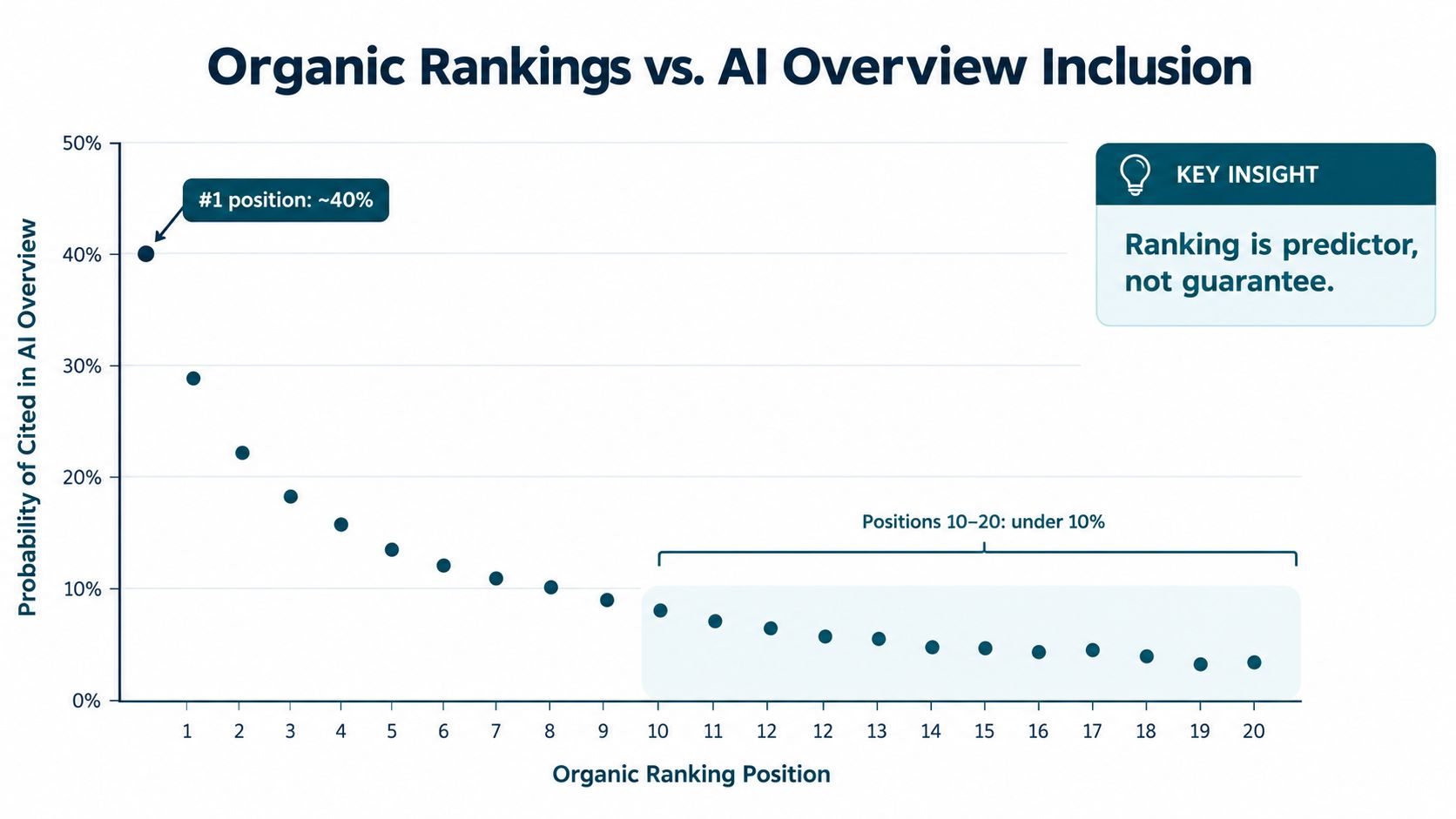
Organic ranking remains the clearest probability lever available, but it isn't a permission slip. An Ahrefs analysis of 1.9 million AI Overview citations found that 76.1% of cited pages ranked in Google's top 10, while 9.5% ranked positions 11 through 100 and 14.4% didn't rank in the visible top 100. The median organic position of cited URLs was 3.
That tells us two things. Pages that compete strongly in ordinary search are more likely to be cited, and position one isn't required. A page below the first page can still earn inclusion when it provides unusually relevant or useful material.
A practical six-part workflow
Choose credible queries. Start with questions your organization can answer through first-hand experience. A web developer can explain implementation constraints. A church can explain its actual accessibility or event-registration process. A startup can document how its product works.
Compete for conventional rankings. Align the page with intent, improve the answer, add original evidence, strengthen internal links, and reference authoritative material. Don't optimize an irrelevant page just because it already exists.
Make passages self-contained. Lead sections with concise answers, then add definitions, steps, examples, and qualifications. Google hasn't promised that a particular passage length or wording triggers inclusion, so clarity matters more than formatting superstition.
Show who stands behind the information. Include authorship, relevant experience, contact details, dates, and methodology where appropriate. Anonymous claims are harder for readers and systems to evaluate.
Test query variations. Compare branded and nonbranded searches across relevant locations and devices. Search intent can change sharply with small wording differences.
Record more than position. Track organic position, impressions, citation appearance, branded searches, and assisted conversions by query. A ranking report alone can't tell you whether the visibility is helping.
A featured snippet and an AI Overview aren't identical, but the discipline behind what is a featured snippet remains useful. Clear answers and strong page structure help users first. They may also make content easier for search systems to interpret.
Technical Foundations Google Actually Requires for AI Search Features
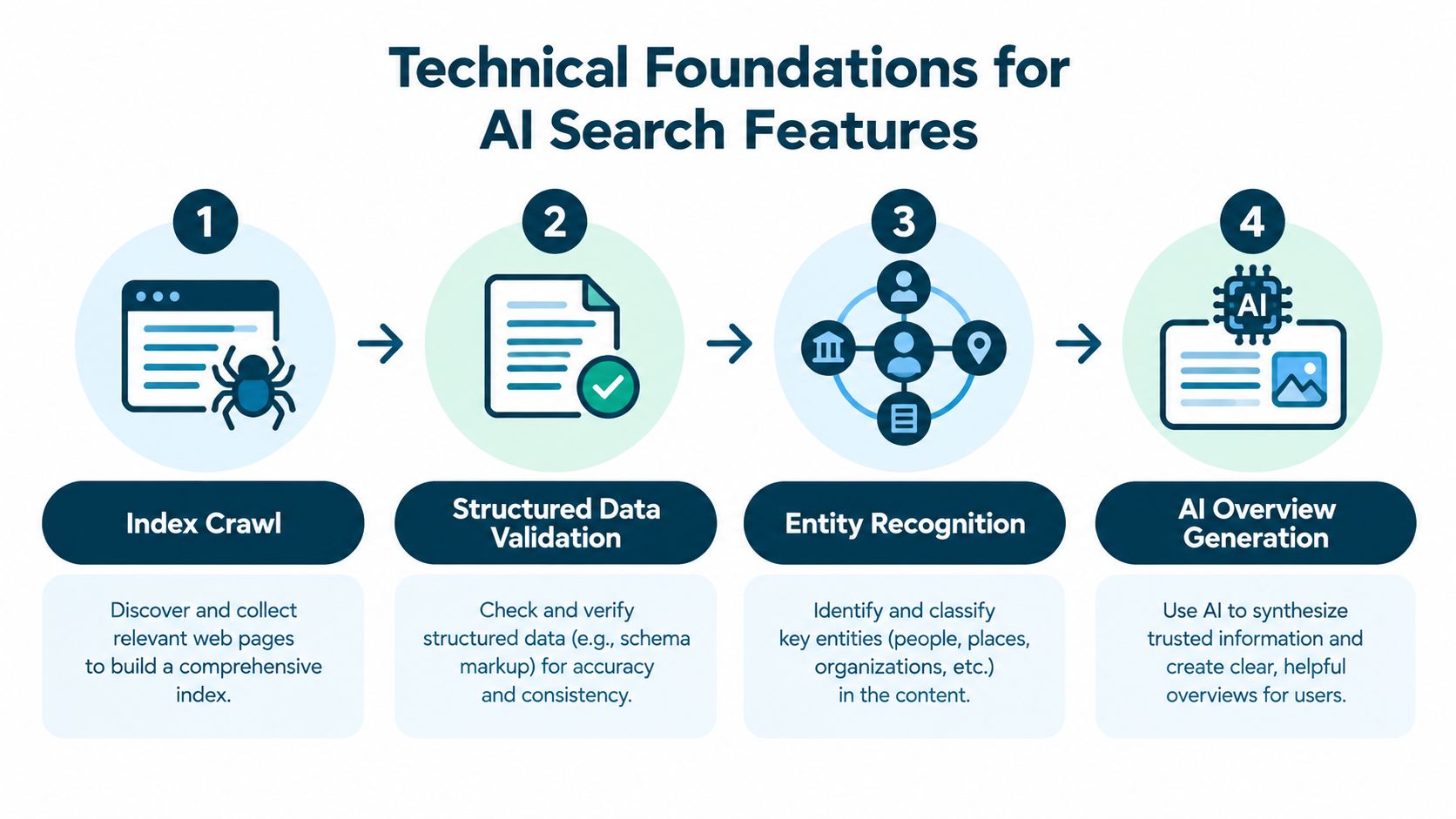
Google's documented baseline is refreshingly ordinary. AI Overviews use the same underlying Search index as regular results and don't require special AI schema markup. Your page still needs to be accessible to Googlebot, return an HTTP 200 success status, and provide indexable content, as explained in Google's guidance on succeeding in AI search.
That eliminates a popular distraction. There's no proprietary “AI Overview tag” that guarantees a citation. Buying or generating one more markup format won't repair a blocked page, weak internal linking, or vague content.
Fix the foundation before polishing the copy
Use this sequence during an audit:
- Check access. Review robots.txt rules, indexability, HTTP responses, canonical signals, rendering, and internal links.
- Map intent to pages. Give each important query a dedicated page or a clearly defined section. Don't make one service page answer every unrelated question.
- Answer early. Put a direct response near the beginning, then support it with definitions, process details, evidence, examples, and relevant entities.
- Validate structured data. Add conventional schema only when it accurately describes visible page content and qualifies for an ordinary search feature.
- Monitor both systems. Compare organic rankings with citation inclusion by query instead of assuming one predicts the other perfectly.
Structured data can help search systems understand a page and may support eligibility for certain features, but the marked-up information should also be visible on the page. It needs to follow Google's guidelines and should be validated.
Content quality matters here, too. Tools focused on removing probabilistic AI signals from text don't solve the central problem if the page contains no original knowledge. Rewriting surface patterns is not the same as adding experience, evidence, or a reason to trust the author.
A technical audit paired with how to optimize content for AI search engines gives teams a better starting point than chasing speculative markup. Clean infrastructure gets the page considered. Useful, specific content gives it something worth citing.
Content Differentiation Factors That Make Pages Citation-Worthy
Ranking well gets a page into the conversation. Distinctive information gives Google a reason to select it when several pages make similar claims.
Available evidence shows the relationship isn't as simple as “position one wins.” A reported analysis found that 76% of AI Overview citations came from pages ranking in Google's top 10, while the median cited URL ranked third. Seer Interactive's analysis of more than 3,100 queries from June 2024 through September 2025 reported a 61% organic CTR decline for queries with AI Overviews, while pages cited in the Overview received 35% higher organic CTR than non-cited pages. These figures come from a summary of AI visibility statistics, and they describe observed patterns, not Google guarantees.
Run the citation-worthiness test
Look at your target page beside several competing results. Then ask:
- Does it contain first-party evidence? Include observations, original data, implementation details, or documented decisions your organization can substantiate.
- Can a reader identify the answer quickly? Use clear answer blocks, but don't stop at a two-sentence fragment. Explain the conditions, limitations, and next steps.
- Are entities consistent? Use the same organization names, service descriptions, locations, authors, and product terminology across relevant pages.
- Does experience appear in the details? Accessibility choices, maintenance considerations, security practices, integration constraints, and operational trade-offs are difficult to fake convincingly.
- Are facts current and attributable? Show dates, authorship, methodology, and references where they improve confidence.
- Does the page resolve follow-up questions? Map the subquestions users need answered instead of adding an interchangeable FAQ section at the bottom.
FAQ blocks can help when they answer real questions. They become decorative when every page repeats the same generic entries. A service page that explains how a decision affects maintenance, accessibility, security, or implementation is usually more useful than one padded with questions nobody asks.
The same principle applies to featured snippet optimization. Format the answer so people can understand it, then provide enough evidence and context to make the page worth visiting. Citation systems need concise material, but businesses need content with substance.
Measuring Success the Way Business Owners Actually Need To
A visibility report can look better while the business performs worse. That's the operational paradox most AI Overview advice skips.
Start with a baseline at the query level, not a single website-wide average. Group searches by the action they represent, then decide what a useful outcome looks like for each group.
| Query group | What a citation may do | Metrics to watch |
|---|---|---|
| Local service | Build trust before a contact action | Branded searches, calls, qualified leads, assisted conversions |
| Technical how-to | Answer the question without a visit | Citation visibility, qualified visits, resource downloads |
| Comparison | Influence consideration before a later search | Branded demand, returning users, contact actions |
| Direct navigation | Confirm an entity or organization | Brand impressions, direct visits, conversions |
For local businesses, churches, and nonprofits, a citation may support a later branded search or contact action. For an informational publisher, losing the visit may matter more because the page's value depends on the reader consuming the full explanation. Neither outcome should be assumed in advance.
A small dashboard beats a giant report
Record citation visibility, organic position, impressions, branded search activity, qualified leads, assisted conversions, and traffic loss by intent. Annotate when AI Overview exposure changes in your Search Console data, then compare conversion rates rather than treating click-through rate as the only score.
A useful decision rule looks like this:
- Optimize for citation when the query is high intent and trust influences a later action, such as requesting a service, donating, attending an event, or starting a conversation.
- Create a reason to click when the answer can be summarized without delivering the page's main value. Add an original tool, localized evidence, downloadable resource, transparent implementation detail, or another asset that the summary can't replace.
- Investigate before changing content when impressions rise but leads, branded searches, and assisted conversions stay flat. More visibility may only mean more exposure to low-intent searches.
A rank tracker can help organize position and SERP feature observations, but it won't know whether a citation produced a qualified inquiry. Connect search data to analytics and your CRM before declaring victory.
Testing Cadence and Action Checklist for Ongoing Optimization
AI Overview coverage changes, so a page that appears today may not appear for the same query later. A Semrush analysis found coverage at 6.49% of tracked keywords in January 2025, rising to 24.61% in July and falling to 15.69% by November, as reported in its AI Overviews study. Search Engine Land reported the same broad movement, with coverage peaking at just under 25% in July before falling below 16% in November.
Separately, a Pew Research Center study cited by Fortune found that approximately 18% of Google searches in March 2025 produced an AI summary, or roughly one in five searches. These figures describe different measurement sets, so don't force them into one universal rate. They do support the same operational conclusion: query coverage moves.
Use a repeatable review cycle
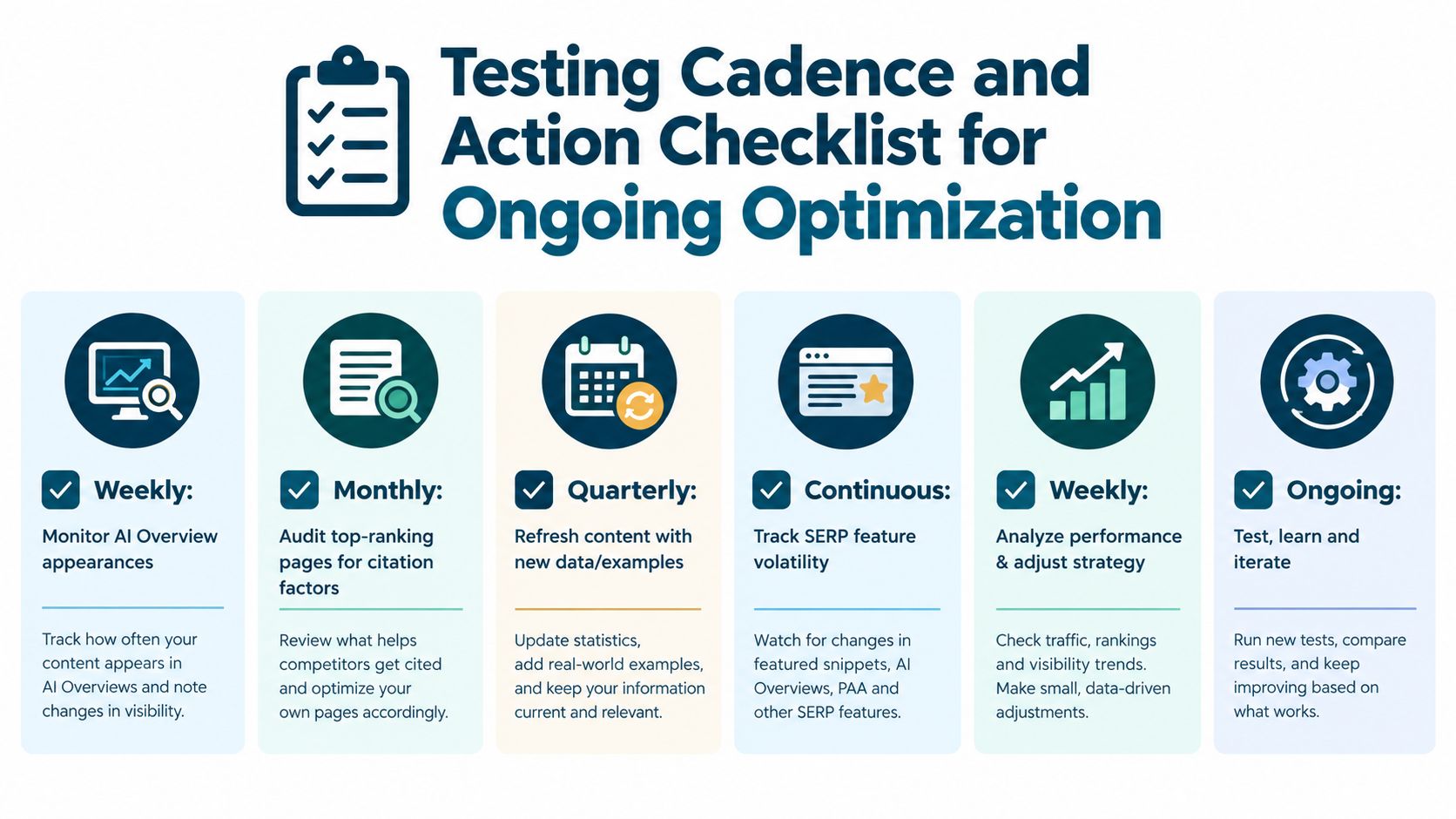
Weekly, review priority queries and record whether an AI Overview appears, whether your page is cited, and whether the organic result changed. Don't treat one manual search as a trend.
Monthly, audit pages that rank well but aren't cited. Compare their answer clarity, first-party evidence, authorship, internal links, page accessibility, and coverage of follow-up questions against cited competitors.
Quarterly, refresh stale dates, broken links, outdated service details, and thin answers. Add original examples or implementation constraints where competing pages only generalize. Remove mass-produced content that adds no distinct value.
Continuously, watch SERP volatility across devices and relevant locations. Segment branded, nonbranded, local service, technical, nonprofit, church, and comparison queries so changing coverage doesn't blur the diagnosis.
Google introduced the experience as the Search Generative Experience in May 2023, began testing AI-generated summaries in ordinary search results in March 2024, and officially launched AI Overviews in the United States on May 14, 2024. It expanded internationally during 2024 and 2025, including additional markets and languages, and upgraded U.S. AI Overviews with Gemini 2.0 in March 2025 for more complex queries, including coding, advanced mathematics, and some multimodal searches. This history, documented in the AI Overviews overview, is a reminder that the feature is still subject to changing coverage and behavior.
The durable approach is straightforward: keep pages crawlable, accurate, useful, and specific. Build authority around real customer questions before optimizing for a particular search feature. AI Overview optimization isn't a shortcut around SEO. It's the part of SEO that becomes visible when Google has to decide which pages can support an answer.
Bruce & Eddy can help connect the technical foundation with the content and measurement work, including website rebuilds, custom development, managed hosting, maintenance, SEO, and analytics. If you want to determine whether your pages are earning useful visibility or merely collecting impressions, visit Bruce and Eddy to start a practical conversation.
