

A mobile app development company plans, designs, builds, tests, launches, and maintains software for phones. Annual maintenance is commonly estimated at 15–20% of the original development budget, so the decision isn't only what it costs to launch, but whether you can support the product afterward.
You may be looking at an app because your website answers basic questions, but it doesn't make repeat interactions easy. Customers still open a browser, search for the right page, remember a password, or abandon the process halfway through. A church may want better event and donation access, a nonprofit may need a volunteer experience, and a startup may need a product that can't be reduced to a few responsive web pages.
That doesn't automatically mean an app is the right answer. A mobile app adds another product to plan, secure, update, test, and support. The right mobile app development company should help you decide whether a native app, cross-platform app, or mobile-optimized web experience fits the job, then stay accountable after the launch announcement has faded.
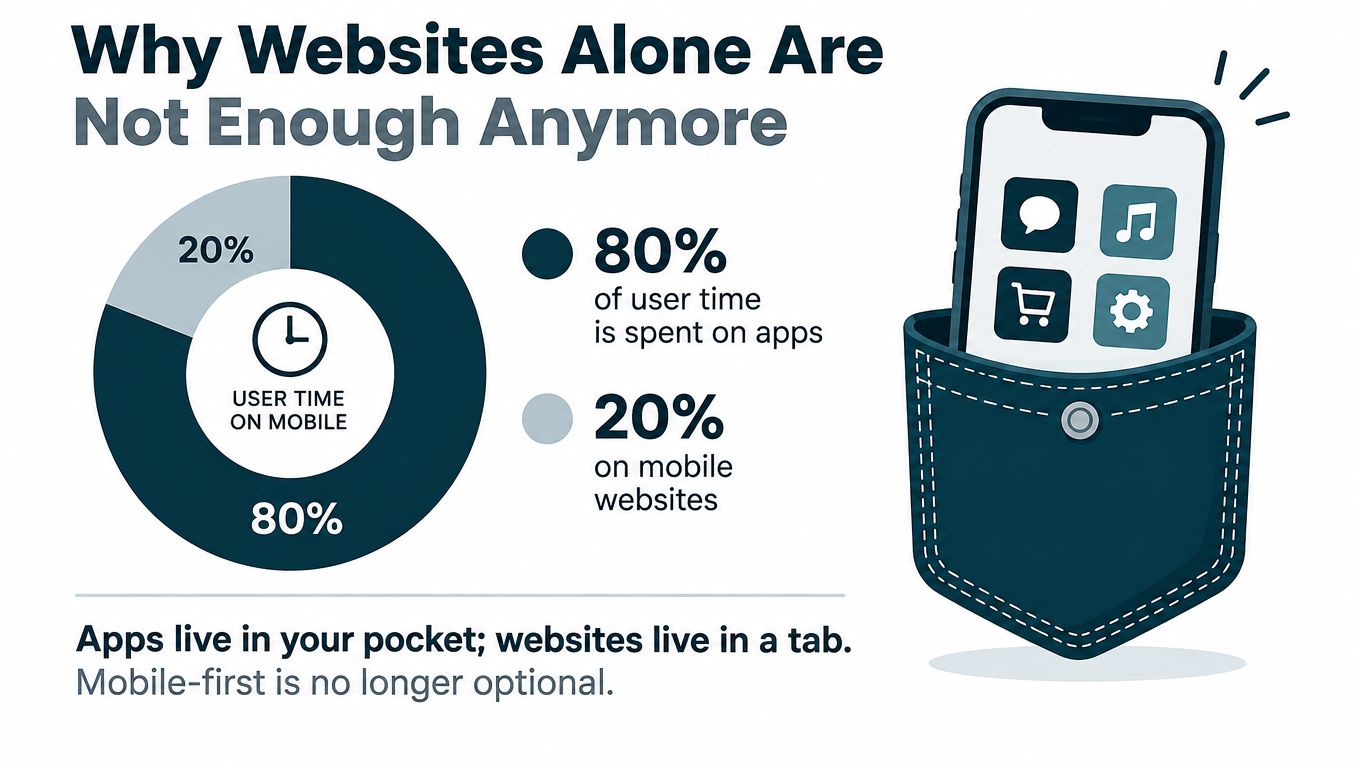
Why Websites Alone Are Not Enough Anymore
Most organizations begin with a website because it gives people a central place to find information. That's sensible. A website is easier to share, easier to update for broad audiences, and often the right tool for publishing content or collecting inquiries.
The trouble starts when the experience depends on frequent, authenticated, or personalized actions. A browser can display an account area, but an app can support a more direct relationship with notifications, device features, saved preferences, offline behavior, or a faster repeat workflow. Those advantages matter only when they serve a real user need. An app that merely repeats the website with a smaller screen is an expensive shortcut to disappointment.
The shift from information to interaction
A dedicated app becomes more defensible when people return for a task rather than a one-time visit. That might include checking an order, managing a membership, receiving relevant updates, recording field activity, accessing a customer portal, or using a service that relies on a camera, location, or other device capability.
The installed smartphone base helps explain why apps became a major distribution channel. A research document on mobile applications reported approximately 2.5 billion smartphone users, about 33% of the global population, while Google Play reportedly reached 48 billion cumulative downloads by May 2013 and later expanded beyond 3.5 million apps and games. Those figures are documented in this research on mobile applications and global markets.
The practical lesson isn't that every organization needs an app. It's that mobile software can reach a global audience through marketplaces, while a website and an app support different behaviors.
Practical rule: Build an app when it makes a repeated, valuable action easier. Don't build one simply because your website feels ordinary.
A mobile app development company should spend early project time testing that distinction. The work includes mapping user journeys, identifying the smallest useful feature set, checking backend requirements, and deciding whether the app needs iOS, Android, or both. Good partners also ask what happens if the app fails, what data it stores, and who will maintain it when operating systems change.
Service Models and Engagement Options
The right engagement model depends on how clearly you understand the product and how much technical capacity you already have. A small business with one defined customer workflow shouldn't buy the same arrangement as a startup expecting constant product experiments or a nonprofit building a system around multiple stakeholders.
Fixed-scope delivery
A fixed-scope project works best when the requirements are unusually clear. The team agrees on features, platforms, deliverables, and acceptance criteria before development begins. This can make budgeting easier for a small organization, especially when the project has a narrow purpose such as a member directory or internal field tool.
The trade-off is rigidity. If user testing reveals that the workflow doesn't make sense, a fixed contract may treat the necessary correction as a change request. A proposal that appears precise can become expensive when the product itself is still being discovered.
Discovery and prototype first
A discovery engagement separates product decisions from full implementation. The team might produce user flows, wireframes, technical recommendations, a prioritized backlog, and a clickable prototype. This costs less commitment than jumping directly into a full build, while giving stakeholders something concrete to review.
It makes particular sense for founders, nonprofits with several decision-makers, and organizations unsure whether an app should be native, cross-platform, or web-based. The important question is whether the discovery deliverables will guide development or just create attractive screens that nobody can build economically.
Dedicated or extended team
A startup or larger nonprofit may need a continuing product team rather than a one-time vendor. This model can include design, engineering, quality assurance, project management, and technical support that expand or contract as priorities change.
It offers flexibility, but the client must provide product direction and make decisions promptly. Without a clear owner, a larger team can produce more activity without producing a better product. If you're considering external staffing alongside an agency, resources covering sourcing, vetting and placement of remote professionals can help clarify the difference between adding individual talent and hiring a partner responsible for an outcome.
Maintenance-only support
Some organizations already have an app but lack the capacity to keep it healthy. Maintenance may include operating-system compatibility, security fixes, dependency updates, monitoring, analytics checks, accessibility adjustments, and store submissions. This is a legitimate engagement model, not an admission that the original build failed.
Ask whether the provider can access the source code, deployment accounts, documentation, analytics, and backend infrastructure. A maintenance contract without operational access is mostly a promise written on paper.
| Situation | Better starting model | Main risk |
|---|---|---|
| Clear, narrow feature | Fixed-scope build | Change requests |
| Unproven idea | Discovery and prototype | Stopping before validation |
| Ongoing product work | Dedicated or extended team | Weak product ownership |
| Existing app needing care | Maintenance support | Missing access or documentation |
The strongest proposal may combine these models. A discovery phase can lead to a defined MVP, followed by a support retainer with a separate budget for new features. That structure keeps routine care from competing with product improvements.
How to Evaluate and Vet App Developers
A polished portfolio proves that a team can present finished work. It doesn't prove that the team can operate your product six months after launch. Vetting should focus on evidence, ownership, technical judgment, and the uncomfortable details that sales presentations tend to skip.
Start with comparable proof
Ask for examples that resemble your app in workflow, risk, and integration complexity, not merely visual style. A beautiful consumer interface tells you little about account permissions, payment handling, offline states, administrative tools, or data synchronization.
Then ask who performed the work. Some agencies show projects completed by subcontractors, former employees, or a different internal division. That isn't automatically a problem, but you should know who will build and support your product.
Request a walkthrough that includes:
- A difficult workflow: Ask how the team handled failed payments, denied permissions, lost connectivity, or incomplete forms.
- The backend: Find out what services, APIs, databases, and administrative controls support the mobile interface.
- Testing evidence: Ask how the team tests across devices, operating-system versions, accessibility needs, and regression scenarios.
- Post-launch ownership: Confirm who fixes defects, handles store submissions, monitors production behavior, and responds to urgent issues.
Ask questions that expose judgment
A capable mobile app development company won't pretend every requirement is settled. Ask what they would remove from the first release, which assumptions need validation, and where native development would be preferable to a shared codebase.
Ownership terms deserve direct attention. The contract should address source code, design files, documentation, infrastructure accounts, third-party subscriptions, data, and access when the relationship ends. If a provider avoids those questions, don't let a low estimate distract you.
Communication matters just as much as code. Establish who makes decisions, how progress is demonstrated, how risks are reported, and what happens when priorities change. A weekly status email can't compensate for unclear acceptance criteria, but silence is worse.
For organizations comparing flexible talent models, Underdog.io's hiring approach offers useful context on curated matching and how it differs from just browsing a large freelancer directory. The distinction matters because adding a person isn't the same as assigning responsibility for architecture, delivery, and support.
You should also evaluate privacy and security before signing. Apple requires an accessible privacy-policy link inside the app and in App Store metadata, with disclosures covering collection, use, and consent requirements described in its App Store Review Guidelines. Google Play requires a maintained Data safety form, including for apps in closed, open, or production testing tracks, and the declaration must account for data handled by SDKs, as explained in Google Play's Data safety requirements.
If your product uses artificial intelligence, ask how data moves through models, vendors, logs, and retention systems. The guide to integrating AI into an app is a useful prompt for that conversation, especially when a feature sounds simple but introduces new data and testing obligations.
Realistic Pricing and Total Cost of Ownership
The most misleading app proposal is often the one that answers only the build question. A launch estimate can look manageable while leaving out hosting, API usage, monitoring, security work, compatibility changes, analytics, accessibility improvements, and product support.
Available 2025 estimates commonly place annual maintenance at 15–20% of the original development budget, as discussed in this breakdown of app development costs and maintenance. Treat that range as a planning signal, not a guaranteed invoice. A small app with fragile integrations may require more attention than a larger but stable product.
Separate the cost categories
Use four budget buckets before comparing proposals:
- Discovery and definition: User research, requirements, technical architecture, prototypes, project planning, and risk analysis.
- Initial delivery: Design, engineering, backend services, quality assurance, accessibility work, deployment preparation, and store submission.
- Recurring operation: Hosting, databases, API consumption, monitoring, analytics, security maintenance, support, and compliance work.
- Product change: New features, redesigns, integrations, experiments, platform expansion, and improvements based on user feedback.
The third category is where small businesses, churches, nonprofits, and startups often get caught. They can fund an MVP, but not the people and infrastructure needed to keep it useful. A product that can't receive security fixes or compatibility updates isn't inexpensive. It's borrowing from a future budget.
Apple's rules make this operational. Its guidelines state that apps must use appropriate security measures for collected user information and can face removal when they share data without consent or fail to meet applicable privacy requirements. That means security architecture, consent flows, data inventories, dependency updates, and review work belong in the ownership budget, not in a vague “later” column. The relevant Apple security and privacy requirements make the distribution risk clear.
Compare support structures honestly
A fixed monthly retainer can make recurring work predictable and may include response targets, monitoring, routine updates, and a defined amount of engineering capacity. Time-and-materials support can be more efficient when the app is quiet, but costs may arrive unpredictably during a platform change or security incident.
Ask for a written distinction between:
- Defect correction, meaning the delivered product doesn't meet its agreed behavior.
- Compatibility work, meaning a platform, device, SDK, or third-party service has changed.
- Enhancements, meaning you want new behavior or a better workflow.
- Emergency response, meaning production access or data is at immediate risk.
This guide to mobile app cost can help you frame the initial estimate, but the more useful exercise is a three-year cash-flow plan. List the one-time build separately from every recurring service, then reserve room for improvements. The cheapest initial proposal should lose its appeal if it leaves the app unsupported.
The App Project Lifecycle Explained
A dependable project moves through recognizable stages, but the stages aren't a conveyor belt. Decisions made during discovery affect design, design exposes technical questions, development reveals edge cases, and testing sends some work back for correction. That movement is normal. Pretending otherwise produces optimistic proposals and tense launches.
1. Discovery defines the actual problem
Discovery should identify users, business goals, workflows, constraints, data sources, integrations, permissions, and success criteria. The team should also decide what the first release won't include.
Scope changes are cheapest at this stage. A confusing registration flow can be redrawn before it becomes code. A risky integration can be tested before it becomes a dependency. A request for “real-time updates” can be translated into a specific technical requirement instead of remaining an impressive phrase in a sales document.
2. Design turns requirements into behavior
Design covers more than colors and screens. It establishes navigation, empty states, errors, loading behavior, permission explanations, accessibility, content, and how users recover from mistakes.
Google Play requires prominent, accessible disclosure before an app requests relevant data access or permission. Its in-app disclosure and consent guidance means permission UX belongs in the product design, not as a last-minute operating-system dialog.
3. Development connects the interface to reality
Engineers build the mobile client, backend, authentication, integrations, administrative tools, analytics, and deployment systems. They also make choices about native or cross-platform implementation. Cross-platform development can reduce duplicated work, but platform-specific features, performance needs, or specialized device behavior may justify native components.
The team should demonstrate working increments rather than waiting until the final week. Early reviews catch misunderstandings while they remain manageable.
4. Testing checks more than whether buttons work
Quality assurance should cover user workflows, interrupted connections, denied permissions, account states, data handling, performance, accessibility, security, and real devices. Store disclosures should match actual SDK behavior, including analytics, crash reporting, advertising, authentication, and payment libraries.
App-store distribution expanded rapidly. A cited industry history records Google Play milestones from 3 billion downloads in April 2011 to 48 billion in May 2013, which illustrates why marketplace submission is only one part of delivery. The broader context appears in this history of mobile apps and app-store adoption.
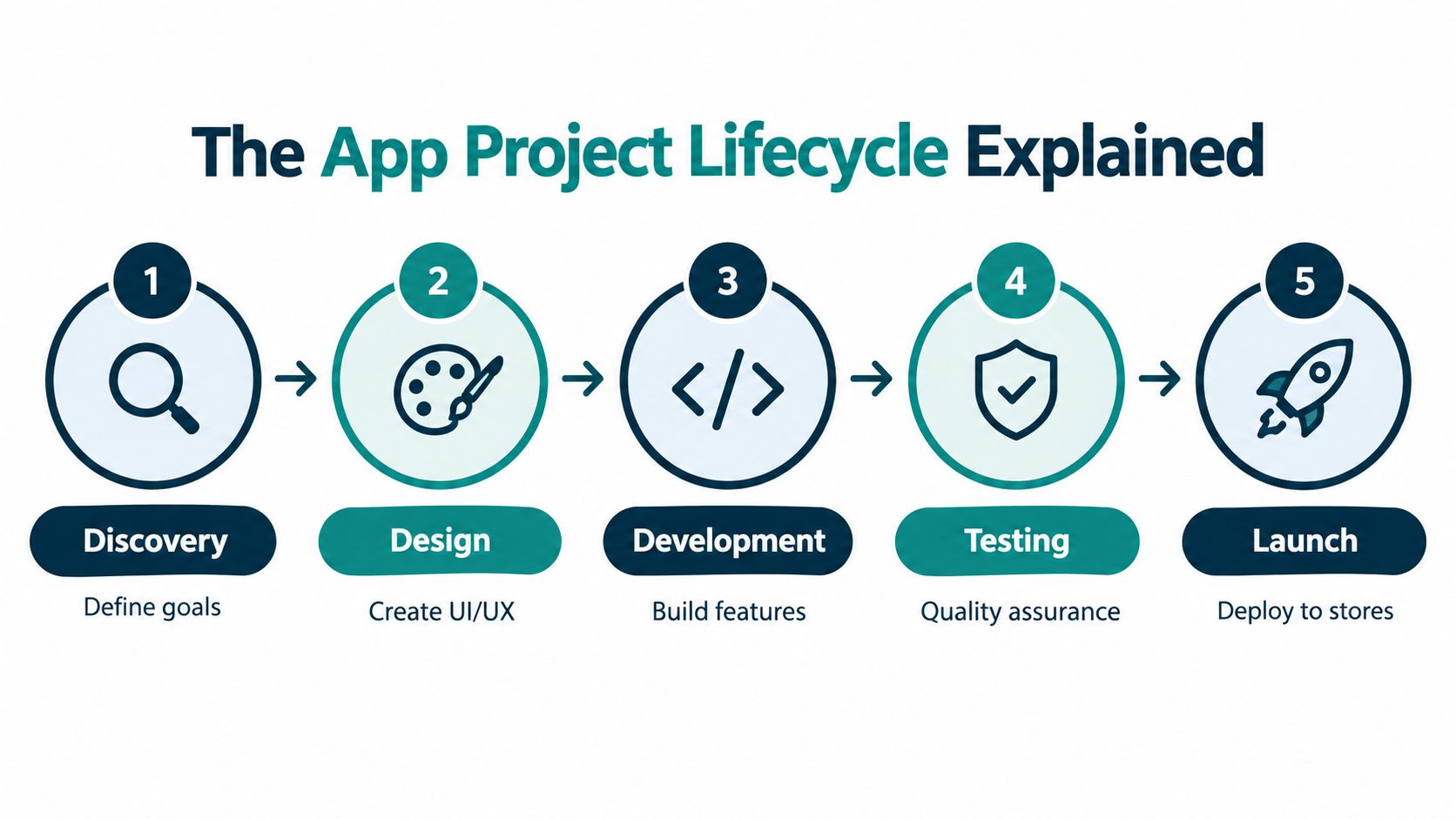
5. Launch starts operations
Before launch, confirm store accounts, privacy policies, Data safety information, monitoring, support ownership, rollback procedures, analytics, user communications, and the first maintenance cycle. The app isn't finished because it passed review. It has entered production, where real devices and real users will find the assumptions the project team missed.
This mobile app development process provides a useful reference for organizing those phases. The key planning question is simple: who owns each responsibility after release, and what budget pays for it?
Making the Right Choice for Your Organization
Choose the partner that fits your operating reality, not the partner with the most impressive vocabulary. A small business may need a focused product with a responsive support relationship. A startup may need discovery, rapid learning, and a team comfortable changing direction. A nonprofit may need careful permissions, accessible workflows, simple administration, and predictable costs more than elaborate visual effects.
Score the fit, not the sales pitch
Before comparing proposals, write down your answers to these questions:
- User behavior: What repeated task will the app improve?
- Platform choice: Does the audience require iOS, Android, both, or a browser-based experience?
- Data responsibility: What personal, financial, location, health, or usage data will the product handle?
- Internal capacity: Who will approve scope, supply content, review designs, and make launch decisions?
- Operational budget: Who will pay for hosting, support, security, analytics, and future changes?
- Exit condition: Can you retrieve code, documentation, data, accounts, and infrastructure access if the relationship ends?
Then score each provider on proof of comparable work, technical explanation, privacy process, communication, contract clarity, and post-launch support. A lower score in one category may be acceptable if you understand the trade-off. A provider that cannot explain ownership or data handling shouldn't make the shortlist.
A mobile-optimized website may still be the better choice when users visit occasionally, search visibility matters most, content changes frequently, or the app offers no meaningful device-specific benefit. An app becomes more compelling when people return often, need personalized access, depend on notifications, or use a workflow that a browser handles poorly.
For early-stage teams, mobile app development for startups offers a relevant way to think about product scope and technical support without treating an MVP as a disposable prototype. A first release should be small enough to learn from, but structured well enough to maintain.
If you're comparing distributed teams, take time to evaluate remote staffing agencies separately from evaluating a full-service development partner. Staffing can solve a capacity problem, while an agency engagement may solve a delivery and accountability problem. Those are related needs, but they aren't interchangeable.
Bruce & Eddy is a Texas-based web technology partner serving clients nationwide, with services that include custom development, integrations, hosting, security, maintenance, analytics, and selected mobile app work. If you need help deciding between an app and a stronger web experience, visit Bruce and Eddy to start a practical conversation about scope, ownership, launch readiness, and the support that comes afterward.
