

So, what are content pillars, really?
Let’s cut through the marketing-speak. Think of a content pillar as the main trunk of a huge, sturdy tree. This trunk represents a broad, essential topic that your audience genuinely cares about and that aligns perfectly with your expertise.
From this solid trunk, smaller branches (your sub-topics) and individual leaves (your specific blog posts, videos, and social media updates) begin to sprout. Everything connects back to that central theme, creating a powerful, cohesive structure that holds strong.
The Strategic Core of Your Content Plan
Adopting this model brings incredible clarity to your content plan right from the start. Instead of just throwing content at the wall and hoping something sticks, you’re intentionally building an interconnected ecosystem of information. This approach not only serves your audience better but also signals to search engines that you are a genuine authority on the subject.
The diagram below shows this in action. You can see how core pillars branch out from your main content strategy, each designed to support a specific business goal like building awareness, driving engagement, or boosting conversions.
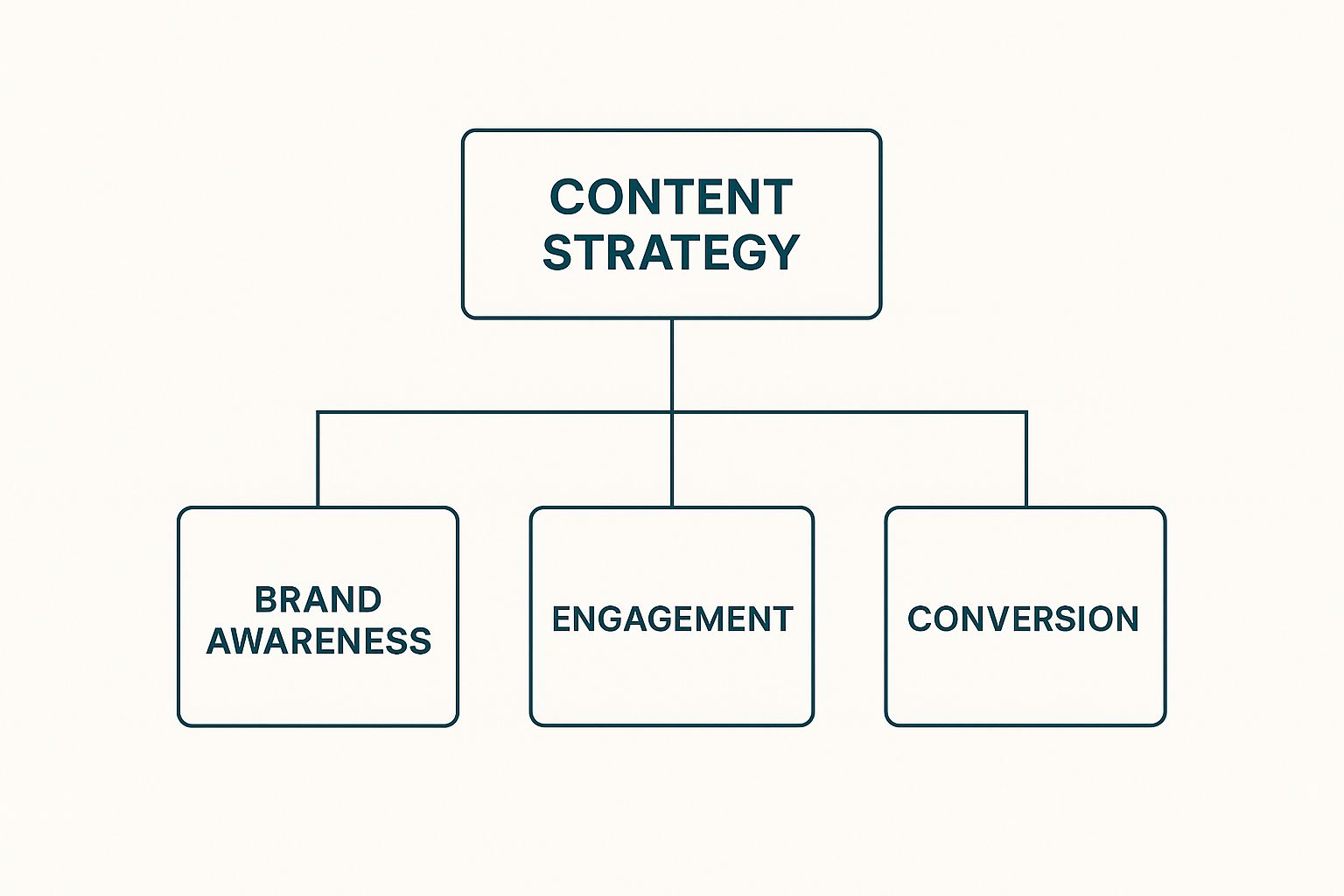
As you can see, every pillar has a strategic purpose. This ensures that every single piece of content you create is actively contributing to a larger objective.
Why They Matter Now More Than Ever
Content pillars aren't just a trendy organizational tool; they are a foundational part of any modern content strategy. The concept has moved way beyond simple thematic folders. Today, it’s a dynamic, data-driven model that’s constantly shaped by audience insights and real-time feedback.
A pillar is no longer a static category you set and forget. It's an adaptive framework that evolves with shifts in user interests and search behaviors.
This keeps your content focused, relevant, and perfectly aligned with what your audience is actively looking for. For a deeper look at how pillars fit into the bigger picture, it's worth exploring comprehensive brand strategy services. By establishing these core themes, you build a sustainable system for creating valuable content that builds authority and drives real results for years to come.
To help you visualize how this works, here’s a simple breakdown of the hierarchy.
The Content Pillar Structure at a Glance
This table shows how a broad theme is broken down into more specific, manageable pieces of content, all working together.
| Component | Definition | Example |
|---|---|---|
| Pillar Page | A comprehensive, long-form piece of content covering a broad topic from top to bottom. | "The Ultimate Guide to Digital Photography" |
| Sub-Pillars | More specific topics that branch off from the main pillar page, covering a niche aspect in detail. | "Mastering Low-Light Photography" or "Choosing the Right Camera Lens" |
| Supporting Content | Individual blog posts, videos, or social media updates that focus on one very specific keyword or question. | "5 Best Lenses for Portrait Photography" or "How to Edit Photos in Lightroom" |
As you can see, this structure creates a logical flow of information, making it easy for both users and search engines to navigate your expertise.
Why Pillars Are a Game Changer for SEO
Content pillars are way more than just a neat method for organizing your ideas—they're a serious strategy for getting seen on search engines. In the past, SEO often felt like a frantic race to rank for one keyword at a time. But search engines like Google have gotten much smarter. Today, they prioritize topical authority, which is all about proving you have deep, comprehensive knowledge on a subject.

This is exactly where the pillar model shines. When you build your content around a central pillar page and a web of related topic clusters, you’re sending a crystal-clear signal to Google that your website is the authoritative resource for that entire topic, not just a single keyword.
Building Authority and Internal Links
This structure automatically creates a powerful network of internal links. Each supporting article (a cluster piece) links back to the main pillar page, and the pillar page, in turn, links out to them. This clean, organized linking architecture nails two critical SEO tasks:
- Channels Authority: It funnels all that valuable link equity to your most important pages, beefing up their ranking potential.
- Improves Crawlability: It gives search engine crawlers a clear map to easily discover, index, and understand how all your content is thematically connected.
Basically, this strategic interlinking makes it dead simple for search engines to recognize the depth and breadth of your expertise on a topic.
The result? You don't just rank for one keyword. You start ranking for a whole family of related search queries, which massively expands your organic footprint.
This approach is absolutely foundational if you're serious about getting more eyes on your website. In fact, a solid pillar strategy is a huge part of learning how to get more traffic to my website through sustainable, long-term growth. Content pillars truly are a cornerstone of any effective SEO plan, helping your site climb the ranks and pull in more organic traffic.
If you're looking to get a better handle on the basics, you can explore this helpful guide on what is Search Engine Optimization (SEO). By proving your expertise with well-structured content, you build a stronger domain authority that pays off across all your marketing efforts.
How to Discover Your Own Core Content Pillars
Figuring out your core content pillars isn't about throwing ideas at a wall and seeing what sticks. It’s a strategic discovery process. It all starts when you shift your focus from what you want to talk about to what your audience is desperate to know. You're looking for that sweet spot where your expertise collides with their biggest problems.

This process isn't rocket science, but you do need to put on your researcher hat for a bit. Dig into the real-world challenges your ideal customers face every single day. What’s keeping them up at night? What are they typing into Google when they’re completely stuck?
Start With Audience Research
Before you even dream of looking at keywords, you have to get inside the heads of the people behind the searches. Your mission is to uncover their main pain points, their goals, and the questions they ask over and over again.
Here's where to find that gold:
- Listen to sales and support calls: These calls are a treasure trove. You'll hear the exact language customers use and the common hurdles they face.
- Scan online communities: Check out Reddit, Quora, and industry-specific forums. See what questions pop up repeatedly.
- Analyze customer feedback and surveys: What customers tell you directly often points straight to their most urgent needs.
This first step gives you a list of broad themes that you know are rooted in real-world demand. Now, you can start backing those ideas up with data.
Validate and Refine With Keyword Research
With a list of potential themes in hand, it's time to see if they have any legs online. Use a keyword research tool to check out the search volume and competition around your topics. You're looking for broad, high-level keywords that represent a whole category of interest.
For example, a marketing agency might notice their audience is constantly struggling with "lead generation," "social media strategy," and "SEO basics." These are perfect candidates for content pillars. They're evergreen topics with a ton of search interest.
The key is to find topics that are broad enough to support at least 10-20 related articles but specific enough to tie directly into what your business does. Aim for 3-5 powerful pillars to start.
Analyze Your Competitors
Finally, take a peek at what your competitors are up to. Analyze their best-performing content to see which pillars they're already winning on. But more importantly, look for the gaps. What topics are they completely ignoring or just barely scratching the surface on?
Those content gaps are your golden opportunity to swoop in and become the go-to expert. By combining deep audience understanding, solid keyword validation, and a little competitive snooping, you can confidently define the core content pillars that will anchor your entire strategy.
Building Your Content Ecosystem from the Ground Up
Once you've locked in your core pillars, the real work begins. A single pillar isn’t just one big idea; think of it as the sun at the center of its own little solar system. Every article, video, and social post you create is like a planet, orbiting that core theme and drawing its energy from it.
This interconnected network is what we call a content ecosystem. Your mission is to build out topic clusters—groups of more specific, niche subjects that branch directly off your main pillar. These clusters are where you answer the detailed, nitty-gritty questions your audience is actually asking.
Mapping Out Your Content Universe
Let's take one of your pillars, say, "Small Business SEO." That's a huge topic. To build an effective ecosystem around it, you have to break it down into smaller, digestible pieces that serve different needs and search intents.
This process is all about brainstorming the sub-topics and questions that spin off from the main idea.
- Long-form Pillar Page: This is your central sun—a massive, comprehensive guide covering "Small Business SEO" from top to bottom.
- Supporting Blog Posts: These are your orbiting planets. Think deep-dive articles on specific things like "Local SEO for Cafes" or "How to Choose SEO Keywords."
- Video Content: A tutorial walking someone through setting up a Google Business Profile or a quick short explaining a common SEO mistake is perfect.
- Social Media Content: Quick tips, infographics, or Q&A sessions that offer bite-sized value and, crucially, link back to your bigger content pieces.
Every single piece of content should purposefully link back to that central pillar page. This creates a powerful internal linking structure that search engines absolutely love. It's a structured approach that shows you know your stuff, much like learning how to create a website sitemap gives search crawlers a clear map of your expertise.
The Strategic Advantage of Ecosystems
Building your content this way is a seriously powerful strategy. Global marketing analysis shows that brands focusing their content around 3 to 5 core pillars build a much more coherent strategy. The payoff? It can improve organic traffic by up to 40% compared to just throwing content at the wall to see what sticks.
By creating a rich ecosystem, you're there for your audience at every single stage of their journey.
Your content ecosystem doesn't just answer one question. It creates a complete resource hub that establishes your brand as the definitive authority on your chosen pillar topics, turning casual visitors into loyal followers.
Content Pillar Strategies in Action
Theory is one thing, but seeing how content pillars work in the real world is when it really clicks. The best part about this framework is how flexible it is. You can mold it to fit just about any business, whether you're a global software company or the coffee shop down the street. The core idea is always the same: find the big-picture topics your audience obsesses over and build a whole universe of content around them.

Let's break down how different businesses might put this strategy into practice. For a B2B software company, a pillar could be something like "Project Management Efficiency." For a direct-to-consumer skincare brand, it might be "Holistic Skincare Routines." Each one goes straight to the heart of what their ideal customer needs and cares about.
Comparing Pillar Strategies Across Industries
To make this super tangible, check out the table below. It shows how three completely different businesses could structure their content. You'll notice the primary goal changes depending on the business type, but that fundamental structure—a main pillar supported by related cluster topics—stays the same.
Content Pillar Strategy by Industry
| Industry | Example Pillar | Example Cluster Content | Primary Goal |
|---|---|---|---|
| B2B Software | Project Management Efficiency | "Top 5 Collaboration Tools," "How to Reduce Team Burnout," "Agile vs. Waterfall" | Generate qualified leads |
| D2C Brand | Holistic Skincare Routines | "Benefits of Vitamin C Serum," "Building a Morning Routine," "Diet for Healthy Skin" | Build brand loyalty |
| Local Service | Sustainable Home Gardening | "Composting for Beginners," "Best Native Plants for a Dry Climate," "Natural Pest Control" | Attract local customers |
This structured approach isn't just for your blog; it's also a powerhouse for social media. In fact, businesses that commit to 3–5 well-defined content pillars often see up to a 30% boost in audience engagement because they're consistently hitting on the topics their followers actually want.
The whole point is to stop posting randomly and start creating a cohesive content experience that your audience can rely on. By sticking to proven content marketing best practices, you can use pillars to establish yourself as an authority, genuinely serve your audience, and get real business results, no matter what industry you're in.
Common Questions About Content Pillars
As you start mapping out your own pillar strategy, a few practical questions almost always come up. Getting these details right can be the difference between a plan that feels clear and one that’s just confusing. Let's tackle some of the most common ones so you can move forward with confidence.
How Many Pillars Should I Have?
One of the first things people ask is, "How many content pillars do I actually need?" While there isn't a single magic number, the sweet spot for most businesses is 3 to 5 pillars.
This range is broad enough to cover your core areas of expertise but narrow enough to keep your strategy from feeling scattered. Starting with fewer, stronger pillars helps you build real authority before you even think about expanding.
Pillars vs. Topic Clusters
Another point of confusion is the difference between a content pillar and a topic cluster. The easiest way to think about it is like a tree.
The content pillar is the main trunk—the big, foundational subject you want to be known for. The topic clusters are the branches that grow from that trunk. These are the specific, niche sub-topics you'll create content about.
For example:
- Pillar: "Digital Marketing for Small Businesses"
- Topic Clusters: "Local SEO," "Email Marketing," and "Social Media Advertising."
Your pillar page will cover the main topic at a high level, while your cluster content dives deep into one specific area, always linking back to that main pillar page. This structure is what helps organize your expertise and show search engines you know your stuff.
A huge part of identifying these clusters is figuring out what your audience is actually searching for. This is where solid research comes in. If you're new to this, exploring what is keyword research in SEO is a fantastic starting point for finding those valuable sub-topics.
Ultimately, your pillars are the "what" and your clusters are the "how." The pillar defines the territory you want to own, and the clusters are the individual pieces of content that prove your mastery.
Finally, remember that your content pillars aren't set in stone. It’s a really smart practice to review them at least once a year. Market trends shift, customer needs evolve, and your own business goals will change. An annual check-in makes sure your content strategy stays relevant and keeps driving results.
