

Answer engine optimization is the practice of making content easy for AI engines such as Google AI Overviews, ChatGPT, and Perplexity to retrieve, trust, and cite as a direct answer, not merely rank as a blue link. The field emerged as a distinct discipline in 2024–2025, while its foundational GEO research was first released on November 16, 2023, and later testing reported visibility improvements ranging from 22% to 41% for targeted generative-search optimizations (OpenReview foundational GEO paper, published GEO benchmark discussion).
You've probably already seen the change. Someone asks an AI tool, “What's the best website platform for a small nonprofit?” or “How much does a website rebuild involve?” The response arrives as a tidy explanation with a few cited sources. The user may never open the ten blue links that used to sit between the question and the answer.
That's the practical meaning of answer engine optimization, or AEO. You're not only trying to earn a position in search results. You're making individual passages clear, trustworthy, and extractable enough for an answer engine to use them while composing a response.
Introduction to What Answer Engine Optimization Really Means
A customer asks an AI tool, “Which website platform suits a small nonprofit?” The tool interprets the question, gathers information, compares sources, and returns a concise response that may cite only a few pages. Google AI Overviews, ChatGPT, Gemini, and Perplexity can all work this way, although their systems and sourcing behavior differ.
Traditional search leaves more comparison work to the user. It presents pages, and the user decides which ones answer the question. An answer engine performs more of that sorting before responding. For a business, the visibility challenge becomes specific: a page can be relevant and discoverable without becoming part of the answer the user sees.
AEO developed alongside generative engine optimization, or GEO, as AI search tools became mainstream. A critical survey identified the foundational GEO paper as first released on November 16, 2023, and recorded 45 studies as the field developed through July 2026 (critical survey and foundational research reference). In practice, many practitioners use AEO and GEO almost interchangeably. This guide uses AEO for the broader work of helping answer engines find, understand, and cite useful business information.
The terminology matters less than the structure of the page. AEO asks whether an answer engine can identify:
- What your business is
- Which questions your page answers
- Whether a specific claim is supported
- Where that claim came from
- Whether the passage is easy to quote accurately
Practical rule: If a human reader has to dig through a page to find the answer, an answer engine may struggle to extract it cleanly too.
For a small business, AEO usually does not require a separate “AI content channel.” A service page may need a direct answer near the top, clear names for the tools or platforms involved, relevant evidence, accessible formatting, and information architecture that keeps related details together. Schema can reinforce what the page represents, while measurement must look beyond rankings and clicks to whether the business is cited.
That work overlaps heavily with search engine optimization guidance. Good SEO helps engines discover and interpret a page. AEO adds sharper attention to passage-level clarity, citation, and answer structure. For implementation ideas, review actionable AEO strategies for businesses.
How Answer Engine Optimization Differs From Traditional SEO
A local contractor may rank for “website services” yet never appear when a customer asks, “What does a website rebuild include?” The page is discoverable, but its answer units are not clear enough for an engine to extract and cite. That gap explains the practical difference between SEO and AEO.
Traditional SEO works toward visibility in search results and qualified clicks. AEO makes the page, or a specific passage, suitable for inclusion in a generated answer. Ranking helps, but it does not guarantee citation. AEO is therefore not a separate channel for every business. Often, it is good SEO with tighter information architecture, clearer evidence, and measurement that includes citations.
AI Overviews select a limited set of sources. A study of 1,000 queries found an average of 4.2 citations per overview, with individual results ranging from 2 to 9 sources. One analysis also found that the top 1% of domains captured 47% of all citations (AI Overviews citation analysis). Treat that concentration figure as one analysis, not a universal rule. It still illustrates the selection pressure: appearing on a results page gives a business more chances than being chosen for a short generated response.
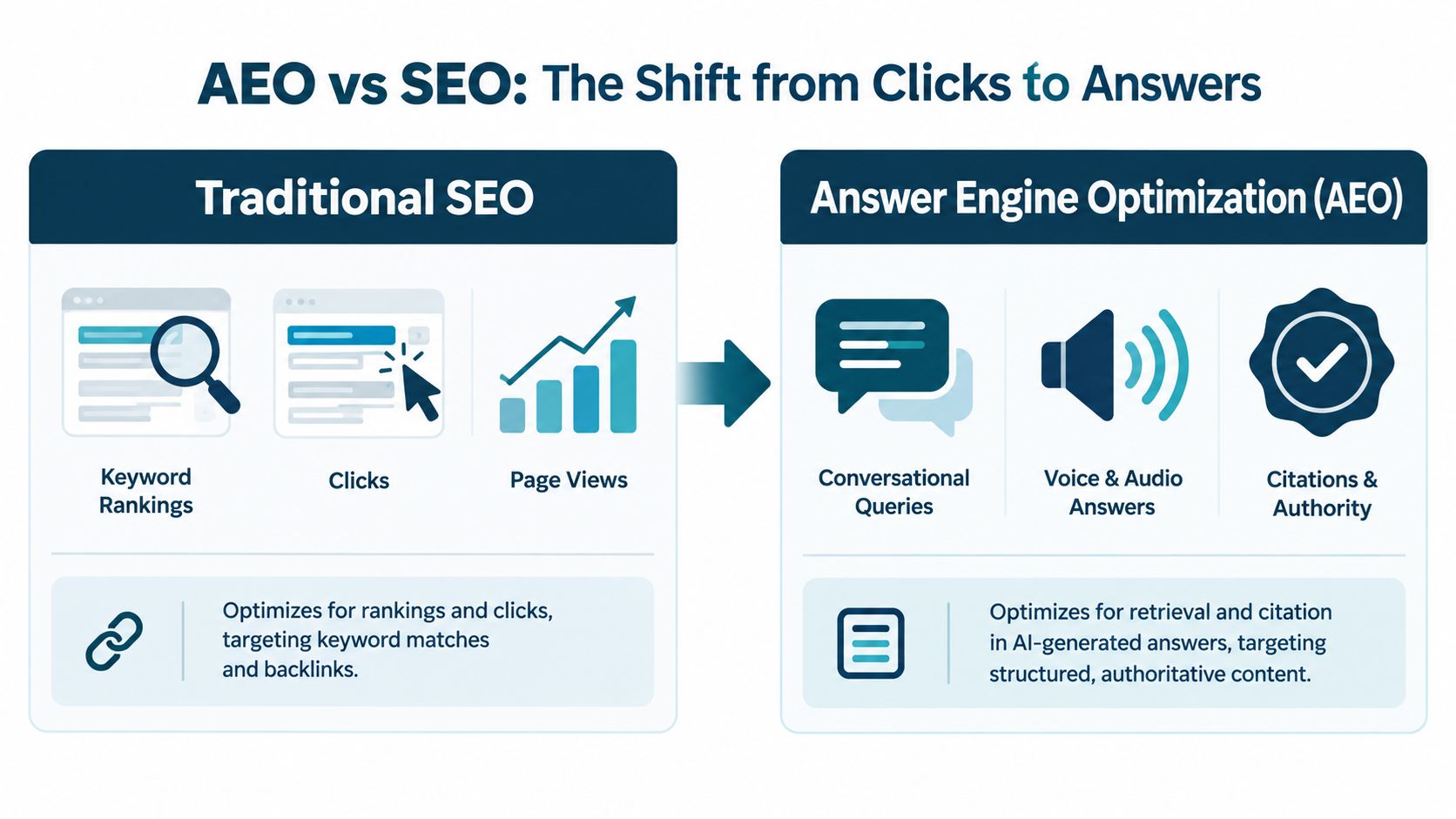
SEO vs AEO at a Glance
| Dimension | Traditional SEO | Answer Engine Optimization |
|---|---|---|
| Primary goal | Earn rankings and qualified clicks | Earn retrieval and citation in generated answers |
| Main optimization unit | The page | The passage, claim, definition, or answer unit |
| Content emphasis | Search intent, relevance, links, usability | Direct answers, evidence, structure, and attribution |
| User experience | User visits a page to research | User may receive the answer without visiting |
| Success signals | Rankings, impressions, organic traffic, conversions | Citations, mentions, answer visibility, assisted outcomes |
| Useful formats | Landing pages, guides, product pages | Self-contained sections, lists, tables, sourced explanations |
| Technical foundation | Crawlability, performance, indexing | The same foundation, plus clear hierarchy and meaningful structured data |
The overlap remains large. A well-organized service page can perform in both environments. AEO needs extra attention when content must survive retrieval and synthesis, especially if an engine must quote one claim without importing context from several unrelated paragraphs.
A page can answer “What does a website rebuild include?” in a short section, then support that answer with scope, process, and evidence. Clear headings, relevant schema, and nearby supporting details help the system understand the page's subject and the boundaries of each claim.
Featured snippets established the habit of expecting direct answers, and generated responses extend that behavior. Bruce & Eddy's guide to what a featured snippet is provides separate context on that earlier search feature.
Why Answer Engines Matter for Voice Search and Business Visibility
A customer asks, “Which local firm can rebuild our website?” and receives a spoken recommendation or an AI-generated comparison before visiting any company page. That shift makes answer engines relevant to small businesses. Voice assistants made concise responses familiar, while AI Overviews brought the same expectation to ordinary searches with business intent.
One 2026 industry compilation reported that Google AI Overviews appeared on 86.7% of business-intent searches in April 2026, compared with 56.9% in April 2025 (AI search visibility statistics compilation). Even accounting for dataset limits, that increase makes AI answers a mainstream surface for business queries.
The visibility gap
A strong ranking no longer guarantees inclusion in the generated response. An answer engine may cite a competitor because that page states the answer more clearly, supports it better, stays more current, or has stronger external references.
Source type also affects the citation pool. One 2026 dataset found that earned media supplied 84% of cited links, while paid content supplied 0.3% (AI search citation data). Brand-owned pages still matter. They need a clear factual structure, and outside coverage can give an engine more reason to treat those claims as dependable.
The business value extends beyond website sessions. A citation can help a prospect confirm your name, understand your specialty, or find your organization while comparing options. For nonprofits and service firms, that recognition may lead to a direct visit, phone call, inquiry, or donation, even when the original AI interaction produces no measurable click.
AEO is partly a traffic strategy, but it's also a trust and verification strategy.
Promotional writing does not automatically create authority. One cited measure found that roughly one in ten AI search citations came from a self-promotional listicle between December 2025 and February 2026 (AI search citation statistics). A page can still appear, but clear evidence usually gives an answer engine more useful material than chest-thumping copy.
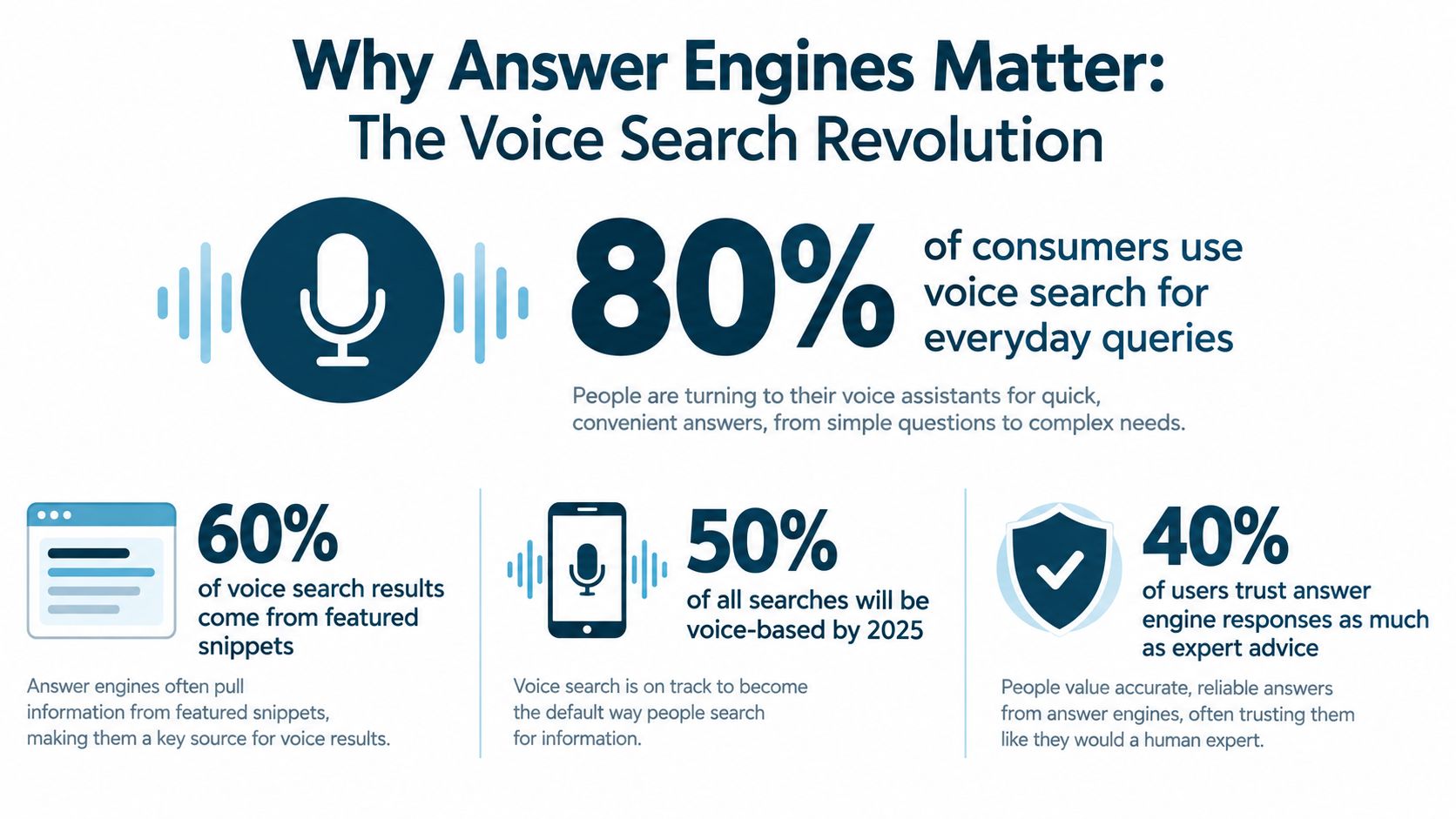
Voice and AI search overlap without being identical. Both reward concise answers and clear entity references. A voice query may need one short spoken response, while a complex AI answer may combine several sourced passages. For a small business, AEO is therefore less a separate marketing channel than a citation and information-architecture problem. Good SEO covers the shared foundation, while clearer page structure, meaningful schema, and citation-focused measurement address the extra work.
How Answer Engines Choose Which Content to Cite
AEO is best understood as a retrieval-and-citation problem. An answer engine first builds a candidate evidence pool. It then evaluates which passages are relevant, understandable, well-scoped, and reliable enough to support the response.
Think of a librarian answering a complicated question. The librarian doesn't want a book that vaguely discusses the subject. They want the page containing a clean definition, a relevant example, and a source they can identify. Answer engines operate differently from librarians, of course, but the editorial lesson holds.
Research-oriented guidance describes a similar mechanism. Citation probability improves when content uses short, self-contained answer units with explicit sources, because models can ground claims more reliably and reduce ambiguity during paraphrasing (research-oriented AEO guidance).
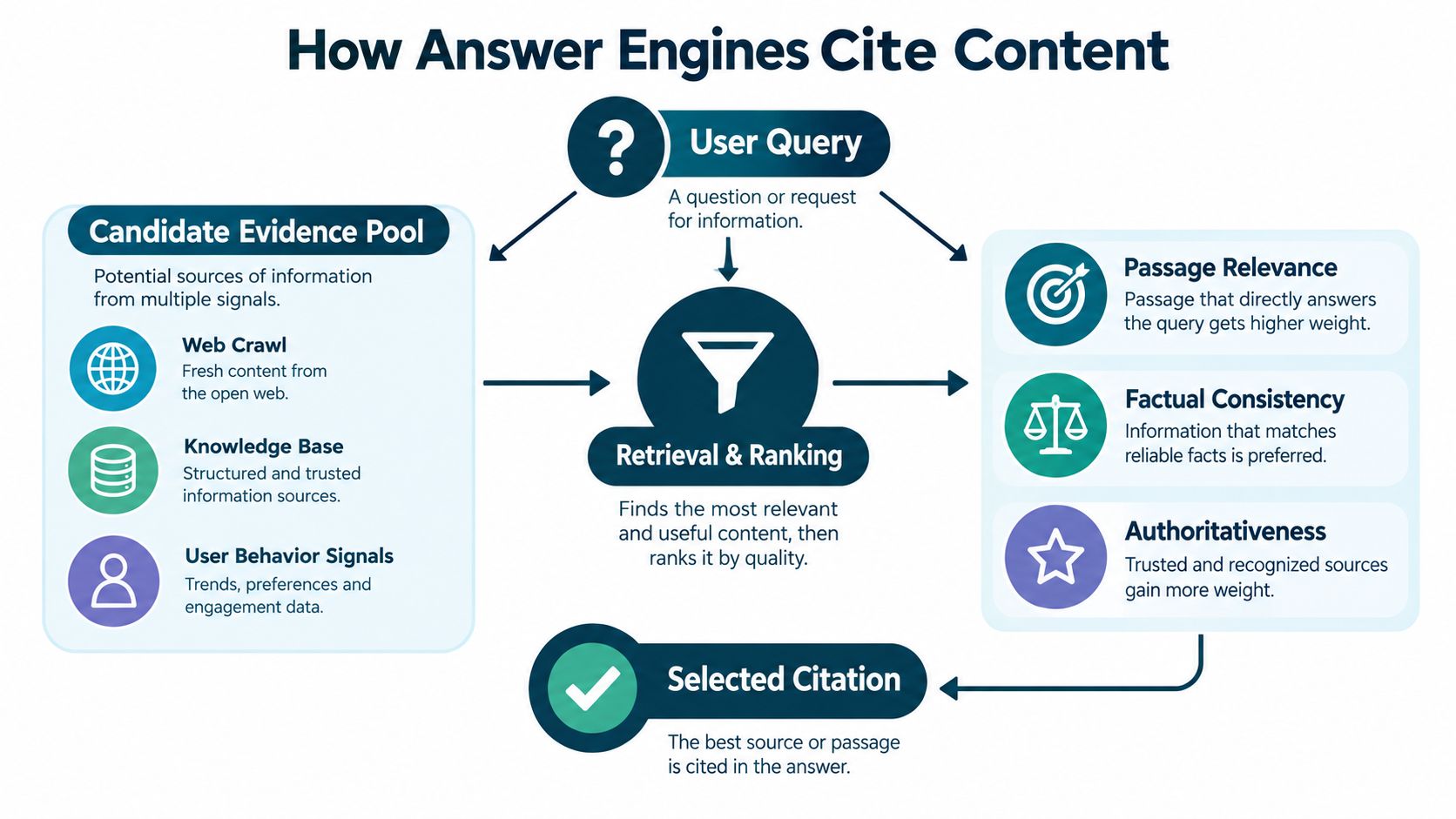
What makes a passage extractable
An atomic answer unit covers one clear question or claim. It can be understood without a paragraph of hidden setup. Useful patterns include:
- BLUF openings: Put the bottom line first, then explain the reasoning.
- Atomic headings: Use headings that identify one specific question.
- Named entities: Identify organizations, products, platforms, and standards consistently.
- Inline attribution: Place a source close to the factual statement it supports.
- Clean formatting: Use lists, tables, and short paragraphs when the information naturally fits those formats.
Suppose a service page says, “We help organizations build better digital experiences through thoughtful strategy.” That may sound pleasant, but it gives an answer engine little to extract. A stronger passage might say, “A website rebuild can include information architecture, content migration, accessibility improvements, integrations, testing, and ongoing maintenance.” The second version names the subject and gives the system a contained factual unit.
Clarity doesn't replace authority. A beautifully formatted unsupported claim is still weak evidence. Conversely, a thoroughly sourced report may remain difficult to cite if its key answer is buried inside a dense narrative.
Technical context helps too. Structured data can clarify what a page represents, although markup doesn't turn weak content into trusted content. For a practical explanation of that layer, see Bruce & Eddy's guide to structured data for SEO. If you're curious about a separate technical field, an overview of real-world edge computing advantages is a useful reminder that technical topics also benefit from clear definitions, named systems, and tightly organized evidence.
Practical Strategies to Optimize Your Content for Answer Engines
A small business rarely needs an AEO makeover across its entire site. Start where a clear answer can influence a decision: service pages, pricing explanations, comparison pages, location pages where geography matters, and guides that address recurring customer concerns. In those places, AEO is often good SEO with sharper structure. It becomes a separate information-architecture problem when related questions, entities, services, or eligibility details are scattered across pages.
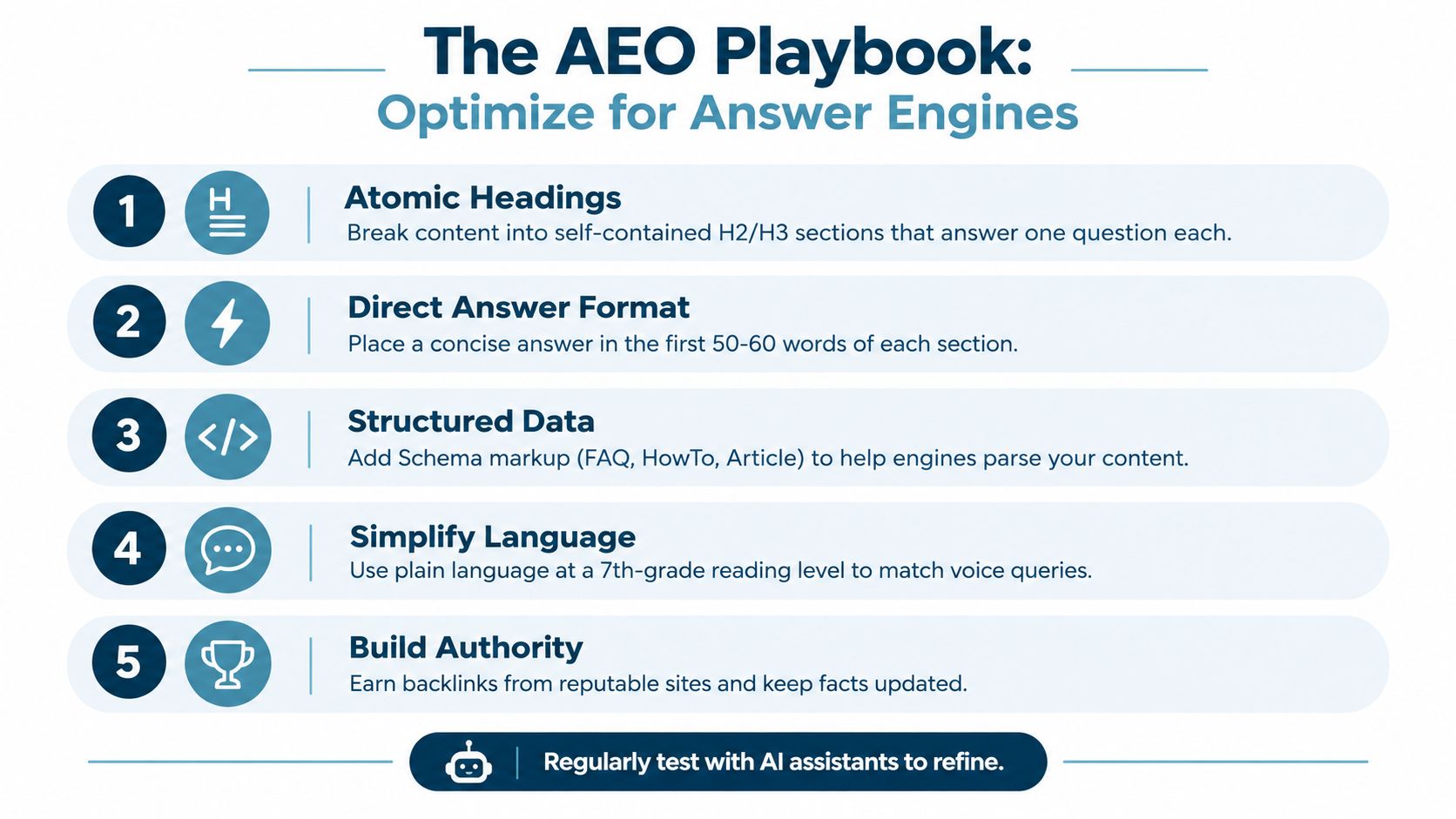
A practical AEO checklist
Write the answer first. Open each major section with a direct response to the question implied by its heading, then add nuance, exceptions, or context. A reader should grasp the point after a quick scan.
Break large ideas into atomic headings. Give each heading one clear job. “How much does a website cost?” and “What affects website cost?” may need separate sections because they answer different questions. This structure also gives a retrieval system smaller, clearer passages to evaluate.
Add evidence close to claims. Use citations, quotations, statistics, official documentation, or clearly labeled examples beside the statement they support. The foundational GEO research found stronger results from content changes that added citations, quotations, and statistics, including relative improvements of 30%–40% on its Position-Adjusted Word Count metric and 25%–35% on its Subjective Impression metric (foundational GEO research). That does not guarantee the same outcome for your page. It does support writing that gives important claims something verifiable to stand on.
Use lists and tables when comparison is the point. A list of included services, a platform comparison, or a sequence of steps is easier to scan than the same material buried in paragraphs. Keep explanatory prose where tradeoffs need context. A list is a tool, not a personality.
Keep facts visibly current. Add a publication or update date when appropriate, and revise information that can change, such as prices, availability, service areas, or platform features. Topical relevance, list position, explicit price information, and recent timestamps have been identified as citation drivers in GEO research (GEO methodology and results discussion). For a small business, this may be as simple as reviewing high-value pages during each major service or pricing change.
Use schema where it accurately describes the page. Article, FAQ, HowTo, Organization, and Product markup can clarify what a page contains when that content is visible on the page. Schema will not rescue vague copy, and hidden or inaccurate markup can create conflicting signals. Treat it as a label on a well-organized file, not a substitute for the file itself.
Rewrite or restructure
A page with outdated, vague, or unsupported material needs a rewrite. A page with useful material buried under a long introduction may only need restructuring.
Use this test:
- Can a reader answer the main question from the opening?
- Does each major section address one identifiable question?
- Can you find the source for important factual claims?
- Are product names, organizations, and technical terms consistent?
- Does the page show when it was published or updated?
- Can a developer and content editor confirm that the schema matches the visible page?
If the answers are mostly yes, improve the page's extraction points before replacing it. If they are mostly no, changing headings will not fix the underlying information problem.
How to Measure Answer Engine Optimization Results Without Chasing Clicks
A founder checks an answer engine for a service question and sees the company named, yet analytics show no visit. That result is not automatically a failure. The answer may have satisfied the user before they opened a website.
Start with citation presence, measured against a defined set of questions. Test prompts tied to business priorities, not random wording chosen to produce flattering mentions. A nonprofit might track questions about its mission or donation process. A service firm could monitor website planning, integrations, or platform selection.
A lightweight measurement model
Track four layers:
- Answer visibility: Does Google AI Overviews, ChatGPT, Gemini, or Perplexity mention or cite the organization for relevant questions?
- Citation share: Which sources appear beside it, and how often do competitors replace it?
- Brand verification: Do systems describe its services, audience, and location accurately?
- Business outcomes: Do calls, forms, booked conversations, direct visits, or donations show activity that may have followed AI exposure?
Choose a manageable prompt set and review it on a consistent schedule, such as monthly. Log each question, platform, date, cited sources, wording accuracy, and next action. This creates a trend line for citation share instead of treating one variable response as a verdict.
A citation can also expose an information problem. If an answer names the business but misstates its service area, audience, or offer, visibility has not yet become useful visibility. Record accuracy separately, then fix the page structure, wording, or supporting evidence that could have caused the confusion.
AI responses vary, and platforms change retrieval behavior, so manual checks are directional rather than laboratory measurements. Compare like with like, keep prompts stable where possible, and note meaningful changes to pages or services alongside the results.
For broader measurement principles, Bruce & Eddy's guide to measuring SEO success provides a useful foundation. Add AEO observations to normal analytics rather than replacing lead and conversion tracking with a mention counter. The goal is to connect citations with accurate brand understanding and qualified business activity, even when the first interaction happens inside an answer engine.
Putting Answer Engine Optimization to Work for Your Business
AEO is not a separate magic channel. It's a practical discipline for making your best information easier to retrieve, verify, and cite. Much of the work is good SEO: clear intent, accessible pages, useful content, logical architecture, and credible references.
The difference becomes meaningful when you optimize at the passage level. A page should answer specific questions directly, support important claims, identify entities clearly, use accurate structured data, and show signs of maintenance. That's information architecture and editorial discipline, not keyword sprinkling with an AI-shaped hat.
Start with a small audit:
- Choose a few high-intent pages.
- Write down the questions each page should answer.
- Check whether the answer appears early in each section.
- Add sources and concrete details where claims need support.
- Test relevant prompts across the answer engines your audience uses.
- Track citations, accuracy, qualified inquiries, and assisted outcomes over time.
A rebuild may be justified when the site's structure prevents important information from being found or maintained. Otherwise, focused content restructuring, schema cleanup, analytics configuration, and ongoing maintenance may be the more sensible investment. The right answer depends on the condition of the website, not on how loudly the latest AEO acronym is shouting.
Bruce & Eddy can help small and midsize organizations connect website strategy, structured content, SEO, analytics, and ongoing maintenance so important pages are easier for both people and answer engines to understand. Visit Bruce and Eddy to review your current website and discuss which high-intent pages are worth improving first.
