

Most SEO roundups start with a pile of tools. This one starts with a plainer question: can search engines reach, read, and trust your pages? Search became a mainstream information behavior long ago. Pew Research Center reported that 91% of U.S. online adults used search engines in February 2012, compared with 84% in June 2004, and 83% of searchers used Google more often than any other search engine. Pew Research Center's findings explain why durable optimization starts with discoverability and user intent, not tricks.
The ten best search engine optimization techniques below run roughly in the order a small or midsize site needs them. Each includes a first practical step, a common tradeoff, and a KPI to watch. That applies whether you run a business, church, nonprofit, startup, or a very talented operation consisting mostly of you and one laptop.
1. Keyword Research and Search Intent Alignment
Keyword research is useful only when it leads to better decisions. The point isn't to collect an impressive spreadsheet. It's to understand what someone wants, then give that need the right page, format, and next step.
Start with a few seed topics tied to your services or programs. Expand them into specific questions and phrases, then group them by intent:
- Informational searches: Someone wants an explanation, such as “how to choose a web developer.”
- Commercial searches: Someone is comparing options, such as “web development services Texas.”
- Local searches: Someone needs a nearby solution, such as “volunteer opportunities near me.”
- Transactional searches: Someone is ready to contact, buy, register, donate, or book.
A Houston nonprofit targeting “volunteer opportunities near me” shouldn't publish a generic mission statement and hope for the best. It should explain volunteer roles, locations, schedules, requirements, and how to get started. A provider discussing keyword research in SEO should also separate educational topics from service pages.
Practical rule: Choose the page type before you choose the wording. A phrase that signals comparison intent usually deserves a comparison, not a sales pitch.
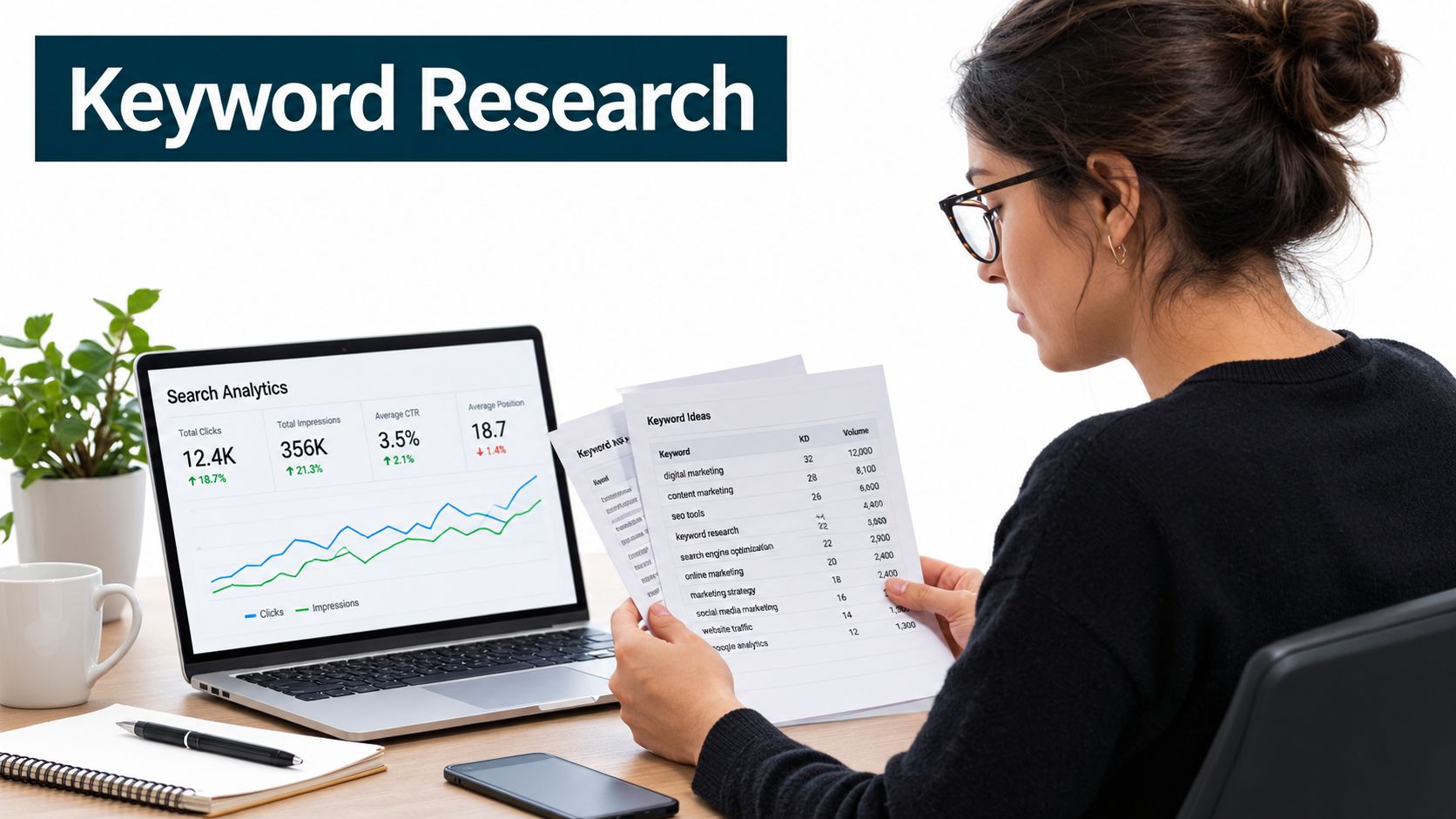
The first step is to review queries already appearing in Google Search Console, then map each meaningful group to an existing page or a genuine content gap. Watch impressions, clicks, CTR, and conversions. A keyword research guide can help with the research process, but judgment still belongs to the person who understands the audience.
2. Technical SEO and Core Web Vitals Optimization
Technical SEO should remove obstacles before you spend more on content or promotion. Check crawlable links, site architecture, indexable pages, canonicalization, XML sitemaps, mobile usability, secure delivery, and templates that make visitors wait or search for basic information. For a small business, church, or nonprofit, begin with the templates that serve your most important pages rather than trying to repair the entire site at once.
Open Google Search Console and review indexed pages, exclusions, crawl issues, Core Web Vitals, and the difference between mobile and desktop performance. Google's Core Web Vitals documentation defines good targets as Largest Contentful Paint at 2.5 seconds or less, Interaction to Next Paint under 200 milliseconds, and Cumulative Layout Shift at 0.1 or less. Search Console reports the 75th percentile from real-user data, so a strong lab result can still conceal problems for visitors using slower devices or connections.
Prioritize properly sized images, fewer render-blocking assets, restrained third-party scripts, reserved space for embeds, and the page's main visual element. Google's page-experience guidance also emphasizes that content should display well on mobile devices.
A large donation form may need different work from a service site loaded with chat and tracking tools. Removing or delaying scripts can reduce reporting detail, personalization, or convenience. Measure before changing, then use Core Web Vitals guidance to connect each fix to the visitor experience. For a practical walkthrough of image sizing and script reduction, see this UK trades guide to faster sites.
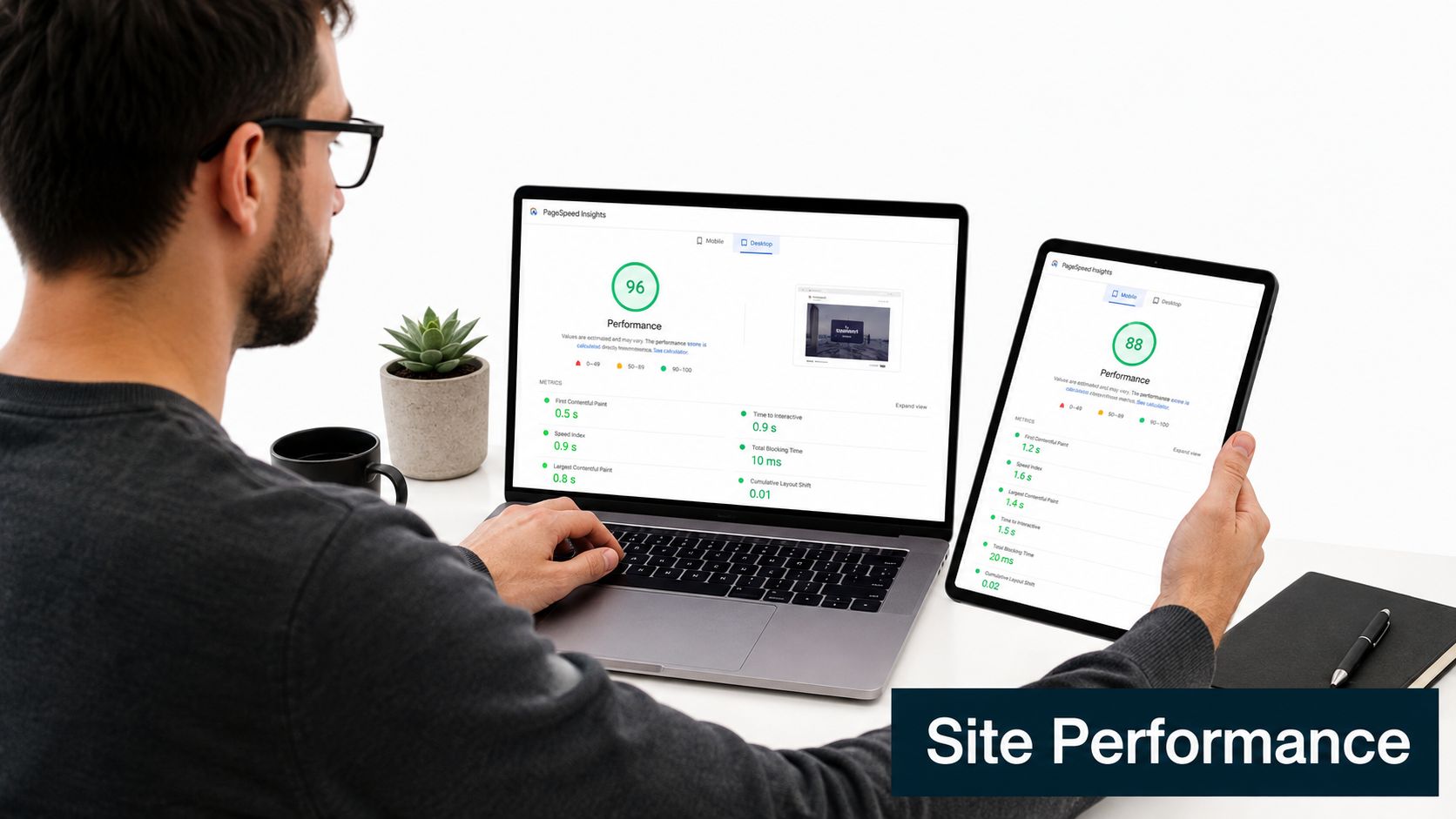
Use PageSpeed Insights for diagnosis, but give field data the final say. Recheck affected template groups in Search Console after changes instead of treating one green score as proof of improvement.
Track Core Web Vitals status by template and device, alongside organic clicks to the affected pages. Faster delivery helps, but it cannot compensate for a page that answers the wrong question.
3. On-Page SEO Elements
A search result has to earn a click before your page can help anyone. Title tags, headings, snippets, URLs, image descriptions, and link text should make the page's subject obvious to both people and crawlers.
Start by opening your most important pages in a crawl or spreadsheet and record the title, H1, meta description, primary topic, and main call to action. Look for vague titles, duplicate titles, missing headings, and pages whose search-result promise doesn't match their content.
Compare “Best SEO Techniques” with “Top SEO Techniques for Small Businesses.” The second gives a clearer expectation, but specificity only helps if the page delivers on it. Google's Search Essentials recommends descriptive titles, headings, alt text, and crawlable links. It also warns against treating keyword placement as a substitute for useful content.
A sensible structure might use one H1 for “WordPress Security Best Practices,” H2s for authentication and access control, and an H3 for two-factor authentication setup. Headings aren't decoration. They help a visitor scan the page and help search systems understand relationships between sections.
Your meta description can state the benefit and the next step, but Google may choose a different snippet. That makes the description worth writing, not worth worshipping. Use guidance on writing meta descriptions to improve clarity, then watch CTR by page and query in Search Console. The tradeoff is simple: a more compelling title may increase clicks, but an exaggerated one can increase disappointment and weaken conversions.
4. Content Clusters and Topic Authority
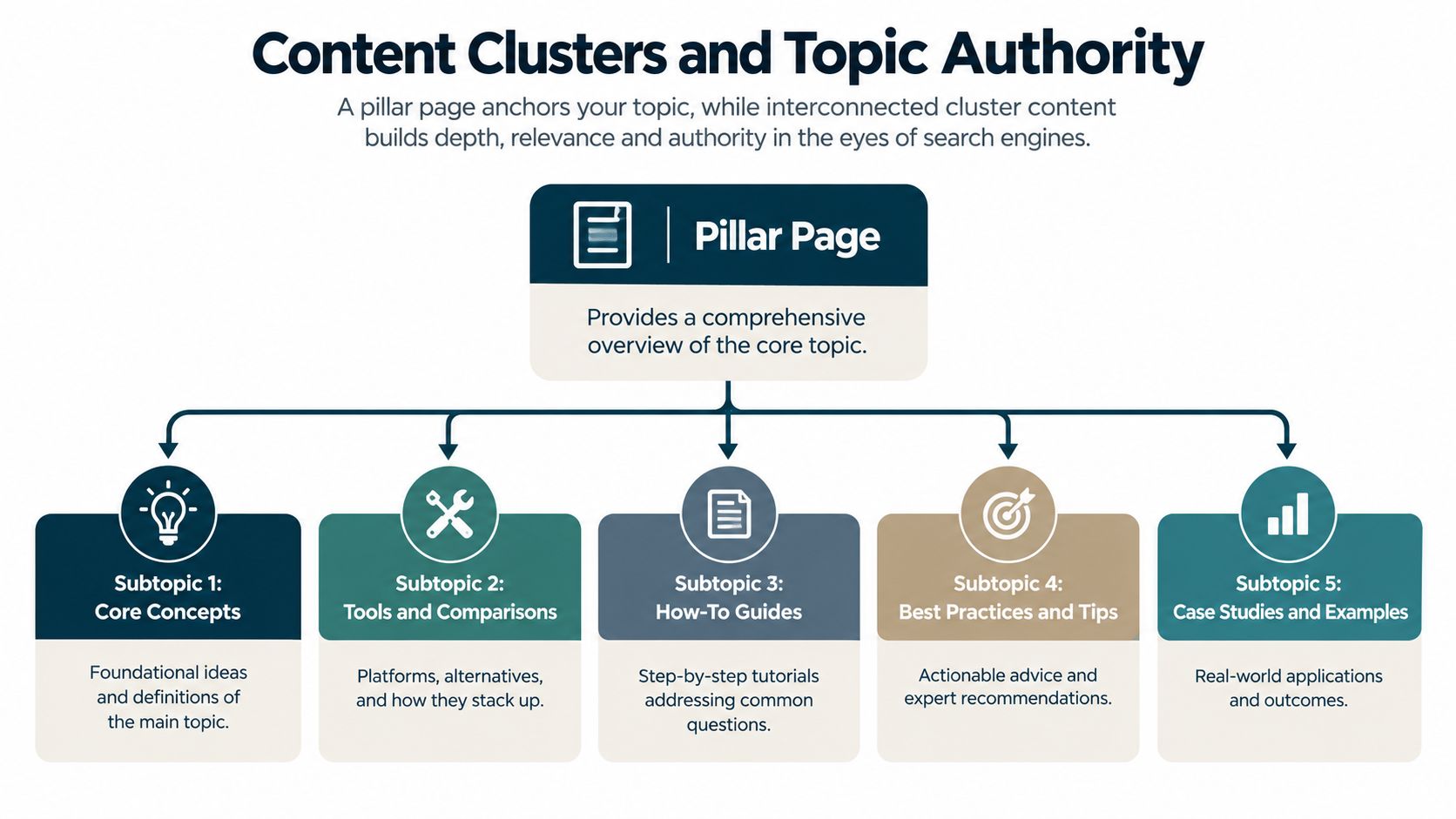
A site earns topical credibility by connecting useful pages, not by publishing a random pile of posts. A pillar page defines the main subject. Supporting pages answer narrower questions. Internal links show visitors how the pieces fit.
A web development company might build a pillar around WordPress website development, then support it with pages about WordPress security, platform comparisons, maintenance, integrations, and accessibility. A nonprofit could organize resources around volunteer management, with supporting guidance on recruitment, scheduling, liability, and recognition.
Begin with one commercially relevant topic and sketch the questions a real buyer or participant asks before taking action. Don't force every possible subtopic into the plan. Three strong supporting pages are more useful than a crowded cluster built to satisfy a content calendar.
- Pillar page: Explain the subject broadly and link to deeper resources.
- Supporting pages: Answer specific questions with enough detail to stand alone.
- Internal links: Use descriptive anchors and connect pages where the reader benefits.
Google says links should be crawlable and descriptive, and internal links help users and crawlers discover important pages. The topical authority explanation provides useful context, but authority isn't a badge you earn by adding the phrase to a page. It comes from consistent relevance and a site structure that makes sense.
The tradeoff is maintenance. A cluster creates more pages to review, update, and connect. Watch non-branded impressions and clicks for the topic group, then inspect whether supporting pages help visitors reach service, registration, donation, or contact pages.
5. Content Quality, E-E-A-T, and Topical Expertise
Quality isn't a tone of voice. It's evidence that the people behind a page understand the subject and have taken responsibility for what they publish.
Add the details a generic summary can't provide. A technical guide should show configuration choices, limitations, and verification steps. A nonprofit resource should identify the program context and distinguish documented outcomes from general aspirations. A service page should explain what the organization does, who it serves, and what a prospective client can expect next.
Google's guidance on AI-generated content says automation isn't prohibited, but using it primarily to manipulate rankings violates spam policies. The important editorial distinction is whether human reviewers add original knowledge, verify claims, remove unsupported material, and make the page useful.
Author information can help when it is specific and honest. Say what the person does and what they know. Link to primary sources for factual claims, especially on health, financial, legal, or safety topics. Don't add a decorative biography that establishes nothing.
Experience is not a paragraph claiming experience. It is the concrete detail that shows how the answer was reached.
The first practical step is to select one important page and mark every sentence that depends on expertise, evidence, or a changing fact. Verify those statements, add attribution where needed, and remove anything the organization can't support. The tradeoff is editorial time. Thin pages are faster to publish, but they give competitors and search systems little reason to trust or cite them.
Track impressions, qualified clicks, assisted conversions, and referrals from relevant sites. For AI search, Google advises creating unique, valuable content for people and warns that mass-produced pages without added value may fall under scaled-content-abuse policies. That makes distinctiveness a business requirement, not a literary bonus.
6. Search Intent Optimization and Conversion-Focused Content
A page can rank and still fail. The usual reason is a mismatch between what the visitor wants and what the page asks them to do.
Search “WordPress vs. Wix” and you'll likely need a comparison with tradeoffs, ownership considerations, maintenance expectations, and fit by organization type. Search “how to optimize page speed” and you'll expect instructions, diagnostics, and tools. Search “web development services Austin” and you'll expect a service page, proof, scope, and a clear contact path.
Start by reviewing the current search results for your target query. Note the dominant formats, the questions answered near the top, and the actions pages invite. Google's Search Console performance definitions distinguish clicks, impressions, CTR, and average position, which helps separate a visibility problem from a messaging problem.
Build content for different decision stages:
- Awareness pages: Explain a problem and earn recognition.
- Consideration pages: Compare approaches, platforms, or providers.
- Decision pages: Clarify fit, proof, scope, and the next action.
- Conversion assets: Make contact, booking, donation, registration, or calculation easy.
The tradeoff is that an informational page shouldn't behave like a sales page. A hard pitch can interrupt the answer and reduce trust, while a page with no useful next step wastes qualified interest. Watch conversion rate and assisted conversions by landing page, not just rankings.
If a page receives impressions and clicks but produces no meaningful action, inspect the intent match before rewriting every sentence. Sometimes the page needs a better CTA. Sometimes it needs to become a different page entirely.
7. Local SEO and Google Business Profile Optimization
Local SEO is about matching geographic need with credible, usable information. A profile with the wrong phone number or an unclear service area can lose a ready-to-contact visitor before the website gets a chance.
Start by claiming and verifying the Google Business Profile, then check the business name, address, phone number, hours, categories, service area, website, and contact path. Make the same information consistent on the site and relevant directories. Add genuine photos that help someone recognize the organization, understand the setting, or evaluate the service.
A church should explain where it meets, when people can attend, accessibility details, and who to contact. A local service provider should make service areas and appointment options clear. A nonprofit should distinguish its administrative address from program locations when that difference matters.
Reviews require care. Ask eligible customers or participants for honest feedback, respond without exposing private information, and avoid scripted replies that sound like a call center wearing a name tag. Location pages should also earn their place. A page that swaps city names while offering no local information creates search risk and a poor visitor experience.
Google's spam policies classify keyword stuffing and link spam as prohibited manipulation. That applies locally too. Don't create near-identical location pages or stuff a business name with every service and town.
The tradeoff is ongoing attention. Profiles, hours, reviews, and local details change, so a one-time setup won't stay accurate forever. Track Google Business Profile actions, direction requests, calls, website clicks, and branded local queries. Those measures tell you whether visibility is producing useful contact, not merely map impressions.
8. Link Building and Domain Authority
Links still matter, but the useful question isn't “How many can we get?” It's “Why would a relevant site send its audience to this page?”
Google's systems analyze how pages link to one another alongside page-level signals. That history reaches back to PageRank, one of the core systems present when Google launched, although ranking has changed substantially since then. The durable approach is to earn relevant editorial links by making something worth referencing.
Start with assets your audience would cite on their own. That could be an original guide, a practical resource, a local directory, a calculator, a well-supported explanation, or a useful piece of research. Then identify sites whose readers would benefit, and make a specific, non-demanding outreach request.
A WordPress security guide may be relevant to plugin reviewers or security publications. A nonprofit may belong in community directories and partner resources. A service provider may find a broken industry link and offer a better replacement. These approaches solve a publisher's problem rather than treating every website as an ATM with a domain name.
A link is valuable when it sends the right people, not merely when a tool assigns it an impressive score.
Avoid buying links mainly for rankings, scaled exchanges, automated placements, and unrelated directories. Google identifies links created primarily to manipulate rankings as link spam. The tradeoff is that editorial link earning takes patience and the result isn't fully controllable.
Track new referring domains, referral visits, linked-page impressions, and assisted conversions. Review relevance manually. A small number of contextually appropriate links can be more useful than a large pile of questionable placements.
9. User Experience Signals and Page Experience
Search optimization and user experience meet at the page. A visitor should be able to understand the offer, move through the content, and complete the intended action without fighting the interface.
Start with the pages that matter most to the organization, such as a contact form, donation flow, event registration page, service page, or appointment request. Test them on a phone. Look for cramped controls, intrusive overlays, unclear button labels, contrast problems, unexpected layout shifts, and content hidden below a slow or distracting element.
Google's mobile guidance asks whether content displays well on mobile devices and points site owners toward tools such as Lighthouse. It also recommends breaking long content into paragraphs and sections with headings. That sounds basic because it is basic. Basic things still break surprisingly often.
A page can be technically fast and still be difficult to use. An accessible form with clear labels may outperform a visually clever form that makes users guess. A concise navigation path may serve a local organization better than a giant menu containing every possible page.
The tradeoff is that simplification can remove features someone considers important. Don't make that decision from a desk alone. Watch recordings or analytics where appropriate, test the task with real users, and preserve information that helps people make a decision.
Track form starts, form completions, CTA clicks, engagement with key content, and mobile Core Web Vitals. Treat behavioral metrics as diagnostic clues, not automatic ranking levers. A high exit rate might indicate a problem, or it might mean the visitor found the phone number and left to call.
10. SEO Tools, Measurement, and Reporting
Measurement turns SEO from a collection of opinions into a sequence of decisions. The goal isn't to produce a colorful report that nobody opens. It's to identify the next fix and know whether it helped.
Connect Google Search Console to analytics or a CRM where possible. Search Console gives you clicks, impressions, CTR, and average position. Analytics or CRM data can show what happened after the visit, such as a form submission, donation, registration, call, or qualified lead.
Start with a baseline for important page groups. Segment branded and non-branded queries, devices, countries, landing pages, and conversions. Branded performance can make discovery look healthy while non-branded visibility remains weak, so those views shouldn't be blended into one flattering number.
A practical monthly review asks:
- Visibility: Which pages gained or lost impressions?
- Messaging: Which pages have high impressions but weak CTR?
- Technical health: Which templates show Core Web Vitals or indexation problems?
- Business value: Which landing pages contribute to qualified actions?
- Change history: What was published, removed, redesigned, or scripted before the movement?
Google accounted for approximately 89.83% of worldwide search-engine market share in August 2025, while Bing held 3.95%, Yandex 2.21%, Yahoo 1.48%, DuckDuckGo 0.90%, and Baidu 0.76%, according to StatCounter's worldwide measurement. Treat that as a directional benchmark, not a promise about any individual site's traffic. A business serving a specialized regional audience may need more attention on another engine.
The tradeoff is reporting complexity. More tools can provide useful cross-checks, but they can also create contradictory numbers and busywork. Track qualified conversions per organic landing page, then use the other metrics to diagnose the path.
LinkedIn analytics tools may help with a separate social channel, but they shouldn't replace search measurement. Keep a changelog, set alerts for major technical issues, and use reports to decide what changes next.
Top 10 SEO Techniques Comparison
| Item | Implementation complexity | Resource requirements | Expected outcomes | Ideal use cases | Key advantages |
|---|---|---|---|---|---|
| Keyword Research and Search Intent Alignment | Medium, ongoing analysis and updates | Keyword tools (GKP, Ahrefs, Semrush), analyst time | More relevant organic traffic, improved conversion alignment | New content strategy, PPC alignment, audience targeting | Targets real user intent; prioritizes content effort and gaps |
| Technical SEO and Core Web Vitals Optimization | High, developer and infrastructure work | Developers, hosting/CDN changes, performance tools | Faster pages, better crawlability, improved Core Web Vitals | Site migrations, slow sites, mobile performance issues | Direct ranking/UX improvements; reduces bounce and increases conversions |
| On-Page SEO Elements (Title Tags, Meta Descriptions, Headings) | Low, editorial updates | Content editors, SEO plugins, auditing tools | Higher CTR, clearer relevance, modest ranking gains | Auditing top pages, improving click-through and readability | Low-lift, high-impact improvements; easy to audit site-wide |
| Content Clusters and Topic Authority | Medium–High, strategic planning and content creation | Content strategists, writers, internal linking work | Stronger topical rankings, increased time on site, authority | Building subject-matter authority, long-term content programs | Systematic authority growth; multiple entry points and internal linking |
| Content Quality, E-E-A-T, and Topical Expertise | High, research and expert contribution | Subject-matter experts, research, editorial resources | Higher trust, natural links, better rankings on sensitive topics | YMYL topics, brand credibility initiatives, competitive niches | Builds trust and conversions; attracts links and media mentions |
| Search Intent Optimization and Conversion-Focused Content | Medium, analysis + tailored content and CTAs | Competitor research, writers, conversion design | Better conversions, lower bounce, intent-aligned rankings | Improving organic conversion rates, buyer-journey content | Aligns content to user intent and the funnel; improves ROI |
| Local SEO and Google Business Profile Optimization | Low–Medium, manual profile and citation management | GBP, citation tools, review management, local pages | Map pack visibility, more local calls/visits, higher CTR | Service-area businesses, multi-location businesses | Fast local ROI; improves visibility in maps and trust via reviews |
| Link Building and Domain Authority | High, outreach and relationship building | PR/outreach team, link-worthy content, time (months) | Increased authority, higher rankings for competitive keywords | Competitive keywords, brand-building, content promotion | Strong ranking influence and referral traffic when done sustainably |
| User Experience Signals and Page Experience | Medium–High, design, dev, and testing | Designers, developers, analytics and A/B tools | Improved engagement metrics, conversions, supportive ranking gains | High-traffic landing pages, conversion funnels, accessibility work | Enhances UX and conversions; complements technical SEO efforts |
| SEO Tools, Measurement, and Reporting | Medium, setup and continuous monitoring | GSC, GA4, Ahrefs/Semrush, reporting tools, analyst time | Data-driven priorities, early issue detection, measurable ROI | Ongoing SEO programs, stakeholder reporting, audits | Holistic visibility and prioritization; validates SEO impact |
Pick One Technique and Set a Baseline
The best search engine optimization techniques aren't equally urgent on every site. A church with an inaccessible mobile donation page has a different first move from a startup with excellent performance but no pages matching commercial searches. A small business with strong branded visibility but weak discovery needs a different plan from a nonprofit whose local profile contains outdated contact information.
Choose the technique that addresses your biggest current gap. If search engines can't crawl or index important pages, start with technical SEO. If people see your pages but don't click, inspect titles and snippets. If visitors arrive but don't complete the intended action, review intent, page experience, and conversion paths. If your site lacks credible references, improve the underlying resource before chasing links.
Record the current KPI in Google Search Console or GA4. For technical work, that may be Core Web Vitals status by template. For content, it may be non-branded impressions, clicks, or CTR. For local visibility, it may be calls, website actions, or direction requests. For a conversion page, it may be completed forms or registrations.
Search results can take a while to respond to changes, so the early win is usually a clean baseline and one fewer blocker, not an instant traffic spike. Don't change five major variables at once. If you rewrite the page, rebuild the template, remove scripts, and launch a new campaign on the same day, you'll have a lively dashboard and very little understanding of cause and effect.
AI-generated search answers add another reason to value original material. Google's current guidance emphasizes unique, valuable content for people and warns that mass-produced AI pages without added value may violate scaled-content-abuse policies. For smaller organizations, that means publishing fewer pages with stronger evidence, clearer ownership, and more useful first-hand detail. Some pages should earn citations and brand memory. Others should support comparison, proof, and action. Not every informational query needs to become a traffic contest.
Move to the next technique only after the first one is measured. A practical SEO program is less like collecting badges and more like maintaining a working digital property. The site should remain findable, readable, trustworthy, and useful as the organization changes.
Bruce & Eddy helps businesses, churches, and nonprofits connect website strategy, technical SEO, local visibility, analytics, development, hosting, security, and ongoing maintenance. If you want a practical review of your site's biggest search blocker and a prioritized path forward, visit Bruce and Eddy and start with the pages most connected to your real business goals.
