

A small business owner decides to take SEO seriously. They choose a few keywords, publish blog posts on a regular schedule, and wait for the traffic to arrive. Months later, the site has more content but no clear improvement in visibility, qualified visits, or inquiries.
The problem usually isn't effort. It's that the pages were created as separate assignments instead of as connected answers to a defined set of customer needs. Topical authority in SEO is the practical discipline of building that connected coverage, proving real subject knowledge, and maintaining it over time.
Understanding the Scenario Most Businesses Face
Consider a church website that publishes one article about fundraising events, another about youth group activities, and a third about facility rentals. Each post might be useful on its own, but the site hasn't shown a consistent area of expertise. The subjects serve the same organization, yet they don't necessarily form a coherent search topic.
The same pattern appears in commercial sites. A web consultant might publish one post about logo design, another about email marketing, and another about office technology because all three keywords looked promising in a research tool. The result is a collection of plausible pages with no strong reason for search systems, or readers, to see the site as a dependable source for one particular need.

The difference between activity and coverage
Topical authority isn't a publishing counter. It's the demonstrated depth, consistency, and reliability of a site's coverage within a defined subject area. A site can publish frequently and still lack it if the pages don't address related questions, use consistent terminology, connect to one another, or show evidence of experience.
Google's public explanation of its news topic-authority system makes the underlying principle clear. Search systems evaluate signals that indicate how much expertise a publication has in specialized areas. That doesn't mean a general business website is treated exactly like a news publisher, but it does support an important distinction: authority is contextual, not universal.
A company may be highly credible for nonprofit website development and have little useful authority on international finance. Publishing a finance article on the same domain doesn't transfer expertise by magic. Search engines need stronger evidence that the page fits the site's purpose and that the organization can explain the subject responsibly.
Why isolated keyword targets underperform
Keyword research is useful, but it answers only part of the planning problem. It can show what people search for. It doesn't automatically tell you which questions belong together, what level of expertise the audience expects, or whether your website has a legitimate reason to speak on the topic.
Before publishing, ask:
- What decision is the reader trying to make? Is the person learning, comparing options, troubleshooting, or preparing to contact a provider?
- What related questions follow? A page about online giving might need supporting answers about security, recurring gifts, receipts, and accessibility.
- What can this organization prove? First-hand processes, qualified reviewers, transparent sources, and accurate maintenance matter more than confident wording.
- Where should the reader go next? A useful page should connect naturally to another relevant resource or service.
A focused content plan is also more realistic for smaller teams. You don't need to cover every subject your competitors mention. You need to become genuinely useful for the subjects your organization serves.
If you're still expecting immediate results from a new publishing routine, how long SEO takes to work provides useful context. Search visibility develops through accumulated relevance and trust, not through a single post arriving on schedule.
How Search Engines Detect Topical Authority
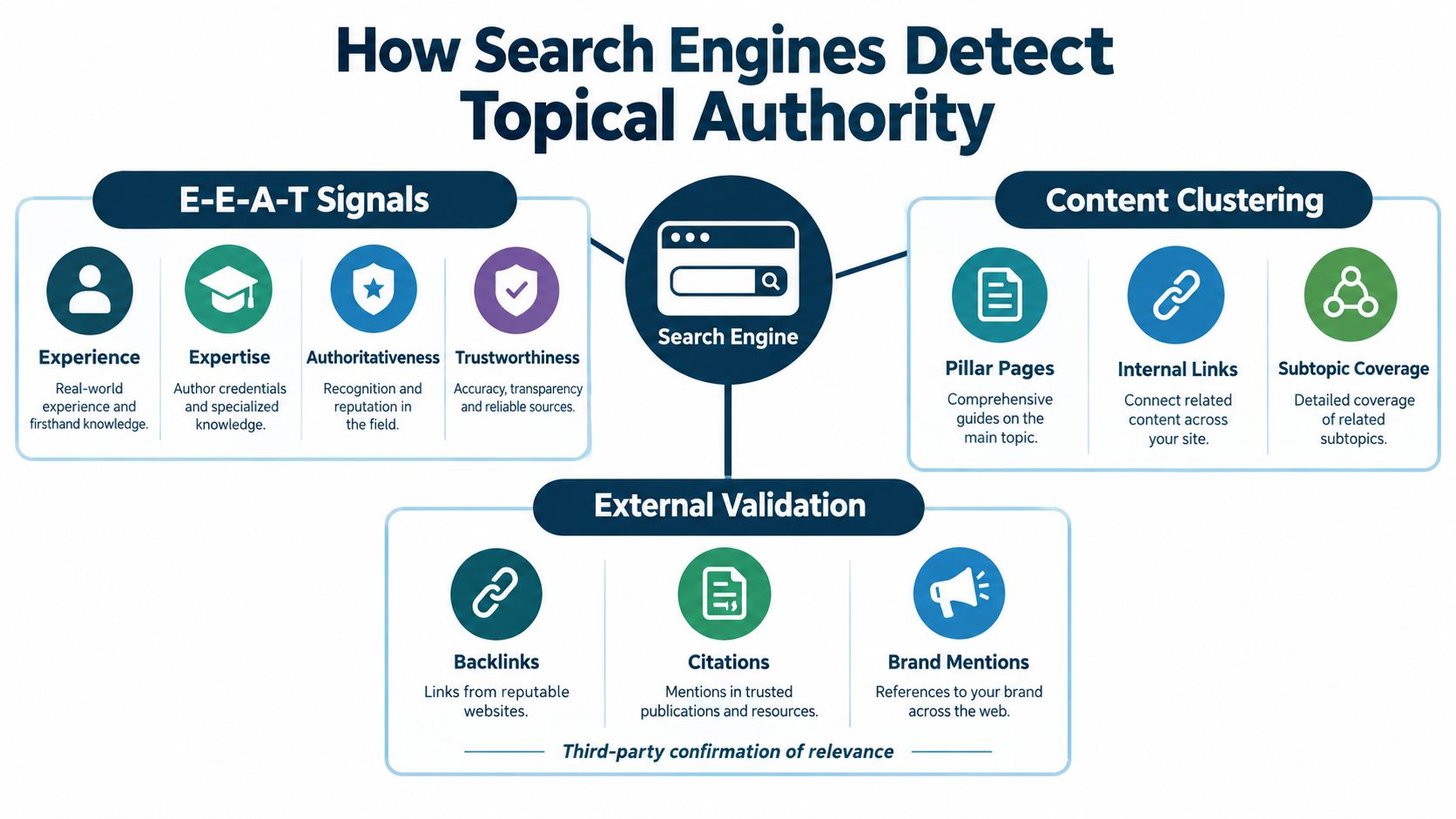
Search engines infer topical authority from patterns, not from a single score. They look for repeated evidence that a site covers a subject with enough depth, clarity, and consistency to satisfy different intents around the same topic. In practice, that means article count matters less than whether the pages fit together and answer the next question a visitor is likely to have.
E-E-A-T is a quality lens, not a metric you can optimize in isolation
Google added the extra E for experience in its December 2022 explanation of the Search Quality Rater Guidelines, which shaped the familiar framework of experience, expertise, authoritativeness, and trustworthiness. Google also explains that these guidelines help human raters assess search results and do not directly set rankings. Its overview notes about 16,000 external Search Quality Raters worldwide (Google's explanation of E-E-A-T).
The practical takeaway is simple. There is no visible E-E-A-T badge to earn, and cosmetic trust signals do not carry much weight on their own. Search systems are trying to determine whether your content shows real subject knowledge, whether the site has a credible reason to publish on the topic, and whether readers can rely on what they find.
On a church site discussing online giving, those signals are concrete. The page may reflect direct experience with donor questions, payment processes, and follow-up communications. It may show expert review from a qualified staff member, explain security and accessibility clearly, keep policy details current, and make it easy for someone to contact the organization when they need clarification.
That is what separates useful content from keyword-shaped copy. A page can mention the right terms and still feel thin if it does not reflect how the subject works in practice.
Clusters help search engines understand subject coverage
Search engines do not measure authority by counting how many times a phrase appears on one page. They look at whether your site covers a topic in a way that matches different stages of intent. A recurring-donations page is stronger when it sits inside a well-structured online-giving section, with related pages for security, receipts, accessibility, setup questions, and donor communication.
Google's helpful content guidance supports that approach. The goal is people-first content that helps visitors complete a task or make a decision, not pages produced mainly to chase rankings. That is why intent mapping comes before publishing. If you publish first and sort out relationships later, you usually end up with overlap, cannibalization, and weak internal pathways.
Internal links make those relationships clearer to users and to search engines. Google's SEO Starter Guide on links and site organization explains how links help discovery, context, and site structure. Clear anchor text matters because it signals what the destination page covers, which is more useful than vague prompts.
External signals and markup support what the site already proves
Mentions, citations, and backlinks from credible sources can reinforce topical relevance. They work best when they confirm what the site already demonstrates through useful first-party content. A respected link to a shallow page does not fix the page.
The same standard applies to AI-assisted writing. AI can help a small team publish faster, but speed creates risk if no one checks sources, adds first-hand context, or edits for accuracy. These ethical AI content writing tips are a useful reference for teams that want efficiency without turning their site into a stack of interchangeable articles.
Structured data adds clarity by labeling what a page is about, not by creating authority on its own. If you want a practical walkthrough, our guide to structured data for SEO explains how to apply schema in a way that supports real page content. Google's structured data documentation also outlines supported markup, validation, detection, and performance checks. Markup can help search engines classify a page more accurately, but it cannot compensate for thin coverage, weak intent matching, or outdated information.
Building Topic Clusters That Actually Work
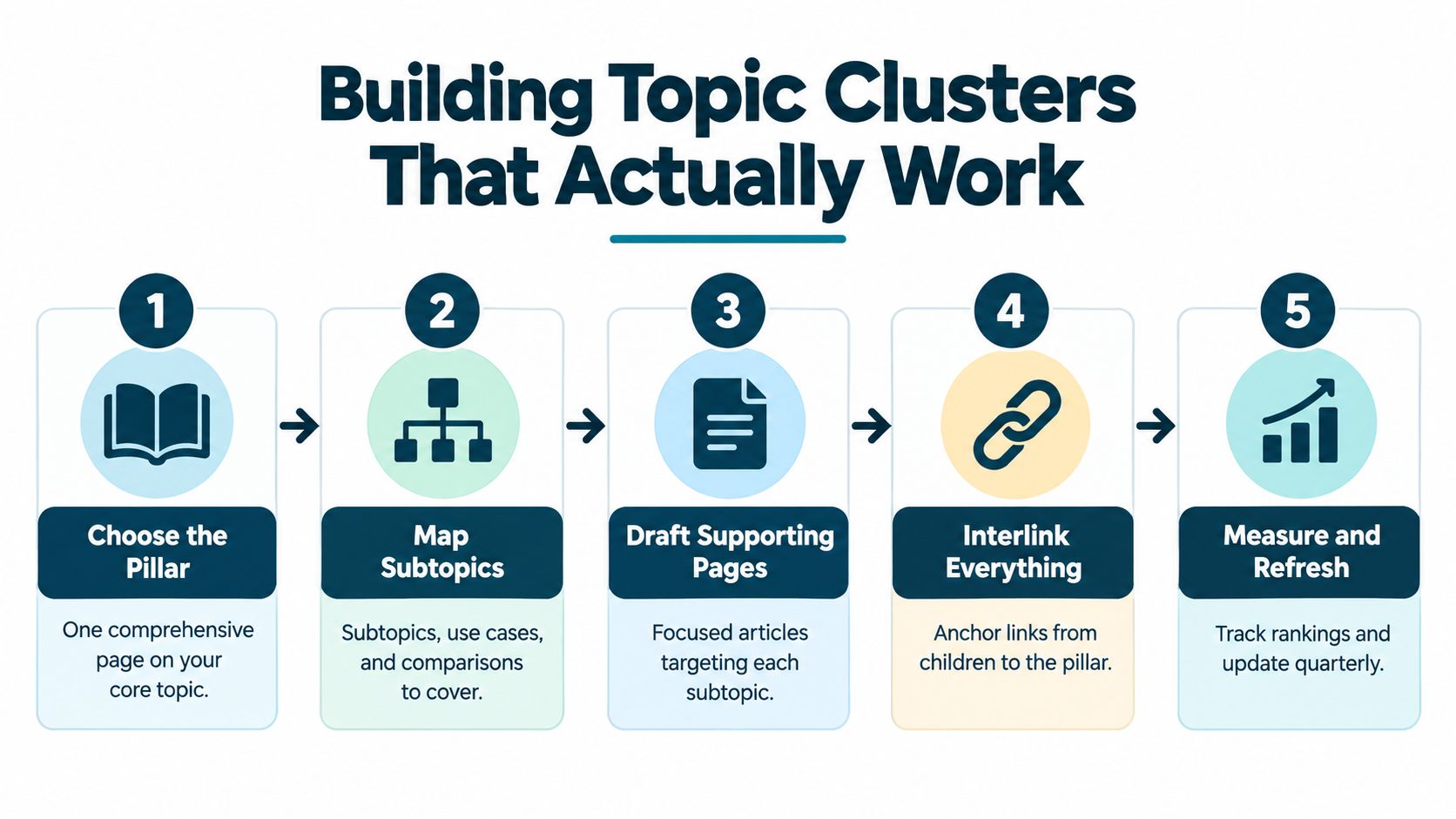
A topic cluster has three practical parts: a central page, supporting pages, and internal links that explain how those pages relate. The structure sounds simple, but the planning decision is important. Each page needs a distinct job, otherwise the cluster becomes several versions of the same article competing for attention.
Start with a real customer subject
Take online giving for a church or nonprofit. The pillar page could explain the overall process, available options, implementation considerations, and questions a donor or administrator is likely to have. Supporting pages might cover:
- Payment security, for readers assessing risk and safeguards.
- Recurring gifts, for donors and organizations evaluating ongoing contributions.
- Donor communications, for teams deciding how to acknowledge and update supporters.
- Tax receipts, for people who need clear records and organizational processes.
- Accessibility, for making the giving experience usable by more visitors.
Those subjects are connected, but each has a different intent. A person comparing recurring-gift options needs a different answer from someone troubleshooting a receipt. Combining all five into one enormous page can make every answer harder to find. Splitting them into disconnected posts creates the opposite problem.
Build the architecture before drafting
A useful planning sheet can include these fields:
- Core entity: The main subject, service, product, or problem.
- Audience: The person searching and their level of familiarity.
- Intent: Informational, comparative, navigational, transactional, or troubleshooting.
- Required evidence: Internal experience, official documentation, specialist review, or another reliable source.
- Destination: The next page, service, form, or resource that helps the reader.
- Maintenance trigger: A change in policy, product, process, regulation, or user expectation.
This prevents a common failure mode, where writers keep finding more keyword variations but don't know whether a new page adds anything. A variation deserves its own page when it represents a distinct question, audience, or decision. Otherwise, improve the existing page.
Google also recommends organizing similar URLs in directories because the structure can help it understand how frequently individual URLs are updated. That doesn't make a directory name a ranking shortcut. It gives your team a clearer way to maintain related content and helps users move through a coherent resource area.
Link with purpose
The pillar should link to each supporting page where the relationship is useful. Supporting pages should link back when the broader context helps, and they can connect laterally when the reader may reasonably need the adjacent answer.
Use anchor text that describes the destination accurately. “Payment security for online giving” tells a reader more than “learn more,” and it gives crawlers stronger context. Don't force every possible link into every page. Internal linking is navigation and explanation, not confetti.
A broader guide to content pillars and website organization can help teams translate this model into their existing site structure.
The strongest clusters also show who stands behind the material. Identify the author or reviewer, cite reliable sources when a claim needs support, include relevant first-hand detail, and update the page when the underlying subject changes. A clean structure can't compensate for content that sounds polished but has no accountable expertise behind it.
Measuring Progress Without Vanity Metrics
Article count is easy to report and easy to misunderstand. A better measurement system asks whether a cluster covers important queries, earns visibility for the right intents, helps users take the next step, and avoids pages competing with each other.
A specialized 2025 study reported that narrow topical authority had the strongest modeled relationship with rank among the variables examined, with a coefficient of -0.293 and p = 0.001, while broad topical authority showed a coefficient of 0.103 and p = 0.020 (the study's analysis). This isn't a universal Google ranking formula. The dataset was specialized, so the sensible takeaway is directional: focused depth may be more useful than broad publishing across unrelated subjects.
Track the cluster, not just the page
Use Google Search Console and your analytics platform to group pages by topic. Review impressions, clicks, average position, indexed-page status, internal-link coverage, and conversions at the cluster level.
| Metric | What It Shows | Target Signal |
|---|---|---|
| Impressions | Whether related queries are placing pages in view | More relevant query coverage |
| Clicks | Whether searchers choose your result | Better alignment between page promise and intent |
| Average position | Directional visibility for the cluster | Progress on related queries, not one isolated term |
| Indexed-page status | Whether important pages can appear in search | Key pages are discoverable and eligible |
| Internal-link coverage | Whether pages connect logically | No important supporting page sits alone |
| Conversions | Whether visibility supports the organization | Qualified actions from the right audience |
The table is a working dashboard, not a promise of rankings. Review the numbers alongside the actual queries and landing pages. A page can gain impressions for an irrelevant phrase and make the report look healthier while doing nothing useful for the business.
Use evidence to decide what happens next
Look for clusters where several related queries receive impressions but no page matches the intent well. That usually points to a missing supporting page, a weak section on an existing page, or a mismatch between the query and the page's purpose.
Then inspect overlap. If two pages answer almost the same question, consolidate them when one stronger resource can serve the intent. Preserve clear scope, use appropriate canonical relationships, redirect retired URLs when necessary, and update internal links so the remaining page becomes the obvious destination.
For a broader measurement framework, how to measure SEO success offers a useful way to connect search data with business outcomes. Review pages when facts, products, policies, or user expectations change. A cluster gains credibility through maintenance, not just its launch date.
Why More Content Doesn't Equal More Authority
Publishing more pages feels productive because it creates visible output. It can also create a maintenance bill, internal competition, and a site where readers must sort through several near-duplicates to find the answer they need.
The better question isn't “How many articles can we publish?” It's “Which distinct user intents remain unanswered?” A new page earns its place when it adds original experience, resolves a separate decision, addresses a meaningful audience need, or provides evidence that the existing structure lacks.
The point of diminishing returns
Suppose a nonprofit already has a strong guide to online giving, a page about security, and a page about recurring donations. A fourth post that just rephrases “how to accept online donations” may add little. It may even split links, impressions, and editorial attention across pages that should have been one resource.
Use these tests before approving another assignment:
- Intent test: Does the proposed page answer a different question?
- Originality test: Can the organization add first-hand detail, examples, or a qualified perspective?
- Navigation test: Would readers benefit from this page as a separate destination?
- Business test: Does it support a relevant action, such as contacting the organization, choosing a service, or completing a task?
- Maintenance test: Can the team keep this page accurate?
If most answers are no, strengthen the existing page instead. Improve the opening answer, add missing evidence, clarify the audience, repair internal links, or consolidate overlapping material. More URLs aren't automatically more useful.
Search results are increasingly selective
Pew Research Center found that 88% of Google AI summaries cited at least three sources in its study of AI summaries and search behavior (Pew Research Center's findings). That behavior supports a practical shift in thinking. A site doesn't need to dominate every version of one keyword to matter. It needs to be a clear, credible source that answers a specific part of the wider question well.
That makes source selection and usefulness more important than raw publishing volume. Search features may synthesize information across several pages and sources, so a concise explanation with accountable expertise can be more valuable than a longer article padded with every related phrase.
Topical authority is therefore closer to a maintained reference system than a content conveyor belt. The right number of pages depends on the subject, audience, decision paths, and evidence available. Stop adding pages when new content repeats existing intent, and redirect that effort toward improving the pages people already need.
Tactical Roadmap for SMBs and Nonprofits
Small organizations can build strong topical coverage without trying to become a general information publisher. The practical advantage comes from choosing a defined service or mission area and covering it with enough depth to be useful.
A focused operating plan
Pick one niche vertical. Choose the service area you want the site to be known for. A nonprofit might focus on online giving operations, while a web partner might focus on website maintenance for organizations with limited internal technical support.
Audit existing content. List current pages, their target intents, internal links, evidence, and performance. Merge thin or overlapping posts instead of preserving every URL as if it were a family heirloom.
Build the pillar page. Create the main resource around the core topic. It should answer the broad question clearly, establish scope, and direct readers to deeper supporting pages.
Publish supporting pages. Cover the subtopics, comparisons, use cases, definitions, and problems that matter to the audience. A steady schedule is useful only when each page has a distinct job.
Add author bios and trust signals. Show relevant credentials, first-hand involvement, reviews where appropriate, contact details, sourcing, and editorial responsibility. Don't claim experience the organization doesn't have.
Review metrics quarterly. Check rankings, traffic, conversions, indexed status, internal links, and USD ($)-reported value where your analytics system uses that reporting format. Use the results to update, consolidate, or expand the cluster.
Keep editorial fit in view
Google's site-reputation-abuse policy draws an important boundary. Third-party content isn't automatically a violation, but publishing it mainly to exploit ranking signals earned by the host site can create a serious problem. Google describes the issue as placing content on an established site without meaningful first-party involvement or oversight, especially when the material is unrelated to the site's purpose.
That makes topic expansion a business decision, not a shortcut. A contributor can be appropriate when the organization has a genuine connection to the subject, provides close editorial review, and stands behind the finished material. A batch of unrelated articles placed on a stronger domain only to borrow visibility has a very different purpose.
The same standard should guide internal teams. Separate clusters for separate services or audiences are usually clearer than one blog mixing unrelated subjects. Review the plan before writing, connect the pages after publishing, and use performance data to decide what deserves more attention.
Topical authority isn't established by keyword density or article volume. It's an operational outcome of focused coverage, expert evidence, semantic relationships, and sustained performance. Bruce and Eddy offers website strategy, SEO, content structure, development, and ongoing maintenance for organizations that need those pieces to work together, so Bruce and Eddy can help you audit an existing site, map a practical topic cluster, and build the supporting web infrastructure around it.
