

Maps, Mayhem, and the Missing Austin Office
TL;DR
- Multilocation local SEO breaks when the basics are messy. If your addresses, phone numbers, and profiles don't match, Google gets confused and your customers do too.
- Each location needs its own real presence. That means a proper Google Business Profile, a useful location page, and local proof that the office serves that market.
- Most failures aren't technical. They happen because nobody owns the process at the location level, so profiles go stale and reviews sit unanswered.
- You need attribution by location, not vibes. Track calls, forms, and direction requests by office so you know where SEO is helping and where it's just taking up oxygen.
- Maintenance beats heroics. A boring monthly checklist will do more for multilocation local SEO than one giant cleanup sprint and a prayer.
Some business problems are dramatic. Server down. Checkout broken. Website hacked by someone with too much free time.
Multilocation local SEO is usually less cinematic. It's more like this: you've got an office in Houston, opened another in Austin, maybe added Fredericksburg because the opportunity was there, and somehow Google still acts like only Houston exists. The Austin team is real. The signage is real. The lease is definitely real. But online, that office is wearing an invisibility cloak.
That's the part a lot of owners find maddening. They did the hard part already. They expanded. Hired people. Started serving new communities. Then search results show an old phone number, a half-built profile, or the wrong page on the website. Not exactly the polished entrance you had in mind.
Multilocation local SEO is what turns that mess into a system. Not a bag of tricks. A system. And with 87% of consumers using Google to assess local businesses, showing up properly in local search has become table stakes. Strong local pack visibility can also drive 126% more traffic than ranking just below it, based on the data summarized by RankMax's local SEO statistics roundup.
So You Have Multiple Locations and Google Notices One
The pattern is almost always the same. The first location has history, reviews, backlinks, and a page that's been around long enough to collect some authority. The newer offices get the digital leftovers.
Houston has a healthy profile. Austin has one photo, no posts, and a website link that dumps people on the homepage. Fredericksburg might not even have its own page yet. Then the owner searches from their phone and starts wondering if Google has a personal grudge.
It doesn't. It just responds to signals.
Why one office wins while the others disappear
Google isn't trying to reward your oldest lease. It's looking for clear local evidence. Is there a dedicated profile for each location? Does each one point to a matching page? Are the business details consistent across the web? Do customers leave reviews for that specific office? Is the website organized in a way that makes geographic coverage obvious?
If those signals are weak, mixed, or copied from another market, one strong location tends to suck up all the attention.
Practical rule: If every location shares the same homepage, same phone number display, and same recycled city copy, don't be surprised when Google treats your whole footprint like one blurry office.
That's why multilocation local SEO isn't just “do SEO, but more times.” It's operational. You're managing a network of local entities under one brand, and each one needs enough independence to rank without drifting off-brand.
What good looks like
A healthy setup usually has a few traits in common:
- A separate Google Business Profile for each real location with accurate categories, hours, and a direct website destination.
- A dedicated page for each office that gives customers useful local information instead of a lazy city-name swap.
- Consistent NAP data across your site, directories, and profiles.
- A review process at the location level so Dallas reviews help Dallas and San Antonio reviews help San Antonio.
- A central strategy with local execution so the brand doesn't turn into a patchwork quilt of random edits.
That's the difference between “we have multiple offices” and “we show up like it.”
Auditing Your Digital Footprint Before You Build
Before anybody starts making new pages, claiming listings, or installing another plugin they found in a forum thread from 2018, audit what already exists.
This part isn't glamorous. Nobody prints out a citation cleanup report and hangs it in the lobby. But it saves months of cleanup later.

Start with a master location sheet
Make one spreadsheet that becomes the single source of truth. Butch would smile at this part, because spreadsheets solve more web problems than people want to admit.
For each location, include:
- Legal business name as it should appear everywhere
- Street address exactly as used on the website
- Local phone number
- Primary email
- Location page URL
- Business hours
- Manager or internal point person
- Google Business Profile status
- Known directory listings
- Notes on old addresses, suite changes, or duplicate records
If this document doesn't exist, everyone starts guessing. Guesses are how old phone numbers survive for years.
Hunt down the junk first
Now search for every location manually. Search the brand name plus city. Search the phone number. Search old addresses if you know them. Check Google, Apple Maps, Yelp, Bing, Facebook, and industry directories.
You're looking for three kinds of problems:
- Duplicate listings
- Old locations still live
- Inconsistent NAP details
A former employee may have created a listing. A data aggregator may have pushed outdated info. A marketing vendor from two agencies ago may have used a call tracking number that still floats around online like a ghost.
Bad multilocation local SEO often starts with good intentions and terrible recordkeeping.
Make one source of truth and stick to it
Once you know what's out there, decide on the exact format for each location's name, address, and phone number. Then enforce it everywhere.
That means the website, Google Business Profile, directories, footer details, contact pages, and structured data all need to match the approved record. Tiny inconsistencies don't feel tiny when they stack up across a dozen listings.
A proper site audit helps here too. If your website itself has conflicting location details, fix that before you push updates outward. If you need a framework, this guide on how to conduct a website audit is a practical place to start.
What to check before moving on
Use this short audit list before you build anything new:
| Check | What to verify | Why it matters |
|---|---|---|
| Location records | Every office has one approved NAP entry | Prevents internal confusion |
| Existing listings | Claimed, duplicate, suspended, or missing | Avoids building on bad data |
| Website structure | Each location has or lacks its own page | Shows what needs to be created |
| Review ownership | Reviews belong to the right office | Keeps local relevance intact |
| Legacy details | Old phone numbers and addresses identified | Stops outdated citations from spreading |
If you skip the audit, every later task takes longer. That's just how this goes.
Mastering Google Business Profile at Scale
A Google Business Profile is not a checkbox. It's a storefront sign, receptionist desk, review wall, and mini landing page rolled into one. Treat it like a one-time setup task and it goes stale fast.
For multilocation businesses, the challenge isn't understanding one profile. It's managing all of them without letting quality fall off a cliff after location number four.
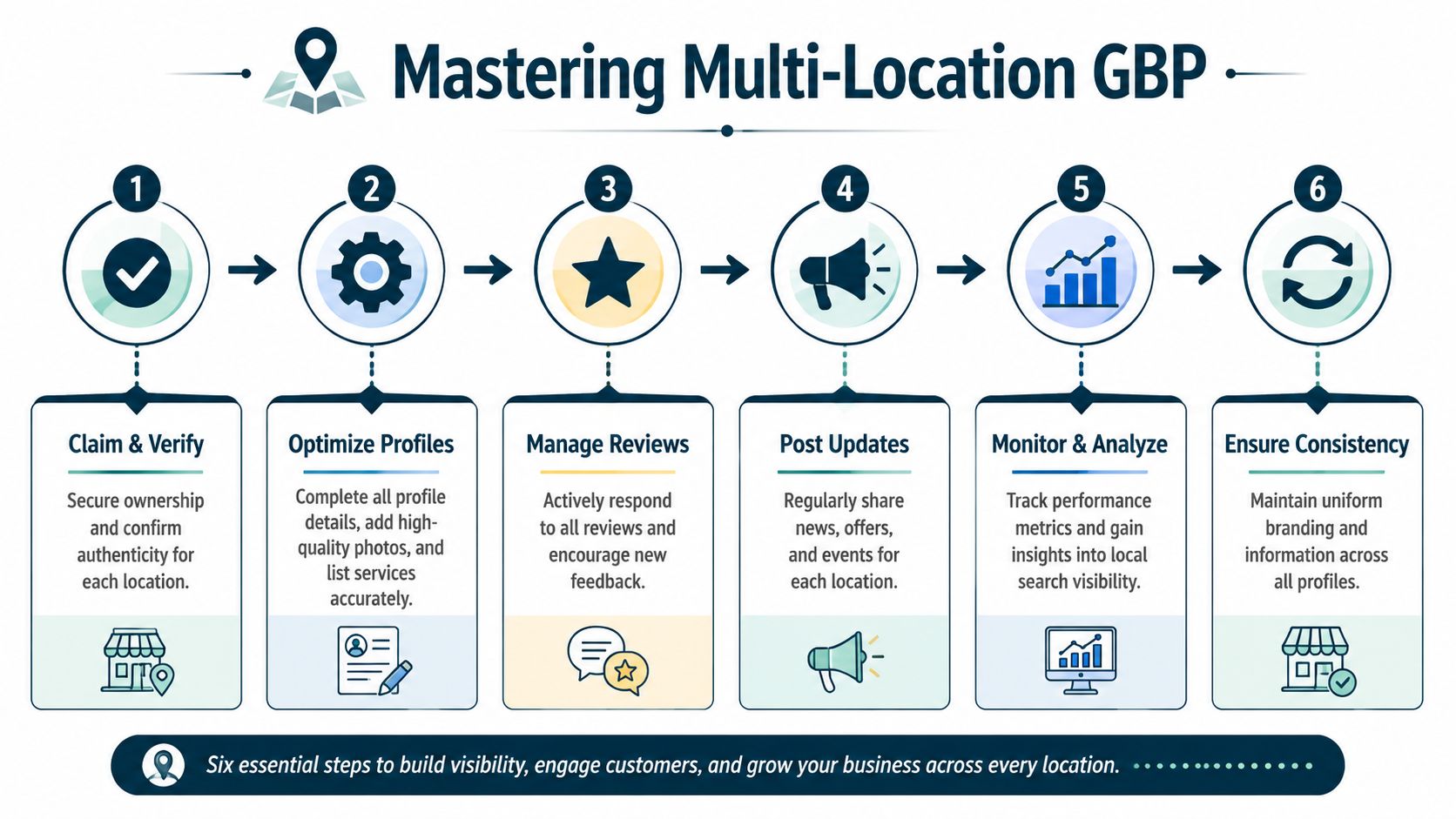
Bulk setup for larger footprints
If you're managing 10 or more locations, Google's bulk verification process matters. According to Graphicwise's multi-location GBP guide, using bulk verification is faster, helps reduce spam flags, and Google reports 80% faster approvals compared with individual verification. The same source notes that active profiles with weekly updates and quick review responses can rank 2.6x higher than dormant ones.
That matters because dormant profiles look abandoned. Customers notice. Google notices too.
What every profile needs before you get fancy
Get the fundamentals right first:
- Correct primary business category
- Exact name, address, and phone
- Accurate hours
- A direct link to the matching location page
- Real photos for that specific office
- Services that match what that office offers
No keyword stuffing in the business name. No sending every listing to the homepage. No using one profile for multiple locations because it feels simpler. It is simpler, right up until it becomes a problem.
If you want a practical walkthrough of what belongs in each profile, this breakdown of what should absolutely be optimized on your Google Business Profile covers the essentials.
The weekly rhythm that keeps profiles alive
A useful GBP workflow is repetitive by design. Fancy systems usually collapse. Simple routines survive.
Try this cadence:
Early in the week
Check hours, categories, and any user-suggested edits. Google sometimes accepts edits from the public, which is a sentence that should make every owner sit up straighter.Midweek
Publish a localized update. Not generic corporate fluff. Something relevant to that market, team, service area, or community activity.Before the week ends
Review new photos, answer questions, and respond to reviews. Good ones, bad ones, weird ones.
The businesses that win in Maps usually look attended to. Not perfect. Attended to.
Don't centralize everything so hard that it becomes fake
Corporate consistency is good until every profile sounds like it was written by the same very tired robot. You want shared standards, but each office still needs its own signals.
A Dallas profile should not read like a copy of Austin with the nouns swapped. Different photos. Different updates. Different review responses. Same brand standards, different local fingerprints.
That's how you manage GBP at scale without flattening every location into mush.
Building Location Pages That People Actually Use
Here's where a lot of websites sabotage themselves. They build one page, copy it twelve times, swap “Houston” for “Katy” and “Arlington,” then act surprised when those pages don't rank or convert.
Google is not fooled by city-name Mad Libs. Neither are users.
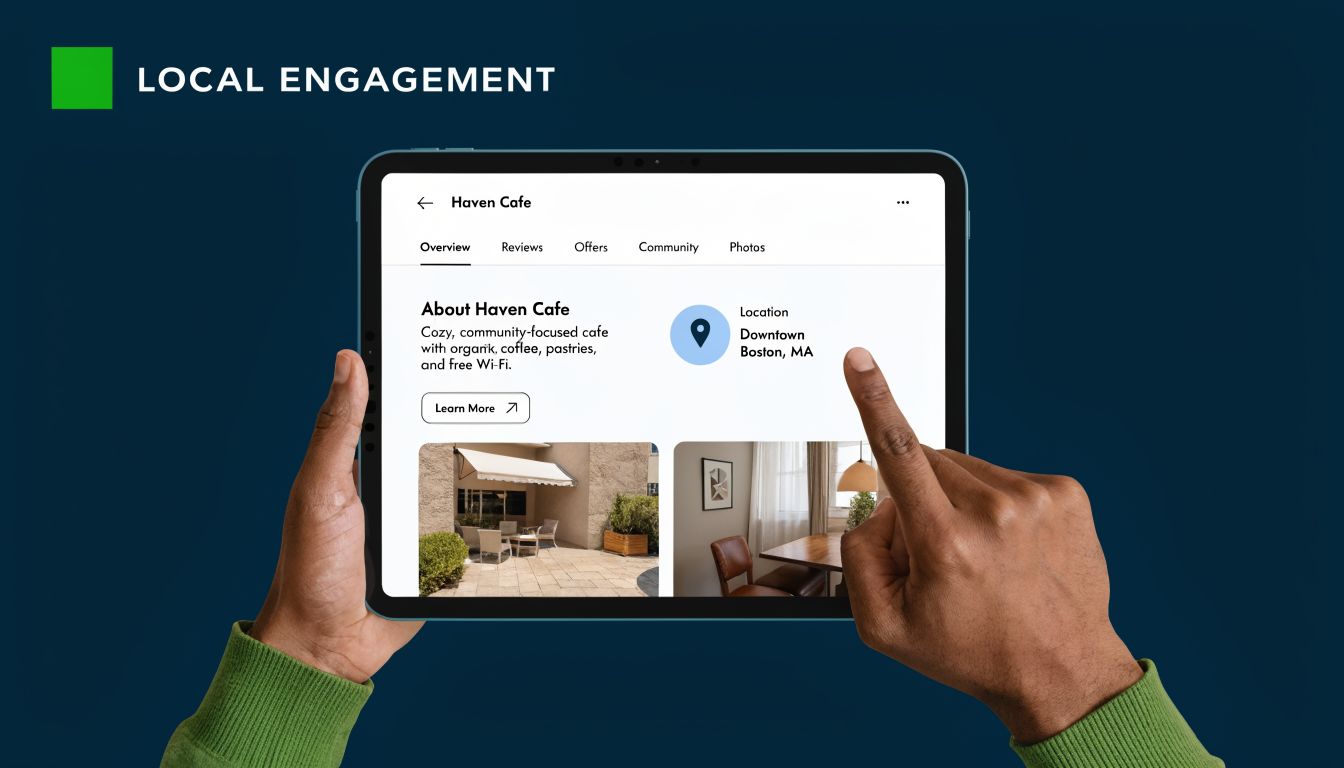
Thin pages don't help anyone
According to this benchmark-driven breakdown of multilocation SEO page issues, over 70% of multi-location SEO failures are due to duplicate or thin location pages. That same source recommends 800 to 1500 words of unique content on each page, including local keywords, case studies, and testimonials, and notes this can boost dwell time by 25%.
Those numbers line up with what many teams learn the hard way. Thin pages may get published quickly, but they rarely build trust.
What makes a location page actually useful
A strong page answers local questions and proves local presence.
That can include:
- Location-specific intro copy that explains who you serve in that market
- Staff or team details if that office has named people customers interact with
- Testimonials from that location's customers
- Photos from that office or service area
- Neighborhood references that make sense for the market
- A local FAQ built around real questions customers ask
- Directions, service area notes, and contact options
- An embedded map
If you need the map embed done cleanly, Feather's guide to Google Maps embeds is a solid reference. It's one of those small implementation details that's easy to do poorly and annoying to fix later.
Site structure matters more than people think
Location pages shouldn't live in random corners of the site like forgotten storage boxes. Organize them under a clear hub, usually a central Locations page, then link out to each office from there.
That gives users a simple path and helps search engines understand the full geographic footprint of the business. It also keeps your internal linking from turning into spaghetti.
For businesses reworking their page hierarchy, this web page strategy guide is a good gut check before you start adding more location URLs.
A quick visual explainer helps here:
A simple test for every page
Read the page and ask one question: would someone in that city feel like this page was made for them?
If the answer is “sort of,” it's probably too generic.
Citations Reviews and Local Links
After site and profile optimization, off-page authority gains significance. Many multilocation campaigns become tedious at this stage, but such repetitive efforts remain essential to overall success.
There are three pieces that matter most here. Citations. Reviews. Local links.
Citations first, because inconsistency spreads fast
Citations are mentions of your business details across the web. Directories, map platforms, industry listings, chamber pages, and niche profiles all contribute to the broader picture.
The job is simple but not short: make sure the name, address, and phone match your approved record for each office. Then clean up duplicates and obvious junk. If your Houston office uses one phone number on the site and another on a major directory, you've introduced doubt where you wanted trust.
For a practical framework, this resource on local citation building is worth keeping nearby while you work through directories.
Reviews need a system, not occasional enthusiasm
Reviews don't scale well if your strategy is “remember to ask when you think about it.” That usually means one motivated employee gets a few good reviews, leaves the company, and the whole thing dies.
Build a repeatable workflow instead:
- Ask at the right moment when the service is complete and the customer is happy
- Send the request from the correct location so the review supports the right office
- Respond quickly so the profile feels active and cared for
- Route unhappy feedback internally so nobody tries to solve a delicate issue in a public argument thread
Amy-types are gold here. Every company needs somebody who can be warm, consistent, and calm while replying to reviews that range from lovely to mildly unhinged.
Review management is customer service wearing an SEO hat.
Local links should come from actual local activity
The best local links usually come from things a real business would do anyway. Sponsor a town event in Sugar Land. Join a chamber in Fort Worth. Partner with a nonprofit in San Antonio. Get mentioned on a local association page in Frisco. Support a school group in Katy.
That kind of link building is slower than buying a pile of nonsense backlinks from a mystery vendor. It is also far less likely to make future-you regret present-you.
A few grounded ideas:
| Link source | Why it helps |
|---|---|
| Chambers of commerce | Strong local relevance and clear business association |
| Community event sponsorships | Good for visibility and often earns a listing or mention |
| Local business blogs | Brings contextual traffic and geographic relevance |
| Nonprofit partnerships | Supports community ties and can generate natural mentions |
| Industry associations by city or region | Reinforces both service and location signals |
If a tactic would feel embarrassing to explain out loud, skip it.
The Human Element Managing Teams and Proving ROI
This is the part most multilocation local SEO guides barely touch. They assume if you hand people a checklist, they'll follow it. That is an adorable theory.
In real companies, the problem usually isn't knowing what to do. It's getting busy humans in different locations to do it consistently.

The human gap is where good plans go to die
As noted in Wix's multilocation local SEO framework, a major failure point is the human gap. Programs often break down not because the technical plan is wrong, but because there's no operational framework to ensure compliance and give local teams a reason to maintain their digital presence.
That's exactly right. The franchise owner in one city may care a great deal. Another may ignore reviews for weeks. A branch manager may update holiday hours. Another may forget for months and send customers to a locked office door.
SEO at this scale is partly governance.
Give local teams a role they can actually perform
Don't hand branch staff a giant SEO document full of jargon and expect joy. Give them a short list of responsibilities they can do without needing to become marketers.
A useful local checklist might include:
- Confirm hours weekly
- Upload fresh photos monthly
- Flag any service or staff changes
- Ask happy customers for reviews
- Reply to reviews using approved guidelines
- Report bad data or duplicate listings
That's manageable. It fits into operations. It doesn't require anyone to suddenly become “the digital growth lead,” which is usually code for “the person we gave extra tasks to without reducing any others.”
Keep the local checklist short enough that a location manager will still read it on a Tuesday afternoon.
Centralize standards, localize execution
The healthiest setups usually split ownership in a clean way.
| Corporate or central team owns | Local team owns |
|---|---|
| Website structure | Review requests |
| Brand standards | Photos from the location |
| Citation cleanup | Hours updates and change alerts |
| GBP governance | Basic Q&A awareness |
| Reporting and dashboards | Flagging local issues fast |
That split keeps the brand coherent without choking off local input.
Proving value without getting lost in vanity metrics
A ranking report is fine. It is not the whole story.
If you want to know whether multilocation local SEO is doing anything useful, track business outcomes by location. At minimum, look at:
- Calls from location pages or profiles
- Contact form submissions tied to each office
- Direction requests
- Appointments or qualified inquiries by market
- Website traffic to individual location pages
- Review activity and response speed
Then compare performance against business context. Maybe Frisco is growing because the market is newer and the local page is stronger. Maybe Richmond has good rankings but weak conversion because the page is vague or the office phone workflow is messy. Maybe Austin gets traffic but not enough qualified leads, which points to messaging, offer, or market fit issues.
Local SEO stops being a marketing chore at this stage and starts acting like an operating system.
If you need a simple finance-side refresher for leadership conversations, this primer on how to evaluate your investment returns is helpful. It won't solve attribution for you, but it gives a clear language for discussing return without hand-waving.
A sane attribution model
Don't overcomplicate this at the start. Use a basic scorecard per location:
| Location | Calls | Forms | Direction requests | Reviews gained | Notes |
|---|---|---|---|---|---|
| Houston | |||||
| Austin | |||||
| Dallas | |||||
| Fredericksburg |
Even a simple sheet beats guessing. Once patterns show up, budget decisions get easier. You can support the offices showing momentum, diagnose the weak ones, and stop treating every market like it deserves the exact same effort forever.
Your Toolkit and Maintenance Plan
Multilocation local SEO works best when it becomes routine. Not exciting. Routine.
A core group of professionals does not need a giant enterprise stack on day one. They need a few dependable tools and a checklist they will use. Fancy dashboards are nice. A system people follow is better.
A practical starter toolkit
Different teams use different combinations, but these categories matter:
- Spreadsheet or database tool for the master location record
- Google Business Profile dashboard for profile management
- Google Search Console for page visibility and query clues
- Google Analytics 4 for location-page traffic and conversions
- Screaming Frog for spotting duplicate page issues and crawl problems
- A citation management process using either manual cleanup or a dedicated platform
- A review workflow that routes each request to the correct location
- A lightweight reporting dashboard so leadership can compare offices without digging through five tabs and a mild identity crisis
The trick is not collecting tools like baseball cards. It's assigning ownership. Every tool should have a human attached to it.
Monthly Multilocation SEO Maintenance Checklist
| Task | Frequency | Why It Matters |
|---|---|---|
| Review all GBP profiles for public edits, hour changes, and missing fields | Monthly | Prevents bad data from lingering |
| Check location pages for outdated staff, offers, or contact details | Monthly | Keeps pages useful and trustworthy |
| Audit major citations for top locations | Monthly | Catches drift before it spreads |
| Respond to all outstanding reviews | Weekly and monthly review | Signals activity and protects reputation |
| Publish localized GBP updates | Monthly or more often if practical | Keeps profiles from going stale |
| Review performance by location page and profile | Monthly | Shows where attention is paying off |
| Log duplicate listings or support issues | Monthly | Gives the team a cleanup queue |
| Review internal links to location pages | Monthly | Helps users and search engines find pages |
| Gather fresh local photos or proof points | Monthly | Adds real local signals over time |
| Update the master location sheet | Monthly | Keeps everyone working from the same record |
What usually gets skipped first
When teams get busy, they stop doing the boring things. They stop checking hours. They stop asking for reviews. They stop updating the spreadsheet. They assume the website still has the right suite number. Then six months later, someone discovers customers have been calling the wrong line in Arlington.
That's why maintenance matters. Not because it's glamorous, but because neglect compounds.
Keep the process boring on purpose
A good multilocation local SEO system should feel almost dull once it's running. That's a compliment. Dull means documented. Dull means repeatable. Dull means nobody has to reinvent the wheel every quarter because one office changed managers.
And if your setup currently feels less like a system and more like a scavenger hunt across Google, old logins, mystery listings, and sticky notes from three years ago, that's fixable. It just needs structure and somebody willing to keep the whole thing honest.
If your locations are real but your search presence still feels half imaginary, Bruce and Eddy can help you sort it out. We've been doing this since 2004 for businesses across Texas and beyond, and we know the difference between a strategy and a pile of digital duct tape. If your multilocation setup is being held together by hope, caffeine, and one overworked office manager, it might be time to talk.
