

A small business owner updates the website, shares the new link, and waits. A church publishes its service schedule, but newcomers still can't find it. A nonprofit builds a thoughtful donation page, yet supporters discover a better-known organization first. The problem isn't always the quality of the work. Often, the right people don't see it when they're looking.
That's why why search engine optimization is important is really a business question, not a technical one. SEO helps your organization appear where customers, members, donors, and partners are already making decisions. It connects useful pages to real searches, then turns that visibility into calls, form submissions, donations, sign-ups, and qualified visits.
The Moment a Customer Tries to Find You
A homeowner searches for a nearby service. A parent looks for a church with a weekday program. A donor seeks an organization addressing a problem they care about. In each case, the searcher has already shown intent. They are asking for an answer, not being interrupted by an advertisement.
Your organization may offer exactly what they need, yet discovery still depends on visibility. A polished website buried below competing results is like an unlisted phone number. The service exists, but nobody can dial it. Strong work produces little response when the path to it remains unclear.
Search has been part of everyday information discovery for years. Pew Research Center reported that 91% of U.S. online adults used search engines in 2012, compared with 84% in 2004. On a typical day, 59% of internet users searched for information, compared with 30% in 2004. The same study found that 54% of search-engine users searched at least once a day. These historical figures from Pew Research Center's findings on search use establish how long-standing the habit is. Search visibility remains a practical way to meet people already looking for help.
Practical rule: If someone can describe your service, mission, location, or program in a search box, your website needs a page that answers that search clearly.
For a local business, that page should make a call easy. For a church, it should explain worship times, childcare, and what a first visit involves. For a nonprofit, it should clarify the problem, show the organization's work, and make donating straightforward. SEO gives these pages a chance to reach qualified visitors before they choose another organization, supporting calls, form submissions, donations, and visits from people with a defined need.
A professional website matters far less than a findable one. The people who need you must reach the right page at the moment they search.
What SEO Actually Is and How It Works
SEO is the alignment of three things: what your organization offers, what your audience searches for, and how search engines evaluate and present pages. A page can fail if any one of those connections breaks.
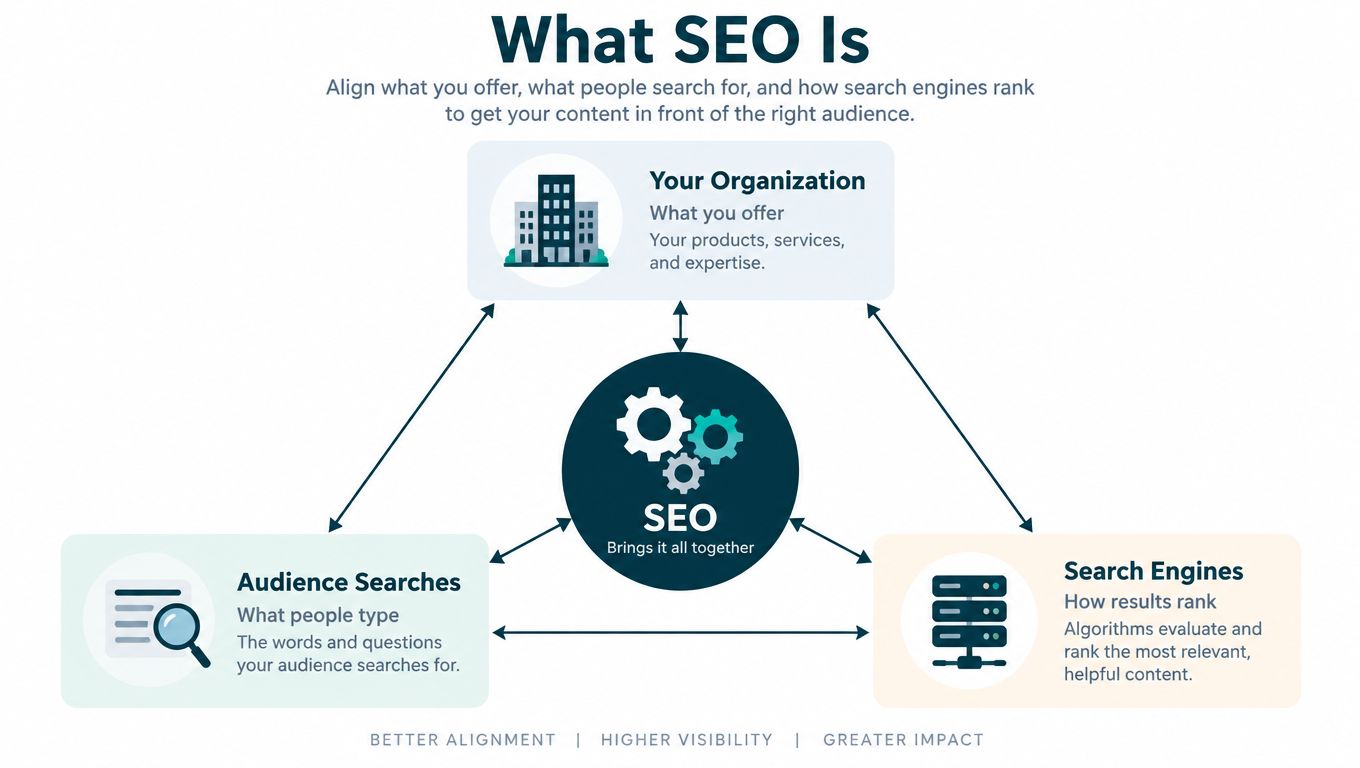
The four checks behind useful SEO
Crawlability means search engines can reach a page by following links and navigating the site. Google says it primarily finds pages through links from pages it has already crawled, and that the vast majority of new pages it discovers each day are found this way. A page buried without a clear internal path is harder for both visitors and search engines to find. Google's SEO Starter Guide also recommends people-first content that is readable, organized, original, current, and helpful.
Indexability means a search engine decides the page belongs in its searchable database. A technically accessible page still needs a clear purpose, useful content, and a structure that doesn't create confusion.
Relevance means the page answers the searcher's actual need. A generic homepage won't adequately answer every question about pricing, eligibility, service areas, programs, or donations. Specific questions deserve specific pages.
Experience covers how easily people can use the page. Mobile readability, clear headings, stable layouts, sensible navigation, and fast loading all affect whether a visitor can take the next step.
A storefront on a well-marked road illustrates the idea. Crawlability is the road connecting to the shop. Indexability is the map listing. Relevance is the sign that tells people what the shop sells. Experience is whether the entrance works and the shelves aren't blocking the aisle.
Organizations building commercial pages can also benefit from practical guidance on how to build B2B lead generation pages, especially when a page needs to move a qualified visitor toward a clear inquiry.
For a concise explanation of the discipline itself, see what search engine optimization means. The meeting-friendly definition is simple: SEO makes the right pages easy for the right people to find.
Why Rankings Matter More Than They Work in the First Place
Ranking position changes the odds that a searcher reaches your website. A large-scale study of 4 million Google search results found that the first organic result received an average 27.6% click-through rate and was approximately 10 times more likely to receive a click than the result in position 10. The study also found that moving up one position increased click-through rate by an average of 2.8%, although the value of movement varied by starting position. Backlinko's Google click-through-rate analysis explains why small ranking improvements can matter more near the top.
The numbers are not a promise. Query intent, devices, ads, maps, featured results, and competition all change the outcome. They do show why page two is a poor place to build a pipeline.
Approximate CTR by position and what it means for 100,000 monthly searches
| Position | Average CTR | Estimated visits |
|---|---|---|
| 1 | 27.6% | 27,600 |
| 2 | About 15% | About 15,000 |
| 3 | About 11% | About 11,000 |
The figures above use the approximate benchmarks reported in SEO Works' search statistics overview. The 100,000-search example is a mathematical illustration, not a forecast. A local church, service business, or nonprofit should measure its own queries rather than assume a universal click rate.
The business consequence is straightforward. A page in a top position has more opportunities to generate a call, donation, registration, or inquiry than the same page buried below stronger results. SEO isn't about collecting a ranking screenshot for the office wall. It's about competing for visibility on searches connected to outcomes.
Paid advertising can create exposure while the budget runs. Organic visibility can continue attracting relevant visitors after the initial work, although it still requires monitoring, maintenance, and improvement. That durability makes SEO one of the few acquisition channels that can keep working after the publishing or optimization task is finished.
For additional practical ideas on improving visibility, SubmitMySaas ranking advice offers a useful companion perspective. The recommendation I'd give a small team is narrower: prioritize high-intent pages first, then improve their structure, internal links, titles, content, and technical performance before producing a mountain of low-purpose blog posts.
The Business Benefits You Actually Care About
Rankings are an intermediate measure. The outcome your organization needs may be a phone call, completed form, donation, event registration, purchase, or qualified visit. A useful SEO program connects search visibility to that action instead of treating traffic as the finish line.
Qualified traffic is better than empty traffic
Searchers who use a service, program, problem, or location in their query often arrive with a clearer need than people reached through broad awareness campaigns. That doesn't mean every organic visitor is valuable. It means SEO gives you a way to attract people based on expressed intent.
Track Search Console impressions, clicks, queries, and landing pages to see whether visibility is growing for relevant searches. Then connect those visits to analytics events such as calls, forms, donations, purchases, or registrations.
Conversions give visibility a job
A nonprofit may care about completed donations and recurring-supporter sign-ups. A church may care about visit-planning actions, event registrations, or calls from prospective members. A local business may care about qualified calls, direction requests, and quote forms.
The page needs to support the action. A service page should explain the service and make contact easy. A donation page should answer basic trust questions and provide a clear path to give. An event page should make date, location, eligibility, and registration details easy to find.
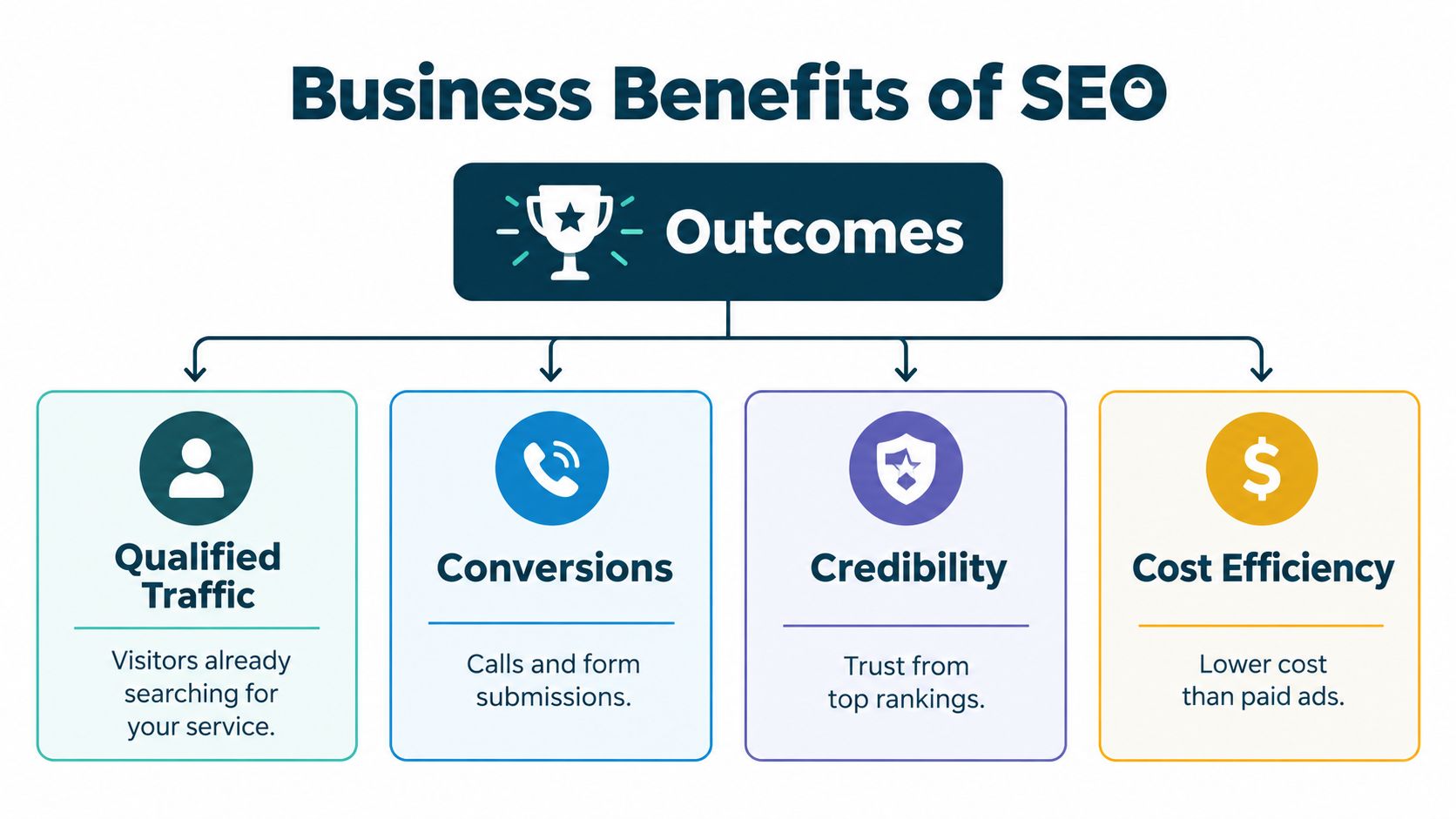
Credibility is part of conversion
Search visibility can support trust, especially when someone doesn't already know your organization. A clear result with accurate information gives the searcher a reason to investigate. It doesn't replace reviews, referrals, strong service, or a credible mission. It helps more people reach the evidence.
Branded search volume is another useful signal. If more people search directly for your organization after encountering its content, that can indicate growing recognition even when the first visit doesn't convert.
Cost efficiency needs honest measurement
SEO doesn't require paying for every organic visit, but it does require real work. Research, writing, design, development, technical fixes, analytics, and maintenance all carry a cost. The fair comparison isn't “free traffic” versus paid traffic. It's the cost of producing qualified outcomes through each channel.
Measure cost per qualified lead, cost per donation, conversion rate, assisted conversions, and revenue or supporter value where those figures are available. A durable channel deserves credit for the actions it influences, not only the sessions it delivers directly.
How SEO Pays Off in a World of AI Summaries
AI-generated summaries change the click equation. They don't erase the value of search visibility, but they make raw sessions a less complete measure of success.
Pew Research Center studied browsing activity from 900 U.S. adults and found that 58% conducted at least one Google search in March 2025 that produced an AI-generated summary. When a summary appeared, users clicked a traditional result in only 8% of visits, compared with 15% when no summary appeared. Just 1% clicked a link inside the summary, and 26% of pages with an AI summary ended without a link click, compared with 16% for traditional results. Pew's analysis of AI summaries and link clicks makes the tradeoff plain.
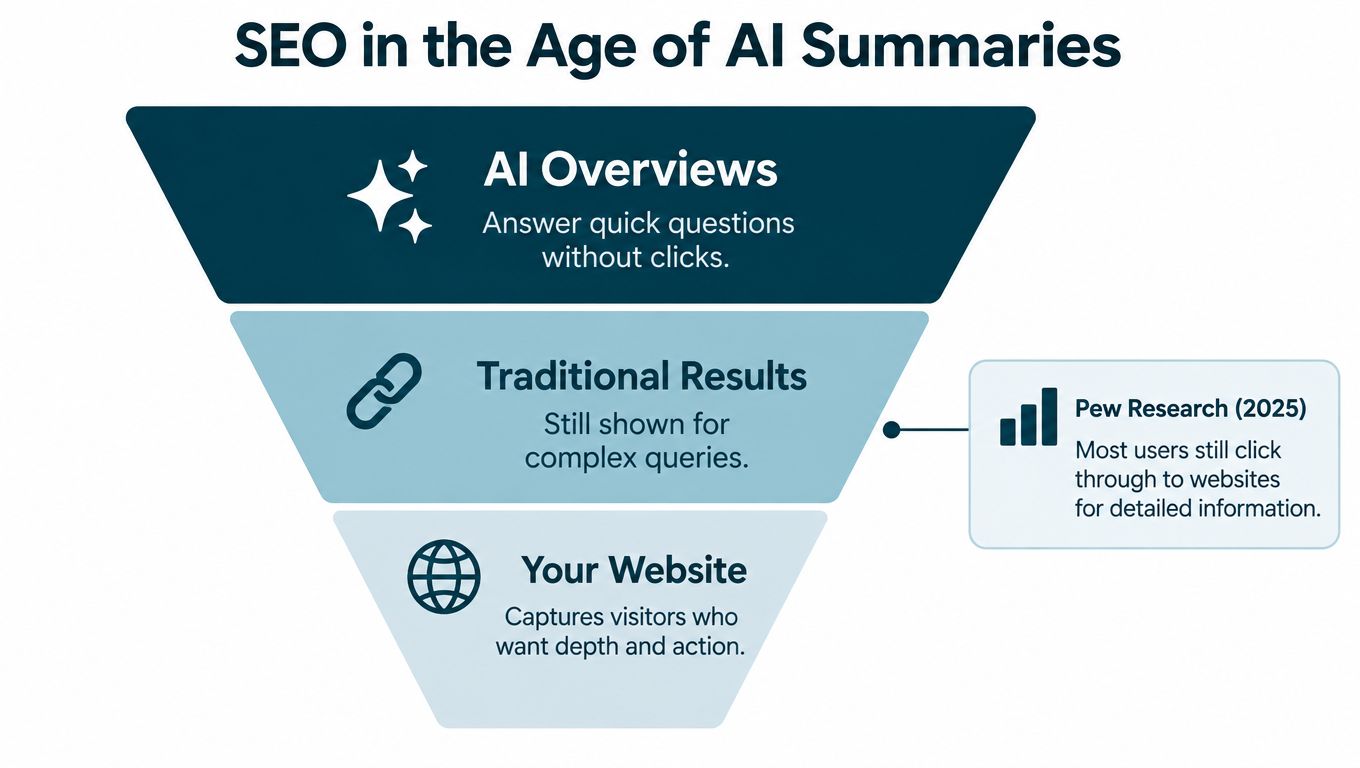
Visibility now includes being understood and cited
A business, church, or nonprofit can benefit when its name, expertise, location, program, or service appears in an answer even if the user doesn't click immediately. That exposure may lead to a later branded search, direct visit, phone call, or recommendation.
The content standard becomes stricter. Publish organization-specific information that is accurate, clear, current, and easy for search systems to summarize. Explain who you serve, what you do, where you operate, what participation involves, and how people can take action. Generic filler gives both readers and systems less to work with.
For practical guidance on appearing in AI-generated search features, Bruce & Eddy's guide to ranking in AI Overviews addresses the overlap between conventional SEO and answer visibility.
Channel quality matters as much as channel volume
An Ahrefs analysis of approximately 81,947 websites, conducted in May and June 2025, found that visitors from major AI platforms viewed about four pages on average, which was 1.2 fewer than search visitors, and were 4.1% more likely to bounce. Ahrefs' AI traffic quality analysis supports an important distinction: AI discovery can broaden reach, while conventional search may deliver stronger immediate intent.
Don't combine every visit into one organic total. Segment traffic by referral source and intent. Watch:
- Brand demand: Branded searches and direct visits after visibility.
- Assisted outcomes: Conversions influenced by earlier search or AI discovery.
- Qualified actions: Calls, forms, donations, registrations, and purchases.
- Engagement quality: Useful page depth, return behavior, and meaningful interactions.
- Business value: Revenue, qualified opportunities, supporter value, or mission outcomes.
SEO still matters. The scorecard has grown up.
Practical SEO Priorities for Small Businesses, Churches, and Nonprofits
Small teams shouldn't try to fix everything at once. Start with the parts that affect discovery and action most directly.
Establish the local foundation
Claim and verify the Google Business Profile. Keep the organization's name, address, phone number, hours, service area, and category accurate. Ask for legitimate reviews through a consistent process, and respond to them like a person rather than a robot wearing a tie.
BrightLocal's 2025 Local Consumer Review Survey, based on a representative panel of 1,026 U.S. adults, reported that 83% of consumers used Google to read reviews, compared with 6% who used ChatGPT or another AI tool to find business reviews. BrightLocal's local review survey reinforces the practical priority: maintain the Google presence people already use.
A local organization should also make its website useful after the click. This explanation of local SEO provides helpful context, but the immediate work is concrete: accurate listings, service-area pages where appropriate, clear contact details, and proof that the organization is active.
Fix technical obstacles
Google recommends Core Web Vitals thresholds of Largest Contentful Paint within 2.5 seconds, Interaction to Next Paint below 200 milliseconds, and Cumulative Layout Shift below 0.1. Google's Core Web Vitals documentation explains that these measurements cover loading performance, responsiveness, and visual stability. Strong scores don't guarantee top rankings, but poor performance creates avoidable friction.
Check mobile layouts, broken links, oversized images, unnecessary scripts, unclear navigation, and important pages that lack internal links. Monitor real-user data after CMS, plugin, template, or hosting changes. A technical audit is more useful when it ends with prioritized fixes rather than a colorful report nobody opens again.
Here's a short video for teams reviewing the practical side of local visibility:
Publish pages with a job to do
A church may need pages for worship, children's programs, pastoral care, and upcoming events. A nonprofit may need focused pages for programs, eligibility, impact, and donations. A business may need service pages that explain scope, location, process, and next steps.
Don't publish generic articles just because a keyword tool suggests them. Start with questions people ask staff repeatedly, then create the page that should answer each question. Ecommerce teams can use Shopify organic traffic tips as a platform-specific reference, but the principle applies broadly: useful page structure beats a pile of disconnected content.
Measure actions, not applause
Connect Search Console queries and landing pages to analytics goals. Record a baseline for impressions, clicks, calls, forms, donations, registrations, and purchases. Review those measures by page and intent, not just by total traffic.
If budget is tight, prioritize one important page, one technical improvement, and one measurement fix before launching a large content calendar. More pages won't rescue a site that can't explain its purpose or make the next action obvious.
Your First 30 Days and Where to Go Next
SEO is worth the investment when it connects real searches to useful pages and measurable outcomes. It isn't a shortcut to guaranteed rankings. It's a disciplined way to make your organization easier to discover and easier to choose.
Use the first month to:
- Audit technical health, mobile usability, internal links, and indexability.
- Verify the Google Business Profile and configure analytics goals.
- Publish two to four high-intent pages based on real customer, member, donor, or program questions.
- Establish a baseline for impressions, clicks, calls, form submissions, donations, and registrations.
If your team is small, don't chase publishing volume. Start with local presence, one strong service or program page, and measurement. The realistic timeline for SEO work depends on competition, site condition, content quality, and consistency, so build a process you can maintain.
Bruce & Eddy helps small businesses, churches, and nonprofits with website strategy, technical work, local visibility, SEO, analytics, hosting, security, and ongoing maintenance. This week, choose one page that should be found, check whether a real searcher can reach it, and connect its next action to a measurable goal.
Bruce & Eddy can help you audit the technical foundation, improve local and organic visibility, and connect search activity to calls, forms, donations, or other meaningful outcomes. Visit Bruce and Eddy to review the available website, SEO, and digital operations support.
