

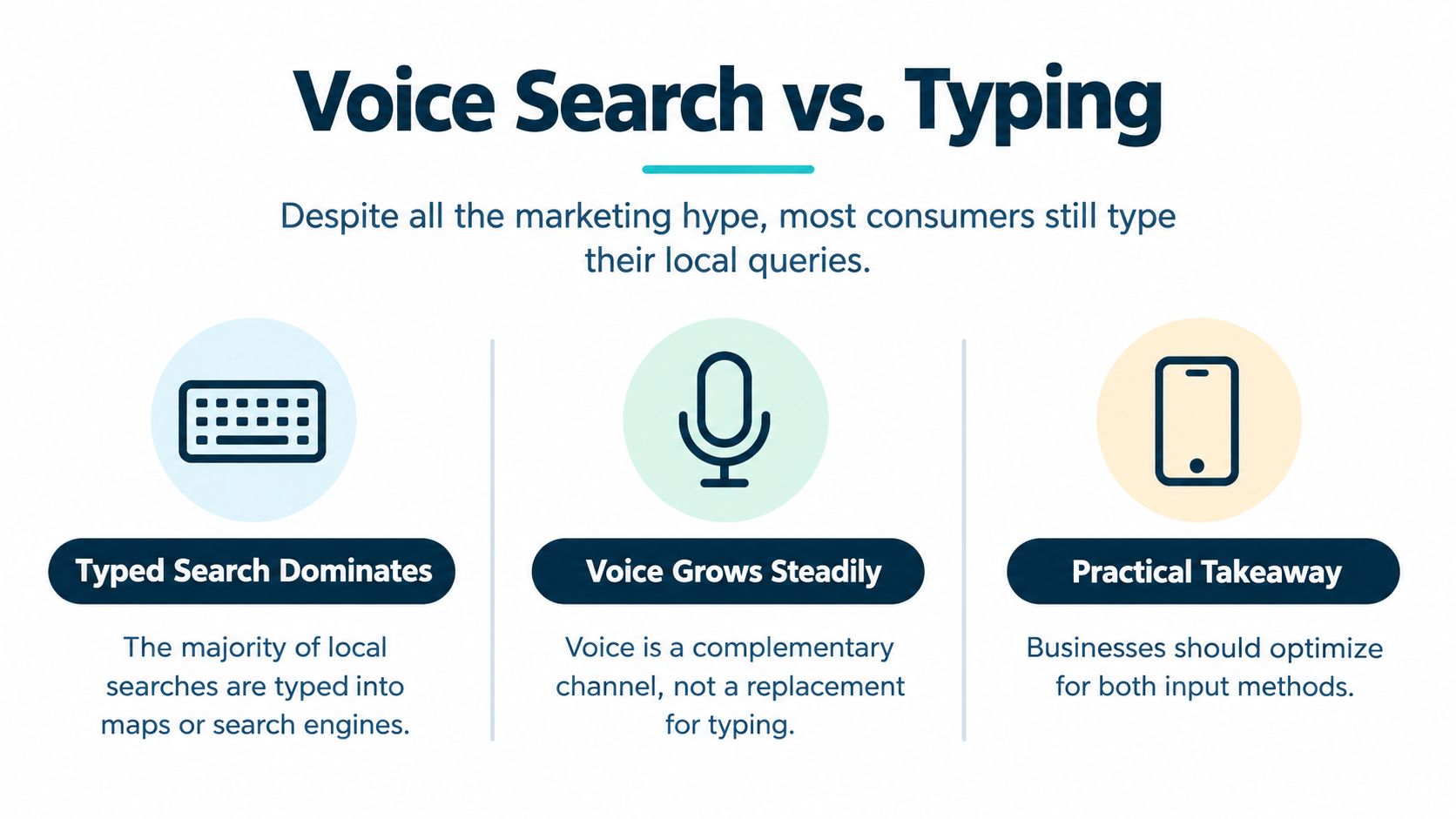
Searchers still type their local queries. 75% typically use a search engine, maps app, or conversational AI by typing, while only 10% primarily use voice on phones or smart speakers, so voice search optimization for local businesses is a supplement to local SEO, not a replacement for it. That's the part the hype skips, because “voice will take over” sounds neat in a slide deck and much less useful in a real service-area market.
The practical job is simpler and more annoying, which usually means it's the right job: make the business easy to find, easy to trust, and easy to contact whether the query starts with a keyboard or a microphone. Voice matters, but it sits on top of the same local foundation that has always mattered. If that foundation is sloppy, the spoken answer won't save you.
Why Voice Search Isn't Replacing Typing
The loudest advice in local SEO still treats voice like the new default, but consumer behavior says otherwise. People are absolutely using voice, just not instead of typing. They're mixing both, which is why a local business should optimize for a blended journey instead of chasing one channel like it's about to become royalty.
The useful lens is this: voice often acts as a discovery shortcut, not the whole search habit. Consumer research shows 62% have used a voice assistant to find a local business, but only 11% begin local discovery with voice, which is a very different story from “voice has won” (GatherUp consumer research). If you're deciding where to spend time, that means your website, map presence, reviews, and profile accuracy still do the heavy lifting.
Practical rule: optimize for the way customers actually behave, not the way marketing decks wish they behaved.
That's also why I like a blended strategy over a “voice-first” posture. Bruce & Eddy's breakdown of featured snippets and answer-style content fits here, because the overlap isn't magic. It's clarity. If a page answers the question well, the same content can support typing, voice, and AI-driven discovery without pretending those are separate universes.
How Google Selects Spoken Answers
Google doesn't pick a spoken answer because a page is stuffed with conversational phrases. It picks from entities and signals it can trust. For local search, the big three are relevance, distance, and prominence, and Google's own guidance is blunt about that structure: relevance is about fit to the query, distance is about proximity, and prominence is about how well-known the business is online.
That matters because voice search optimization for local businesses is mostly a data quality problem. If the profile is incomplete, the website is vague, and the directory footprint disagrees with itself, the system has less confidence in you. The assistant doesn't need poetic copy. It needs a clean record of what you do, where you are, and why you're legitimate.
A useful way to think about it is as a trust stack. Relevance tells Google whether you match the request, distance tells it whether you're nearby enough to matter, and prominence tells it whether people know and talk about your business. Google also notes that links, articles, directories, review count, and review ratings influence prominence, which is why local visibility is never just a profile-only game (Google local business guidance).
If you want a broader answer-engine perspective, a good outside resource is find the best AEO agency, mainly because it frames the current mess as an answer-selection problem rather than a keyword one. That's the right mental model.
Claiming and Structuring Your Business Profile
Claiming your Business Profile is the first adult step in this process. It gives you control over the core facts that assistants and search systems use, and it stops random directory fragments from defining the business for you. But claiming the profile is only the starting line, not the finish.
The better question is whether the profile is complete enough for an algorithm to trust. Google says to provide complete and detailed business information so its systems can match the profile to relevant queries, and that includes the basics as well as the operational details that customers need. If your hours, phone number, service area, or category choices are weak, the profile is leaving money on the table in very boring ways.
Here's the practical workflow that usually holds up:
- Claim the profile fully. Make sure the business controls the listing rather than hoping a platform guessed right.
- Fill in the operational facts. Services, hours, contact details, and location data need to be explicit and current.
- Keep the identity consistent. The name, location or service area, and phone number should line up with the website.
- Use structured data on the site. Google says local business markup should include required properties, platform guidelines, validation, error correction, and deployment on relevant pages, with each physical location defined as the most specific entity possible (Google structured-data guidance).
- Validate after deployment. Don't assume markup works because the code exists. Search systems are not sentimental.
For teams that want to go deeper into the profile side, Bruce & Eddy's Google Business Profile setup guidance is a sensible companion. And if you're comparing who can help with the local side more broadly, the same due-diligence mindset you'd use when scanning a local SEO agency Berlin listing still applies, even if the business is nowhere near Berlin. The point is process, not geography.
Near the middle of this work, it helps to remember that the website and profile are not interchangeable records. The profile controls the local presence, while structured data helps the site communicate meaning to crawlers.
A profile that's partially correct is still a liability. The algorithm can't “guess” its way to confidence.
Understanding Typed Versus Spoken Queries
Typed local searches are usually fragments. Spoken ones are usually complete thoughts. That sounds obvious, but a lot of local pages still read like someone shook a keyword bag over the keyboard and called it strategy.
The difference matters because assistants need clean, direct passages they can read aloud without turning the answer into a weird improv routine. A person typing might search for “HVAC repair Katy” and be perfectly satisfied. A person speaking is more likely to ask a full question, with timing, location, and urgency baked in.
Short version: typed search is compressed intent, spoken search is expanded intent.
That's why question-based content works so well when it's done naturally. Not because questions are trendy, but because they map better to how people talk. Bruce & Eddy's AI search content guidance fits the same pattern, since AI tools and voice assistants both reward content that states the answer plainly before adding detail.
Historical consumer data backs the long-running importance of this channel, too. 58% of consumers had used voice search to find local business information within the previous year in 2018, which is old by internet standards but still useful because it shows voice was already a meaningful local-discovery path well before today's AI layer (Tagsclick reference). That's the point many “voice is new” takes miss completely.
The practical tradeoff is simple. If you write only for typed fragments, you may miss the conversational flow assistants prefer. If you write only for voice, you can end up with awkward copy that feels inflated and unnatural. The better move is to answer the typed version cleanly, then structure enough context around it that the spoken version still makes sense.
Optimizing Page Speed for Voice Results
Voice users are often on mobile, and mobile users are impatient. If the page lags, shifts, or stalls, the answer won't matter much because the visit dies before it becomes a visit. That's why speed isn't a side issue in voice search optimization for local businesses, it's part of the basic eligibility test.
Google's performance guidance is useful here because it gives teams something concrete to watch instead of guessing. INP should stay below 200 milliseconds, and CLS should be at or below 0.1. A page can be attractive and well-written, but if the main content takes too long to appear, visitors leave immediately (Bruce & Eddy website audit checklist).
The cleanest speed fixes are usually the dullest ones:
- Compress images early. Large assets are an easy way to make a useful page feel sluggish.
- Keep the mobile layout stable. Nothing says “don't trust this page” like buttons jumping around.
- Cut unnecessary scripts. If a widget doesn't help a user act, it's probably just decorative baggage.
- Design responsively from the start. A mobile page that merely “shrinks” is usually not a mobile page, just a desktop page in denial.
For teams comparing implementation approaches, responsive SEO design principles are worth a look because the overlap between design and visibility is bigger than most owners expect. Speed, structure, and usability tend to travel together.
Focusing on Post-Answer Conversion
Getting selected as the spoken answer is nice. Getting a call, booking, donation, or visit is better. That's where most voice strategies get embarrassingly vague, because they celebrate visibility and skip the part where the business makes money.
The data makes the conversion problem hard to ignore. 28% of voice-search users call the business they found, while 33% of conversational-AI users always click cited links before deciding, so the post-answer path matters a lot (Shno voice-search marketing statistics). That means the landing page can't be an afterthought. It has to confirm the answer, remove uncertainty, and make the next action obvious.
For local businesses, the best conversion pages usually do a few things well:
- Show the phone number clearly. If someone wants to call, don't make them hunt for it like it's a scavenger hunt with bad prizes.
- Match the spoken promise. If the assistant suggested certain hours, services, or locations, the page should confirm them immediately.
- Make appointment paths obvious. Booking should not require three detours and a hopeful mood.
- Keep review signals and business facts consistent. Trust drops fast when the page and profile disagree.
Practical rule: don't measure victory by “we were mentioned.” Measure it by completed calls, bookings, and visits.
If you want to track whether the phone side is working, Bruce & Eddy's phone call tracking resource is a sensible next read. It's much easier to improve what you can see. That's true for local SEO, and it's especially true for voice, where the user journey can look invisible until the phone rings.
Bruce & Eddy helps businesses untangle local visibility, site structure, and the technical details that make voice answers possible in the first place. If your profiles, pages, and conversion paths aren't pulling in the same direction, visit Bruce and Eddy and start with a practical audit of what is happening on your site.
