

The popular advice about SEO services is usually backward. Businesses get offered keyword research, monthly blog posts, backlinks, and an impressive dashboard before anyone checks whether Google can reach the important pages or understand which URL should represent the business.
SEO is better understood as website operations for search visibility. Google discovers pages through crawling, analyzes and stores eligible content through indexing, then ranks indexed pages for specific searches. The right service mix makes a business easier to discover, interpret, compare, and contact. The wrong mix just repackages basic maintenance under a newer label.
What SEO Services Actually Cover
A useful answer to “what are the SEO services?” starts with the three processes every service should support:
- Crawling helps Google discover pages through links, sitemaps, and other crawlable paths.
- Indexing helps Google analyze, select, and store the pages that are eligible to appear.
- Ranking helps Google decide which indexed page best matches a searcher's query and how results should be ordered.
Google describes SEO as work that helps search engines understand website content and helps users decide whether to visit it. That definition is more practical than a keyword list because it includes both machine accessibility and human usefulness. Google's SEO Starter Guide also makes clear that most pages are discovered automatically, but blocked resources, inaccessible pages, and confusing structures can still interfere with understanding.
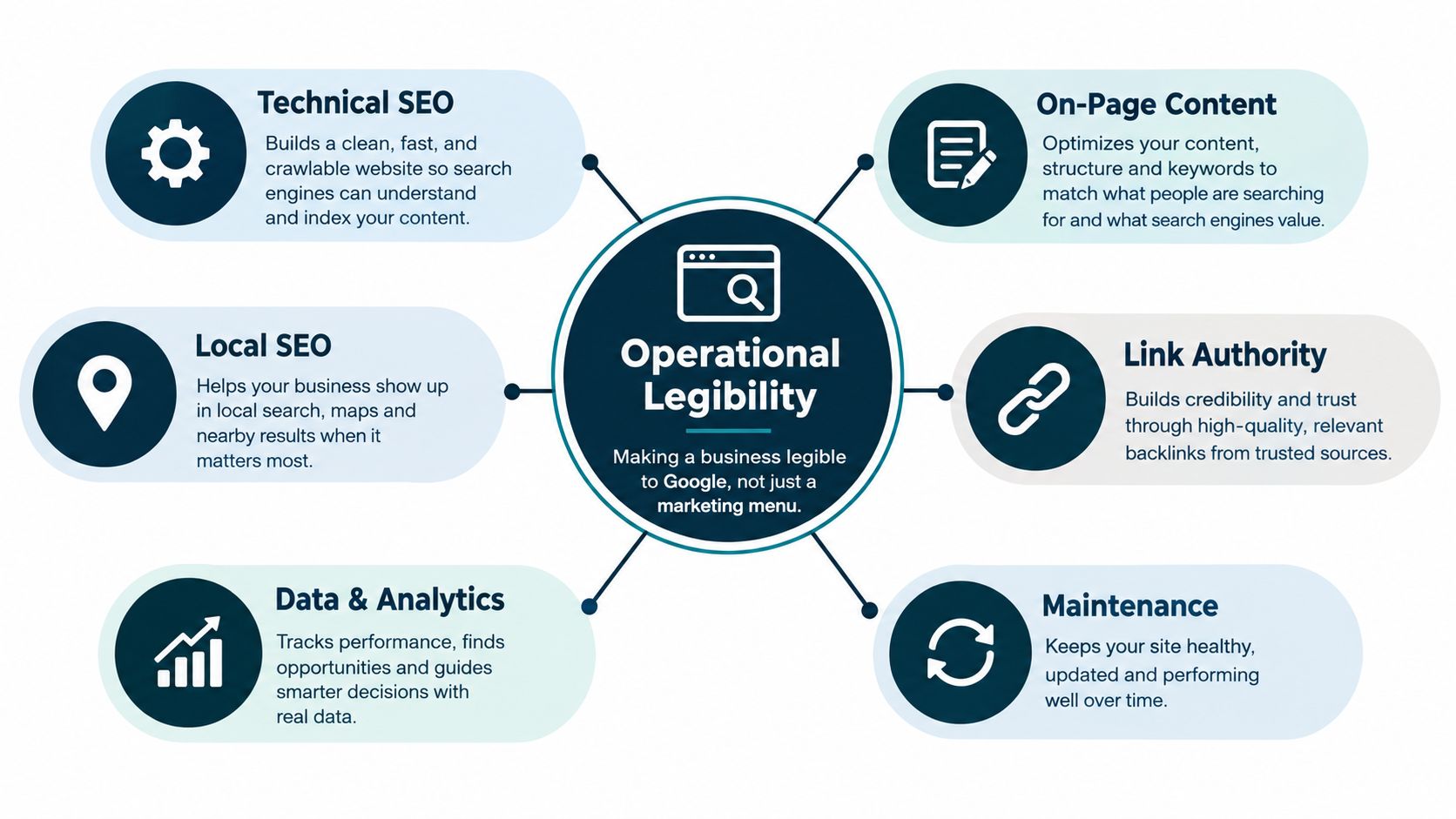
The six operating functions
The service categories below are useful only when they connect to a real search problem:
- Technical SEO makes important pages reachable, renderable, indexable, and correctly represented.
- On-page SEO and content clarify what each page covers and whether it satisfies the searcher's intent.
- Local SEO improves the accuracy and prominence of a business in location-based searches.
- Link building and off-page work develops legitimate authority and reputation outside the website.
- AI-search readiness applies durable SEO fundamentals to systems that summarize or cite web content.
- Reporting and maintenance keeps the site healthy after the initial fixes and content work.
The trade-off is straightforward. Technical access comes before promotion, and useful pages come before authority-building. A beautifully written article that cannot be indexed is an expensive brochure. A pile of links pointing to vague or broken pages is just a more complicated way to waste money.
The same agency pitch deck may call ordinary title optimization “search experience engineering” one month and “AI visibility architecture” the next. Some new labels describe legitimate work. Others charge twice for the same sitemap, schema, content, and monitoring tasks. For a deeper explanation of the advisory side, see what SEO consulting services involve. The important question isn't whether a service has a fashionable name. It's whether the work improves crawling, indexing, ranking, or the business outcome that follows.
Technical SEO and the Crawl Index Rank Pipeline
Technical SEO follows a sequence. Googlebot must first find a URL, Google must then decide whether and how to index it, and only after that can the page compete for a query.
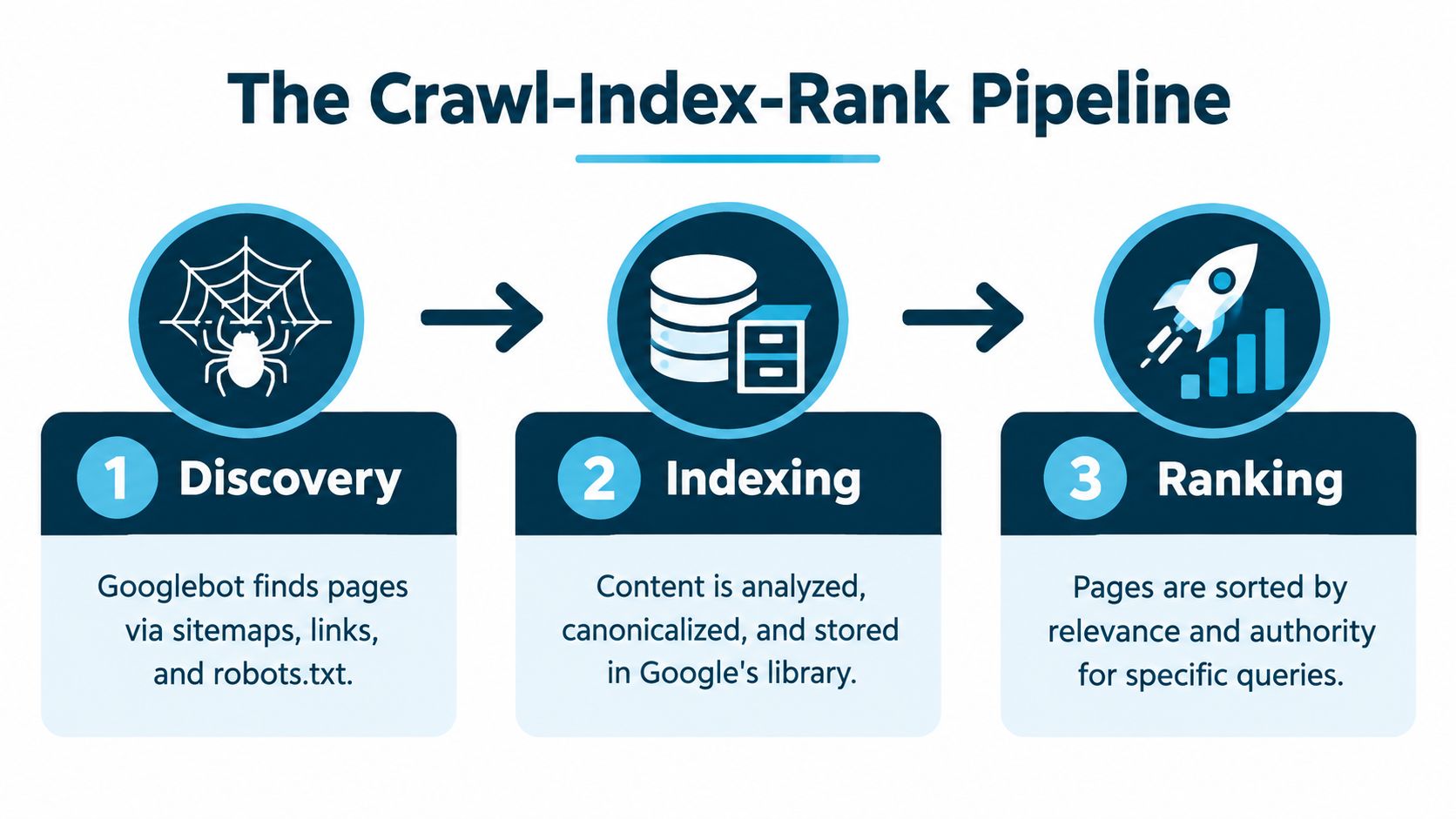
Discovery starts with access
Googlebot can discover URLs through crawlable internal links, XML sitemaps, and redirects. A technical review should confirm that important pages use standard HTML anchor elements, appear accurately in the sitemap, and aren't unintentionally blocked by robots.txt. A sitemap can help discovery, but it doesn't force indexing. That distinction saves teams from treating a submitted URL as a guaranteed invitation to the search results.
The first technical checks should include:
- Important-page reachability: Can a crawler reach service, product, location, and support pages through the site's navigation or internal links?
- Crawl controls: Do
robots.txt,noindexdirectives, and access restrictions block pages that should be eligible? - Status handling: Do old URLs resolve through appropriate redirects instead of long redirect chains or unnecessary error pages?
- Rendering: Does the useful content appear when JavaScript-dependent templates are rendered?
Indexing is selection, not storage by force
Google analyzes page content, canonical signals, metadata, and other technical clues before deciding what belongs in its index. Canonical tags help identify a preferred version where similar URLs exist, while noindex can deliberately exclude a page. A 404 response can be correct for a page that no longer exists, but it becomes a problem when a valuable page disappeared during a redesign.
Structured data provides explicit semantic clues and can make pages eligible for rich results, although it doesn't guarantee higher rankings. Google's documentation on structured data supports a practical approach: validate the markup, make sure it matches visible content, and judge its value by eligible search appearances rather than by installing schema everywhere.
A technical report should measure indexed-important-URL rate, crawl errors, sitemap coverage, redirect-chain count, and rich-result impressions. “Your site scored 82” is a conversation starter, not an operating plan.
The crawl-rank pipeline is also covered in this short visual explanation:
For a more detailed technical checklist, see what technical SEO includes.
On-Page SEO, Content, and Core Web Vitals
On-page SEO gives every important URL a clear job. That includes a descriptive title, a useful meta description, logical headings, relevant copy, descriptive image text, internal links, and a page structure that matches the reason someone searched.
Content production and content optimization aren't the same service. Production creates a new page. Optimization improves an existing page's intent match, clarity, internal connections, calls to action, and technical presentation. Thin rewrites and AI-spun filler rarely solve a missing point of view, weak evidence, or poor topical coverage. A people-first page should answer the question directly, explain the subject with relevant expertise, and give the reader a useful next step.
Performance belongs in the same conversation, but it needs careful interpretation. Google identifies Largest Contentful Paint at or below 2.5 seconds, Interaction to Next Paint below 200 milliseconds, and Cumulative Layout Shift below 0.1 as the thresholds associated with a good page experience. Google's Core Web Vitals documentation also explains that these signals are only part of the ranking system.
| Metric | Good Threshold | Measurement Source | Practical Ranking Impact |
|---|---|---|---|
| Largest Contentful Paint | At or below 2.5 seconds | Field data in Search Console and PageSpeed Insights | Indicates whether the main content loads promptly. Fix large images, slow servers, and render-blocking resources first. |
| Interaction to Next Paint | Below 200 milliseconds | Field data in Search Console and PageSpeed Insights | Indicates responsiveness after interaction. Reduce excessive JavaScript and long tasks. |
| Cumulative Layout Shift | Below 0.1 | Field data in Search Console and PageSpeed Insights | Indicates visual stability. Reserve space for images, embeds, and dynamic elements. |
Field data is more useful than a single laboratory test because it reflects real visits. Still, passing Core Web Vitals won't rescue a page that answers the wrong question, lacks trust, or has no clear relationship to the business.
A practical measurement model pairs performance data with page-level impressions, clicks, conversions, and engagement. A page that becomes faster but attracts irrelevant queries needs a content correction. A page that earns impressions but few clicks may need a clearer title and snippet. Teams looking to plan useful video formats can also consult this video SEO content guide, then connect each video to a page that answers the same search intent.
For a plain-language explanation of the performance metrics, see what Core Web Vitals measure.
Local SEO and the Relevance Distance Prominence Framework
Local SEO isn't just adding a city name to a service page. Google identifies relevance, distance, and prominence as the primary factors in local results. Those factors give local work a useful operating model because each one points to a different action.
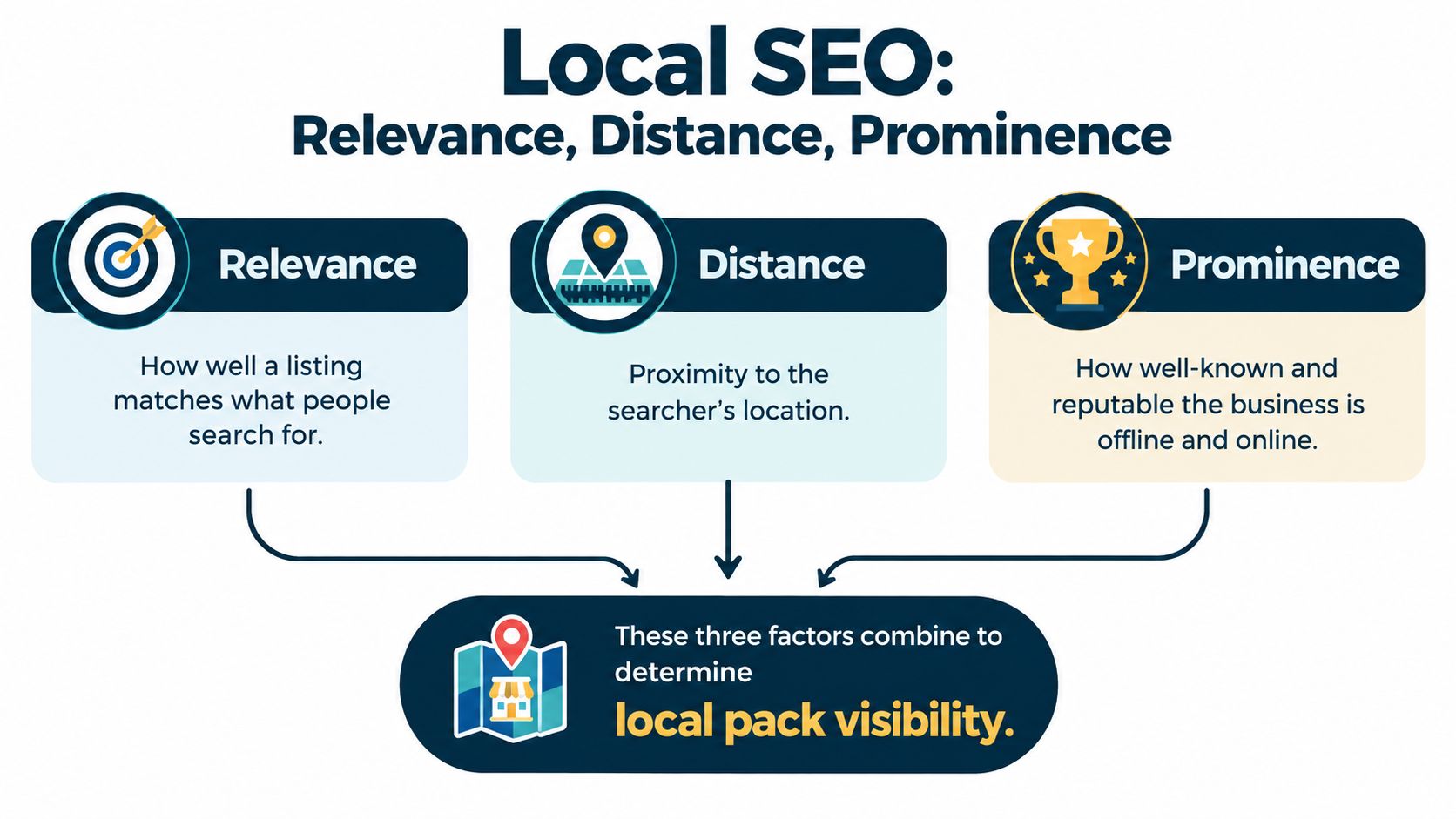
Relevance measures how well a Business Profile matches the searcher's query. Accurate categories, services, attributes, descriptions, photos, posts, and answers can make the listing easier to interpret. The service action is profile optimization, but the profile must remain truthful. Adding an irrelevant category because it seems popular creates confusion rather than relevance.
Distance reflects how far the business is from the searcher, using the searcher's known location when available. An operator can't change that physical relationship. They can confirm the address, map pin, service area, hours, and business details across important directories so the location isn't represented inconsistently.
Prominence reflects how well-known the business is. Google says prominence can be influenced by information such as links from other websites and customer reviews. That makes review processes, legitimate local mentions, community relationships, and accurate citations more useful than a page stuffed with neighborhood names. Google's local ranking guidance explains the framework directly.
A practical local maintenance checklist includes:
- Primary category: Confirm that it describes the core business accurately.
- Secondary categories: Align them with actual services, not hoped-for searches.
- Photos: Add current, descriptive images that represent the business accurately.
- Google Posts: Publish useful updates on a regular schedule, when the business has something worth sharing.
- Review responses: Prepare courteous templates, then personalize each response.
- Citation review: Audit the top important directory and industry listings monthly for accuracy.
Local SEO and link building overlap because both can strengthen prominence. Neither can overcome an incorrect address, an unusable landing page, or a profile that promises services the business doesn't provide.
Link Building and Off-Page Signals Worth Your Budget
Links matter because they can help Google understand a page's relationships, reputation, and prominence. They aren't magic votes, and a link from an irrelevant or manipulative site can be worth less than a genuine mention from a publication or organization that serves the same audience.
The services worth considering are the ones that create a credible reason for another site to reference the business:
- Digital PR outreach: Offer useful expertise, original information, or commentary to relevant journalists and industry publishers.
- Resource placements: Earn inclusion on a practical resource page where the business belongs.
- Guest contributions: Publish a substantive contribution with a real byline and a contextual link, not a thin article built only to place anchor text.
- Mention reclamation: Ask site owners to link an existing brand, product, or organization mention when the reference is relevant.
- Backlink audits: Investigate suspicious patterns before considering disavow work. Disavow isn't a routine cleaning product for every unfamiliar domain.
A set number of links per month is a poor scope by itself. The provider should explain why a target site is relevant, what the proposed page contributes, and how the link supports a business goal. Bulk directory submissions, private network placements, mass-produced guest posts, and bargain marketplace packages generally optimize the vendor's production process, not the client's reputation.
| Service | Typical Cost | Likely ROI |
|---|---|---|
| Digital PR and expert outreach | Varies by research, campaign, and outreach effort | Potentially useful when the story or expertise earns genuine editorial attention |
| Relevant resource placement | Varies by relationship and editorial fit | Useful when the page attracts the same audience and the placement is earned |
| Byline-based guest contribution | Varies by subject expertise and publisher quality | Can support recognition and referral traffic when the contribution is substantial |
| Unlinked mention reclamation | Usually lower effort than new outreach | Often efficient when existing mentions are accurate and linkable |
| Bulk link packages | Often priced by volume | Usually weak because quantity doesn't establish relevance or trust |
Anchor text should read naturally. Branded, naked, and generic anchors should make up most of a profile, while exact-match anchors should remain a small minority. For a grounded explanation of the work, review what link building involves. The budget usually belongs with pages and relationships that deserve attention, not with a spreadsheet that celebrates acquisition speed.
AI Search Services That Are Mostly Repackaged SEO
“AI SEO,” GEO, AEO, and LLM optimization are often sold as separate products. The underlying work usually isn't separate. AI-generated search features still depend on pages that can be crawled, indexed, interpreted, and associated with a recognizable business or author.
That means several fashionable labels map neatly to existing services:
- AI content optimization is often on-page editing, intent analysis, and clearer answer formatting.
- AI citation building is usually digital PR, brand mention work, and legitimate link acquisition.
- Schema for AI is structured data, which has long helped search systems interpret entities and page relationships.
- LLM monitoring is frequently branded-query monitoring with additional reports for mentions or citations.
Google's guidance for AI features in Search says the same fundamentals remain important. Pages need to be accessible, content should be helpful and people-first, important information should be available as text, internal links should support discovery, and structured data must match visible content. Google also states that special files such as llms.txt aren't required for visibility in its generative search features.
Budget rule: Don't buy a second package for deliverables your existing technical, content, PR, and analytics work already includes.
Some work is worth adding. A site may need concise answer blocks, stronger author entities, clearer organization data, or useful image and video assets that give search systems more context. Those are improvements to the site's communication, not a secret channel into an AI answer. No service can guarantee that a page will appear in an AI-generated response.
For teams that want a readable overview of practical ways to improve AI search visibility, the useful test is whether the recommendations lead back to crawlability, content quality, entity clarity, and measurement. A small organization with limited funds may get more durable value from fixing inaccessible templates and incomplete first-party information than from purchasing a standalone generative-engine package.
Measure qualified visits, conversions, branded demand, and available mentions or citations. Rankings still matter, but they aren't the only evidence that search visibility is helping the business.
SEO Reporting and Ongoing Maintenance That Hold the Gains
SEO doesn't end when an audit spreadsheet is delivered. Templates change, URLs move, plugins introduce markup errors, content becomes stale, and a CMS migration can create a new set of crawl problems. Reporting and maintenance keep the operating system from drifting.
Google Search Console provides four core metrics:
- Clicks count visits from Google Search.
- Impressions count appearances in search results.
- Click-through rate is clicks divided by impressions.
- Average position represents the average topmost result for the property or page grouping being measured.
Those definitions matter. If a property appears twice on one results page, Google counts one impression. Average position reflects the topmost result rather than every listing, so a blended number can hide meaningful differences between queries and pages. Google's Search Console performance report documentation explains those reporting rules.
A report should support decisions
A useful monthly review connects a change to a page, query, and action. It should answer:
- What changed? Compare clicks, impressions, CTR, and position by query, landing page, country, or search appearance.
- Why might it have changed? Check releases, migrations, content updates, indexing changes, seasonality, and competitor movement.
- What happens next? Assign a specific technical, editorial, or conversion task to the next review period.
The report should also include index coverage, newly surfaced errors in the Pages report, and landing-page performance. A single average position is not a complete visibility picture, especially when low-value queries outnumber valuable ones.
Maintenance earns its keep
A practical maintenance cycle validates structured data after template changes, reviews Core Web Vitals, checks important URLs after migrations, and consolidates or improves thin pages where appropriate. It also checks internal links, redirects, sitemap accuracy, and pages that have lost impressions without an obvious explanation.
Reporting isn't status theater. If a number doesn't change a decision about a page, query, or next action, it probably doesn't belong at the top of the report.
Bruce & Eddy's web operations work can connect SEO recommendations with website maintenance, security, hosting, and analytics when a business needs the same team to handle both the diagnosis and the implementation. That connection matters because an SEO recommendation that sits in a backlog for months hasn't improved crawlability, indexing, or customer experience.
Matching SEO Services to Your Real Business Goals
The right SEO service mix depends on what the business needs to earn. A preset package reverses that logic by deciding the tasks first and finding a justification afterward.
| Business goal | Start with | Postpone until the foundation exists |
|---|---|---|
| Local service inquiries | Business Profile accuracy, local relevance, review processes, and basic technical health | Broad link campaigns and large content calendars |
| Informational SaaS demand | Technical health, intent-led content, internal linking, and a focused topic map | General directory work |
| Large ecommerce catalog visibility | Crawl and index controls, faceted navigation review, category architecture, and product structured data | Blog production disconnected from product and category priorities |
| Buyer-intent rankings | Page-level intent mapping, useful service or product pages, internal links, and conversion paths | Traffic campaigns aimed only at broad informational terms |
| A new website or redesign | Technical audit, URL planning, redirects, sitemap validation, and core pages | Authority-building before the new structure is stable |
A local business doesn't need to win every informational query. It needs accurate local signals and landing pages that help a nearby customer take the next step. A SaaS company may benefit more from comparison, use-case, integration, and problem-focused pages than from a generic stream of blog posts. An ecommerce team can waste substantial crawl capacity on filter combinations while publishing more articles that don't solve the catalog problem.
Use this sequence to choose the next service:
- Define the outcome: local visibility, qualified leads, product discovery, or stronger branded demand.
- Identify the blocking signal: crawl access, index selection, relevance, prominence, performance, or conversion clarity.
- Fix the smallest meaningful layer: don't purchase link building when important pages aren't indexed.
- Set page-level measures: connect changes to queries, landing pages, clicks, impressions, conversions, or qualified actions.
- Review before expanding: add content or authority work only after the first service has produced evidence about the next constraint.
A scoped conversation should cover the business model, important pages, current baseline, technical risks, and available capacity. That produces a more credible plan than a package that promises every SEO service at once.
Bruce & Eddy helps businesses connect SEO strategy with the website development, technical implementation, analytics, hosting, and maintenance work that makes search visibility durable. Visit Bruce and Eddy to discuss which service belongs first, which can wait, and how to turn the diagnosis into a practical operating plan.
